



![TRADEMARK [#4] by Edward Ruscha](https://cdn.shopify.com/s/files/1/0833/9292/1935/files/artwork-edward-ruscha-trademark-4.jpg?width=480)
![TRADEMARK [#5] by Edward Ruscha](https://cdn.shopify.com/s/files/1/0833/9292/1935/files/artwork-edward-ruscha-trademark-5.jpg?width=480)
![TRADEMARK [#6] by Edward Ruscha](https://cdn.shopify.com/s/files/1/0833/9292/1935/files/artwork-edward-ruscha-trademark-6.jpg?width=480)
![TRADEMARK [#7] by Edward Ruscha](https://cdn.shopify.com/s/files/1/0833/9292/1935/files/artwork-edward-ruscha-trademark-7.jpg?width=480)


Edward Ruscha
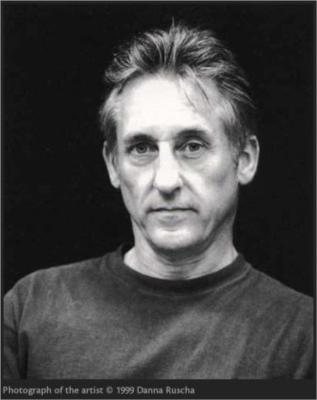
Ed Ruscha arrived in Los Angeles in 1956 from Oklahoma City with a friend and a plan to attend art school, and the city never really let him go. At Chouinard Art Institute he encountered a faculty that took commercial art seriously alongside fine art, a position that suited his interests precisely. After graduating in 1960 he worked briefly in advertising, spent time in Europe, and returned to Los Angeles to begin exhibiting at the Ferus Gallery from 1963, the same downtown dealer that showed Warhol's first Campbell's soup cans on the West Coast.
Biography
His early breakthrough was a series of artist's books that documented Los Angeles not as a cultural fantasy but as an infrastructure of asphalt and signage. Twentysix Gasoline Stations (1963) catalogued filling stations along Route 66 with the deadpan neutrality of a surveyor. Various Small Fires, Every Building on the Sunset Strip, and thirty-four Parking Lots followed, each book produced cheaply and sold cheaply, insisting on photography and seriality as legitimate artistic means. The books made his reputation in New York before the paintings did.
The paintings, once they arrived in force, became the work he is most recognised for: words and phrases rendered against atmospheric colour fields, drawn from the language of billboards, westerns, and California mythology. "Hollywood" appears repeatedly; "HONK" floats above liquid pools; "OOF" was sold and re-sold at rising prices until it became something of an art-market joke. Ruscha has worked in this vein for six decades, returning to language and Los Angeles without obvious fatigue. His seven-volume catalogue raisonné, published by Gagosian between 2003 and 2016, documents the full arc.
Timeline
- 1937Born in Oklahoma City.
- 1956Moved to Los Angeles from Oklahoma City to attend art school.
- 1960Graduated from Chouinard Art Institute and briefly worked in advertising.
- 1963Began exhibiting at the Ferus Gallery in Los Angeles.
- 1963Published "Twentysix Gasoline Stations", an artist's book documenting filling stations along Route 66.
- 2003Gagosian began publishing his seven-volume catalogue raisonné; the project concluded in 2016.
Notable Works
Tap to view larger.
Where to See Edward Ruscha
1 museum worldwide.
-
364 works
National Gallery of Art
Washington D.C., United States
Mon–Sat 10:00–17:00, Sun 11:00–18:00 · Free

Next stop
Browse the movements →
Every movement in the collection, from the Renaissance to Pop art.
Related Artists
_%E2%80%93_LOC.jpg)


Take Edward Ruscha home.
See all Edward Ruscha prints →Frequently Asked Questions
What is Edward Ruscha known for?
Ed Ruscha is most recognised for his paintings of words and phrases rendered against atmospheric colour fields. These works draw from the language of billboards, westerns, and California mythology.What is Edward Ruscha's most famous work?
Edward Ruscha is known for his Pop art paintings and prints that often incorporate advertising imagery. Born in Omaha, Nebraska, in 1937[1], he moved to Los Angeles in 1956 and studied at the Chouinard Art Institute. His most recognisable work is arguably the series of paintings inspired by his photographic book, Twentysix Gasoline Stations (1963). One image, a Standard station in Amarillo, Texas, captured his attention. Ruscha felt it had a mysterious quality and a connection to the future. One painting from this series, Standard Station, Ten-Cent Western Being Torn in Half (1964), depicts a gasoline station against a blue sky. The painting also includes a partially torn comic book. The bold lettering and dynamic composition evoke the optimism of the modern motoring era. Ruscha rejected Abstract Expressionism, favouring a more premeditated style aligned with the burgeoning American[1] Pop art movement.What should I know about Edward Ruscha's prints?
Edward Ruscha is an American[1] artist associated with the Pop art movement. He is known for paintings, prints, drawings, and artist's books that often incorporate words and phrases. Ruscha began experimenting with printmaking in the early 1960s. He often uses screen printing, a process well-suited to the clean lines and flat colours of his work. His prints frequently feature single words or short phrases, presented in bold typefaces against monochromatic backgrounds. These words are often taken from advertising, popular culture, or everyday life. Some of Ruscha's notable print series include "Stains" (1969), a portfolio of screen prints depicting various substances, and "News, Mews, Pews, Brews, Stews & Dues" (1970), which features words related to community and institutions. His prints often explore themes of language, consumerism, and the urban environment. Ruscha's work is characterised by its deadpan humour and detached observation. His prints have been exhibited extensively and are held in major museum collections worldwide. He continues to produce prints, exploring new techniques and themes.What style or movement did Edward Ruscha belong to?
Edward Ruscha is most often associated with the Pop Art[1] movement, though his work also has connections to Conceptual Art and the New Objectivity. Pop Art emerged in the 1950s, drawing inspiration from popular culture, advertising, and everyday objects. Ruscha's paintings, prints, and artist's books frequently incorporate words and phrases, often presented in a deadpan style. His use of commercial imagery and typography aligns him with Pop Art's interest in mass media. However, Ruscha's work differs from traditional Pop Art in its focus. He often presents words and phrases in isolation, removing them from their original context. This approach connects him to Conceptual Art, which emphasises ideas over aesthetics. Furthermore, Ruscha's precise, almost clinical style of painting relates to the New Objectivity movement. This movement, which originated in Germany in the 1920s, aimed to depict reality in a clear and objective manner. Ruscha's work shares this emphasis on clarity and precision, even as it engages with the themes of Pop Art. Therefore, while Pop Art is the primary association, his practice engages with several different tendencies.What techniques or materials did Edward Ruscha use?
Edward Ruscha is associated with several techniques and materials, particularly in his prints. He is known for his screenprints, often incorporating words and phrases. His early work frequently used simple, bold typography. These pieces explored the interplay between text and image. Ruscha's interest in commercial art is evident in his choices. He often employed flat, graphic colours and clean lines, echoing advertising aesthetics. Lithography was another method Ruscha used. This process allowed for greater detail and tonal variation compared to screenprinting. Some of his lithographs feature more subtle colour gradations. Ruscha also experimented with unusual materials in his printmaking. For example, he used foodstuffs like chocolate and gunpowder as printing mediums. These unconventional choices reflect his interest in pushing the boundaries of traditional printmaking. He also used unusual supports, such as moiré paper. These choices often added another layer of meaning to the work.What was Edward Ruscha known for?
Edward Ruscha (born 1937[1]) is known for his paintings, prints, drawings, photographs, and artist's books. He is associated with the Pop art movement, although his work often differs in subject and style from that of his contemporaries. His early work included single words or short phrases, often isolated against monochrome backgrounds. These pieces explored the visual qualities of language and the urban environment. Ruscha's word paintings, such as "OOF" (1962) and "HONK" (1962), are among his most recognisable works. Ruscha also produced a series of influential artist's books, starting with "Twentysix Gasoline Stations" in 1963. These books typically feature deadpan photographs of everyday subjects, such as swimming pools, parking lots, and buildings on Sunset Strip. The books are notable for their simple design, mass-produced feel, and conceptual approach to photography. Throughout his career, Ruscha has experimented with various media and techniques, including gunpowder drawings and vegetable-juice stains. He continues to produce work that examines American[1] culture, language, and the visual landscape.When did Edward Ruscha live and work?
Edward Ruscha was born in Omaha, Nebraska, on 16 December 1937[1]. He spent his early life in Oklahoma City, before moving to Los Angeles, California, in 1956 to study at the Chouinard Art Institute (now part of the California Institute of the Arts). Ruscha's early works in the late 1950s included mixed-media pieces, such as Dublin (1959), incorporating comic strip elements. By the early 1960s, he was associated with the burgeoning Pop Art[1] movement on the West Coast. Walter Hopps and Edward Kienholz opened Ferus Gallery in Los Angeles in March 1957, providing a venue for local avant-garde artists, including Ruscha. Ruscha continues to live and work in Los Angeles.Where can I see Edward Ruscha's work?
Edward Ruscha's artworks are held in many major public collections. These include institutions in the United States, as well as in Europe. In the US, The Museum of Modern Art in New York holds a number of his paintings, prints, and artist's books. The Los Angeles County Museum of Art (LACMA) has a substantial collection of Ruscha's work, given his long association with the city. The Smithsonian American[1] Art Museum in Washington, DC, also possesses examples of his screenprints and other graphic works. Outside the United States, Ruscha's pieces can be found in institutions such as the Tate Modern in London. The Centre Pompidou in Paris also includes examples of his work. These museums often feature selections from their permanent collections, along with temporary exhibitions that may include Ruscha's pieces. Checking museum websites for current exhibitions is advisable before planning a visit.Where was Edward Ruscha from?
Edward Ruscha was not born in Los Angeles, the city most associate with his art. He was born in 1937[1] in Omaha, Nebraska. When Ruscha was four, his family relocated to Oklahoma City after his father accepted a job there. Ruscha's father had worked for twenty-five years as an insurance auditor. Ruscha's mother decorated their house with a bust of Shakespeare. Ruscha attended a convent school for a year, where a nun bullied him. In 1956, Ruscha moved to Los Angeles with his high school friend Joe Goode. From 1956 to 1960, he attended the Chouinard Art Institute. After art school, he worked for an advertising agency for a short time. Ruscha began exhibiting his work at the Ferus Gallery in Los Angeles in 1963. In 1976, he built a house in the California desert.Who did Edward Ruscha influence?
Edward Ruscha's work has influenced various fields, from architecture to photography, and has resonated with artists interested in the urban environment and the passage of time. Architects such as Reyner Banham, Robert Venturi, Denise Scott Brown, and Steven Izenour credited Ruscha with insights into car-oriented urbanism. Banham used Ruscha's photographs in his book *Los Angeles: The Architecture of Four Ecologies* (1971), and Scott Brown admired the "deadpan" quality of his images, suggesting that architects and planners should emulate their non-judgmental character. Ruscha's approach to documenting the changing urban landscape, particularly in Los Angeles, has also had an impact on contemporary artists. His series of photographs of Sunset Boulevard and other locations, which capture the same sites over extended periods, have inspired others to explore similar themes of urban decay and transformation. Gabriel Orozco is one contemporary artist whose work mimics and subverts graphic design. Ruscha's interest in temporality and social change, evident in works such as *Course of Empire*, has further broadened his influence. His work encourages viewers to compare and reflect on the changes occurring in their environment.Who influenced Edward Ruscha?
Edward Ruscha's artistic development involved several influences. During his time at art school, from 1956 to 1960, he was influenced by teachers such as Robert Irwin. He also absorbed the attitudes of the Beat Generation, exemplified by Jack Kerouac's writing. Ruscha's interest in becoming a fine artist grew gradually. He recalled being excited by reproductions of Jasper Johns's *Target* and Robert Rauschenberg's *Odalisk*, works he saw in an art magazine. At the time, Johns and Rauschenberg were often described as Neo-Dadaists, a connection that resonated with Ruscha's earlier interest in Dadaism. Before encountering these artists, Ruscha had been taught about Abstract Expressionism. He was inspired by Jackson Pollock and experimented with painting canvases on the floor. However, he felt that this approach was becoming exhausted and began to look towards popular culture and figurative ideas, seeing them as a way to push beyond abstraction. He also internalised lessons from modernist print design, becoming acquainted with Mexican modernist design through his sister's boyfriend.Who was Edward Ruscha?
Edward Ruscha (born 1937[1]) is an American[1] artist associated with the Pop art movement. He is known for his paintings, prints, drawings, and artist's books. Ruscha's early work included commercial art. He studied at the Chouinard Art Institute (now California Institute of the Arts) in Los Angeles from 1956 to 1960. His style incorporates words and phrases, often isolated against flat, colourful backgrounds. These works explore the intersection of language and visual representation. His early artist's books, such as "Twentysix Gasoline Stations" (1963), presented deadpan photographs of everyday subjects. These books are considered important examples of conceptual art[1]. Ruscha's paintings often feature single words or short phrases, rendered in distinctive typography. "OOF" (1962) is one such example. Ruscha has been the subject of numerous exhibitions worldwide. His work is held in major museum collections. He continues to live and work in Los Angeles.
Sources
Editorial draws on the following primary and tertiary references for Edward Ruscha.
- [1] wikipedia Wikipedia: Edward Ruscha Used for: biography, birth dates, death dates, identifiers, movement attribution, nationality.
- [2] book Beard, Lee, 1973- author, Butler, Adam, author; Van Cleave, Claire, author; Fortenberry, Diane, author; Stirling, Susan, author, Beard, Lee, 1973- author, Butler, Adam, author; Van Cleave, Claire, author; Fortenberry, Diane, author; Stirling, Susan, author - The Art Book_ New Edition, Mini Format Used for: biography.
- [3] book Getty, Getty - Ed Ruschas Streets of Los Angeles Used for: biography.
- [4] book Alastair Sooke, Pop Art Used for: biography, stylistic analysis.
- [5] book Sooke, Alistair, Pop Art Una storia a colori Used for: biography, stylistic analysis.
- [6] book Landauer, Susan, The not-so-still life : a century of California painting and sculpture Used for: biography, stylistic analysis.
Editorial overseen by Solis Prints. Sources verified 2026-09-27. Click a source for details, or hover over [N] in the page above to preview.
Editorial standardsMethodologyCorrectionsAI disclosureAbout the editorial team