



Edward Henry Potthast
- American Impressionism
Edward Henry Potthast spent the first four decades of his career as a professional lithographer before abandoning the trade entirely at age 39 to pursue painting full-time. The Cincinnati-born artist had trained rigorously at Munich's Royal Academy and in Paris under Fernand Cormon, where he absorbed the tonal discipline of the Munich school before Impressionism loosened his palette.
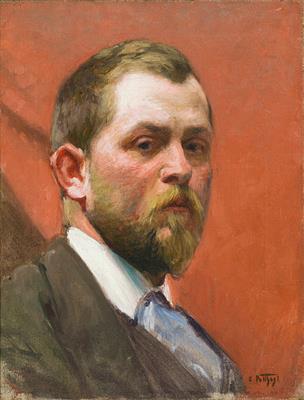
Biography
After settling in New York in 1895[1], Potthast supported himself through magazine illustration while building a reputation at the National Academy of Design. But it was his sun-drenched beach scenes that secured his place in American[1] Impressionism. Crowds at Rockaway Beach, children wading in Long Island surf, picnickers in Central Park on summer afternoons: his subjects were ordinary Americans at leisure, rendered with a luminosity that owed more to Monet than to his Munich teachers.
His technique evolved considerably over two decades in New York. The heavy contrasts of his early training gave way to broken brushwork, higher keys, and an almost pure concentration on light as subject. He won the Inness Prize twice, in 1903[1] and 1906, and a Silver Medal at the 1904 St. Louis Exhibition, though he never achieved the market recognition of Childe Hassam or William Merritt Chase.
Potthast remained a working painter until his death in New York in March 1927[1]. His work is held in the Brooklyn Museum, the Cape Ann Museum, and the Delaware Art Museum.
Timeline
- 1857Born in Cincinnati.
- 1895Settled in New York and supported himself through magazine illustration.
- 1903Won the Inness Prize.
- 1904Won a Silver Medal at the St. Louis Exhibition.
- 1906Won the Inness Prize for a second time.
- 1927Died in New York in March at the age of 69.
Notable Works
Tap to view larger.
Next stop
Browse the movements →
Every movement in the collection, from the Renaissance to Pop art.
Related Artists




Frequently Asked Questions
What is Edward Henry Potthast known for?
Edward Henry Potthast is known for his sun-drenched beach scenes and paintings of ordinary Americans at leisure. These paintings depict crowds at Rockaway Beach, children wading in Long Island surf, and picnickers in Central Park.What is Edward Henry Potthast's most famous work?
It is difficult to name one single work as Edward Henry Potthast's most famous. He is best known for his paintings of beach scenes, particularly those depicting children enjoying themselves at the seashore. These works capture the carefree spirit of summer and the simple pleasures of childhood. Potthast's beach scenes are characterised by their bright colours, loose brushwork, and focus on capturing the effects of light and atmosphere. He produced many paintings with similar subjects, rather than focusing on one specific masterwork. Potthast's style is often compared to that of the Impressionists, and his paintings are admired for their ability to evoke a sense of nostalgia and warmth. His work is held in many important American[1] collections.What should I know about Edward Henry Potthast's prints?
When considering Edward Henry Potthast's prints, it is useful to understand some basic print terminology. "Original prints" are produced by hand, with the artist creating the artwork directly on a plate, woodblock, or screen. These include woodcuts, engravings, linocuts, mezzotints, etchings, lithographs, and serigraphs. Each print is considered an original because the artist creates the artwork specifically to be a print. Offset reproductions, also known as posters, are created through photochemical means. The plates do not wear out, so there are no physical limits to the number of prints made; however, publishers may limit quantities to increase value. Giclée prints are inkjet fine art prints that have gained popularity as colour-copier technology has improved. Canvas transfers involve transferring the image onto canvas, giving the work the appearance of a painting. Limited edition prints are numbered, for example, 35/100, where the larger number is the total number of prints, and the smaller number indicates the print's sequence. Artists sometimes hold back a percentage as artist's proofs, marked with "AP".What style or movement did Edward Henry Potthast belong to?
Edward Henry Potthast is associated with American[1] Impressionism. This movement took root in the United States in the late 19th and early 20th centuries. American artists, including Potthast, adopted Impressionistic techniques, often after training in Europe. The influx of Impressionism into America occurred via several routes. Mary Cassatt was one of the first, followed by artists such as Childe Hassam and William Merritt Chase. The American art colony in Giverny, France, also played a significant role. Giverny became an Impressionist centre after Claude Monet settled there in 1883[1], attracting numerous American artists who sought to learn from him and paint in a similar style. By the early 20th century, Impressionism had become well-established in America, leading to regional variations such as Connecticut Impressionism, California Impressionism, and Pennsylvania Impressionism. Other leading American Impressionists included Edmund Tarbell, Frank Weston Benson, and Alden Weir.What techniques or materials did Edward Henry Potthast use?
Edward Henry Potthast is best known for his Impressionistic paintings, particularly beach scenes. He favoured oil paint, applying it with loose brushstrokes to capture the effects of light and atmosphere. Potthast's early training at the McMicken School of Design in Cincinnati provided him with a foundation in draughtsmanship. Later, he studied at the Royal Academy in Munich, where he was exposed to academic painting techniques. However, he moved away from these formal methods as his style evolved. His mature work demonstrates an interest in capturing fleeting moments. He often worked en plein air, painting directly from nature to record the immediate impressions of a scene. This approach is evident in his depictions of children playing on the beach, where he used broken colour and gestural brushwork to convey movement and spontaneity. Potthast's skill in watercolour is less well known, but he also produced works in this medium.When did Edward Henry Potthast live and work?
Edward Henry Potthast (1857[1]-1927[1]) was an American[1] Impressionist painter. He is best known for his depictions of leisure activities. These include beach scenes, park gatherings, and images of children at play. Born in Cincinnati, Ohio, Potthast studied at the McMicken School of Design, and later at the Cincinnati Art Academy. His early artistic education was grounded in academic realism. He travelled to Europe in the 1880s, studying in Munich at the Royal Academy. Here, he adopted a darker, more tonal style, typical of the Munich School. Upon returning to the United States, Potthast moved to New York City in 1896[1]. He then shifted towards Impressionism. The artist's Impressionist style is characterised by broken brushstrokes and a lighter colour palette. He frequently painted scenes of Coney Island and Central Park, capturing the energy of urban life. Potthast exhibited widely during his career. Venues included the National Academy of Design and the Society of American Artists. He won several awards and achieved recognition for his contributions to American Impressionism[1]. Although he died in 1927, his paintings continue to be popular with collectors.Where can I see Edward Henry Potthast's work?
Edward Henry Potthast's work can be viewed in several museums. In the United States, these include the Metropolitan Museum of Art (New York), the Museum of Modern Art (New York), the Los Angeles County Museum of Art, the Minneapolis Institute of Arts, the Virginia Museum of Fine Arts (Richmond), the Charles Hosmer Morse Museum of American[1] Art (Winter Park, Florida), and the Wolfsonian at Florida International University (Miami Beach). In Canada, Potthast's pieces are held at the Royal Ontario Museum (Toronto). In the United Kingdom, you can find his work at the Victoria & Albert Museum (London), the Brighton Museum & Art Gallery, the Manchester Art Gallery, and the National Museums of Scotland (Edinburgh).Where was Edward Henry Potthast from?
Edward Henry Potthast was born in Cincinnati, Ohio, in 1857[1]. He remained in his home city for much of his early artistic development. He studied at the McMicken School of Design, and later at the Cincinnati Art Academy. There, he studied with Thomas Satterwhite Noble. Potthast's early career saw him working as a lithographer in Cincinnati. This commercial experience likely honed his skills in composition and detail. In the 1880s, Potthast travelled to Europe for further study. He went first to Antwerp, Belgium, where he enrolled at the Royal Academy. Later, he moved to Paris, a popular destination for American[1] artists at the time. He studied with academic painters Gustave Boulanger, Fernand Cormon, and Jean-Paul Laurens. These instructors would have reinforced a strong foundation in figure drawing and painting. Upon his return to the United States, Potthast settled in New York City around 1896[1]. He remained there for the rest of his life, painting scenes of urban life and leisure, especially beach scenes. He died in New York in 1927[1].Who did Edward Henry Potthast influence?
It is difficult to say precisely who Edward Henry Potthast influenced. The reference texts do not discuss Potthast's influence on other artists. However, they do mention a number of artists who were active during Potthast's lifetime, some of whom were his teachers and peers. For example, Edward Hopper studied with Robert Henri and Kenneth Hayes Miller at the New York School of Art. Henri's class included Guy Pene du Bois, Rockwell Kent, Gifford Beal, George Bellows, and others. These artists, along with still life painters such as William Harnett, John Frederick Peto, Jefferson David Chalfant, and Alexander Pope, represent a portion of the artistic milieu in which Potthast worked. Further research into the connections between these individuals may reveal more information about Potthast's artistic impact.Who influenced Edward Henry Potthast?
Without more specific source material, it is difficult to name particular influences on Edward Henry Potthast. However, the references do list many artists, philosophers, and historical figures from a range of eras and styles. These include painters such as Isaac van Ostade, Jean-Baptiste Oudry, Richard Parkes Bonington, Camille Pissarro, Paulus Potter, Gaspard Poussin, and Adam Pynacker. Also listed are Raphael, Odilon Redon, Johann Christian Reinhart, and Edouard Manet. Philosophers such as Plato and Proudhon are mentioned, as are architects such as Ange-Jacques Gabriel. Knowledge of Potthast's biography and the art movements of his time would be needed to analyse which of these figures had a direct impact on his artistic development.Who was Edward Henry Potthast?
Edward Henry Potthast (1857[1]-1927[1]) was an American[1] Impressionist painter. He is best known for his depictions of leisure activities on beaches and in parks. Born in Cincinnati, Ohio, Potthast studied at the McMicken School of Design, and then at the Cincinnati Art Academy. There, he trained with Thomas Satterwhite Noble. In the 1880s, he travelled to Europe, studying in Antwerp and Munich. While in Paris, he encountered Impressionism. Upon his return to the United States, Potthast settled in New York City in 1896[1]. He initially worked as a magazine illustrator. Over time, he gained recognition as a painter. His style moved towards Impressionism, influenced by artists like Monet and Renoir. Potthast exhibited widely, including at the National Academy of Design, and the Society of American Artists. He became an associate member of the National Academy in 1899, and a full academician in 1906. His paintings are held in many museum collections, including the Metropolitan Museum of Art, and the Cincinnati Art Museum.Why are Edward Henry Potthast's works important today?
It is difficult to say why Edward Henry Potthast's works are important today. The art critic Eddy, writing in 1903[1], dismissed Edgar Degas because his 'art, fine as it is, is an illustration of the triumph of technique'. Eddy felt that Degas was indifferent to his subjects, which 'often sees things scarce worth painting at all'. Eddy found fault with Claude Monet, too, claiming that Monet was 'a painter by theory rather than conviction... but his conviction is of a scientific character rather than religious, formal rather than emotional, theoretical rather than intentional, reasoned rather than felt'. Eddy concluded that 'Monet and his immediate forerunners have disturbed the equilibrium of French art'. Eddy's opinions may be of interest to art historians, but they do not offer insight into Potthast's importance.
Sources
Editorial draws on the following primary and tertiary references for Edward Henry Potthast.
- [1] wikipedia Wikipedia: Edward Henry Potthast Used for: biography, birth dates, death dates, identifiers, movement attribution, nationality.
- [2] book Alfred Frankenstein, After the Hunt _ William Harnett and Other American Still Life Painters, 1870-1900 Used for: biography.
- [3] book Post-impressionism : cross-currents in European painting Used for: biography.
- [4] book Post-impressionism : cross-currents in European painting Used for: biography.
- [5] book Antoinette LaFarge, Sting in the Tale Used for: stylistic analysis.
- [6] book Saward, Susan, The Golden Age of Marie de' Medici Used for: biography.
- [7] book 1892-1968, Panofsky, Erwin,, Tomb sculpture: four lectures on its changing aspects from ancient Egypt to Bernini Used for: biography.
Editorial overseen by Solis Prints. Sources verified 2026-08-29. Click a source for details, or hover over [N] in the page above to preview.
Editorial standardsMethodologyCorrectionsAI disclosureAbout the editorial team