



Charles Willson Peale
When George Washington reportedly doffed his hat to the life-size painted figures in The Staircase Group (1795[2]), the illusion was complete enough to fool even the president. Charles Willson Peale had constructed the trompe l'oeil with a real wooden step at the base and a door jamb as frame, embedding his sons Raphaelle and Titian into the architecture of his Philadelphia studio.
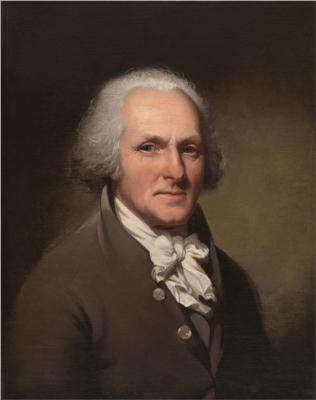
Biography
Before settling on portraiture, Peale had already worked as a saddle maker, watchmaker, silversmith, and upholsterer. Born in Chester County, Maryland, in 1741[2], he received no formal training until he studied briefly with John Singleton Copley in Boston and then spent two years with Benjamin West in London. Back in Annapolis, he opened a portrait studio and school, beginning the sustained practice that would produce roughly 60 portraits of George Washington alone.
His output extended well beyond portraiture. Peale founded both the first art gallery and the first art school in the American[2] colonies, and ran a natural history museum in Philadelphia containing more than 100,000 objects. In 1801[2] he led the first scientific excavation of a mastodon skeleton, exhibiting it to the public and commissioning a commemorative painting of the dig. His inventions included new spectacle designs, porcelain false teeth, and a stove that consumed its own smoke.
He named 17 children after European masters: Raphaelle, Rembrandt, Rubens, Titian, and others. Several became working artists, sustaining an American[2] painting dynasty well into the nineteenth century. Peale himself remained restlessly productive into extreme old age. At 86, he was said to be whooping down hills on one of the first bicycles. He died that same year, reportedly from overexertion while searching for a fourth wife.
Timeline
- 1741Born in Chester County, Maryland. He later named several of his 17 children after European masters.
- 1760Studied briefly with John Singleton Copley in Boston.
- 1762Spent two years studying with Benjamin West in London.
- 1764Opened a portrait studio and school in Annapolis.
- 1795Completed the trompe l'oeil painting "The Staircase Group", embedding his sons Raphaelle and Titian into the architecture of his Philadelphia studio.
- 1801Led the first scientific excavation of a mastodon skeleton. He exhibited it to the public and commissioned a painting of the dig.
- 1827Died at 86, reportedly from overexertion while searching for a fourth wife.
Notable Works
Tap to view larger.
Next stop
Neoclassicism →
Explore the artists and ideas of Neoclassicism.
Charles Willson Peale prints
Hand-finished archival prints from Charles Willson Peale's body of work.
 Portrait of William Harris Crawford - Charles Willson Peale
From £28.00
Portrait of William Harris Crawford - Charles Willson Peale
From £28.00
 Portrait of a Maryland Gentleman - Charles Willson Peale
From £28.00
Portrait of a Maryland Gentleman - Charles Willson Peale
From £28.00
 Benjamin Lincoln - Charles Willson Peale
From £28.00
Benjamin Lincoln - Charles Willson Peale
From £28.00
 View of the Garden at Belfield - Charles Willson Peale
From £28.00
View of the Garden at Belfield - Charles Willson Peale
From £28.00
 Henrietta Maria Bordley - Charles Willson Peale
From £28.00
Henrietta Maria Bordley - Charles Willson Peale
From £28.00
 Mr. and Mrs. Alexander Robinson - Charles Willson Peale
From £28.00
Mr. and Mrs. Alexander Robinson - Charles Willson Peale
From £28.00
Related Artists


Take Charles Willson Peale home.
See all Charles Willson Peale prints →Frequently Asked Questions
What is Charles Willson Peale known for?
Charles Willson Peale is known for establishing portraiture in the United States. He produced roughly 60 portraits of George Washington and founded the first art gallery and art school in the American[2] colonies.What is Charles Willson Peale's most famous work?
It is difficult to isolate a single most famous work by Charles Willson Peale, as his notability rests on his extensive output of portraits, his museum leadership, and his role in the American[2] Revolution. However, some specific paintings are better known. Peale painted multiple versions of some subjects. Among his most recognised pieces are his portraits of George Washington. He painted Washington from life on several occasions, and these images became iconic representations of the first US president. Another well-regarded work is 'The Artist in His Museum' (1822[2]), a self-portrait showing Peale lifting a curtain to reveal his natural history museum; it offers insight into his diverse interests, scientific inclinations, and his role as an American Enlightenment figure.What should I know about Charles Willson Peale's prints?
Charles Willson Peale, born in Maryland in 1741[2], was a significant figure in early American[2] art. He is best known for his portraits, which provided visual documentation of important people and events in the new nation. Before becoming a painter, Peale trained as a saddle maker. He studied painting with John Singleton Copley in Boston and Benjamin West in England. By 1776[2], Peale had moved to Philadelphia, where he received many commissions. He also served as a captain in the Pennsylvania Militia during the Revolutionary War. Peale's portraits include Thomas Jefferson, Alexander Hamilton, and George Washington. He painted around sixty portraits of Washington, beginning in 1772. In addition to portraits, Peale created idyllic images of rural American land. One example is Belfield Farm (circa 1816), now at the Detroit Institute of Arts. Peale also opened the first art gallery in the United States, promoting a native tradition of painting. He trained his brother James, and several of his children, including Raphaelle, Rembrandt, Rubens, and Titian, as artists. His painting The Staircase Group (1795) is a trompe l'oeil image of two of his sons.What style or movement did Charles Willson Peale belong to?
Charles Willson Peale (1741[2]-1827[2]) was an American[2] painter who helped establish portraiture in the United States. He provided visual documentation of important political and cultural figures during the country's early years. Peale's artistic development included studies with John Singleton Copley in Boston and Benjamin West in England. West's work is considered Neoclassical, a style that coincided with the founding of the American republic. The Neoclassical style drew inspiration from ancient Rome, which was seen as a model for the new nation. Peale was a multifaceted man; before becoming a painter, he worked as a saddler, watchmaker, silversmith, and upholsterer. He also served as a soldier in the Revolutionary War and was a politician and inventor. He founded the first art gallery and art school in the colonies. His portraits include images of Thomas Jefferson, Alexander Hamilton, and George Washington. He painted around 60 portraits of Washington.What techniques or materials did Charles Willson Peale use?
Charles Willson Peale was a portrait painter who played a major role in establishing the genre in the United States. He was born in Maryland and initially trained as a saddle maker. He later studied painting with several artists, including John Singleton Copley in Boston and Benjamin West in England. Peale's artistic methods were influenced by the conditions of the time. Portraitists often lacked a formal studio; they were at the mercy of their surroundings, such as a local tavern or the sitter's house. The artist often had to rely on daylight from a window. Lacking an easel, he might prop the canvas on the back of a chair. The patron often paid for the materials, and might not be willing to purchase expensive pigments or fine linen canvas. The painter either had to travel with art materials or rely on local merchants. Manuals such as *The Artist and Tradesman's Guide* (1829) were addressed to artists and craftsmen alike, who purchased their supplies from common sources. Artists in rural regions could not obtain the more expensive pigments and used these manuals to improvise with fewer colours.When did Charles Willson Peale live and work?
Charles Willson Peale (1741[2]-1827[2]) was an American[2] painter, soldier, and museum keeper. Born in Queen Anne's County, Maryland, he was the son of Charles Peale and Margaret Triggs. Apprenticed to a saddler at age thirteen, Peale later pursued painting. He received instruction from John Hesselius and John Singleton Copley before studying in London with Benjamin West from 1767[2] to 1769. Returning to America, Peale settled in Annapolis, Maryland, and became active in the independence movement. He served in the Continental Army during the American Revolution, rising to the rank of captain. Throughout his military service, he continued to paint portraits of fellow officers, including George Washington. After the war, Peale moved to Philadelphia, where he established a museum dedicated to natural history and American portraiture. Peale's Philadelphia Museum, established in 1786, displayed portraits of notable figures alongside natural history specimens. The museum became a centre for scientific and artistic activity. He also operated a studio, producing portraits of prominent Americans, and he taught his relatives, including his sons Rembrandt, Raphaelle, and Rubens Peale. He experimented with various artistic techniques and promoted scientific knowledge through his museum and writings until his death in 1827.Where can I see Charles Willson Peale's work?
Charles Willson Peale's artwork can be found in several locations in the United States. The Metropolitan Museum of Art, located in New York City, owns some of his pieces. Other New York museums that hold his work are the Museum of Modern Art, and the Whitney Museum of American[2] Art. Outside of New York, Peale's art can be viewed at the Pennsylvania Academy of the Fine Arts and the Philadelphia Museum of Art, both in Philadelphia. Further afield, the Carnegie Museum of Art in Pittsburgh, the Corcoran Gallery of Art, the National Gallery of Art, and the National Museum of American Art in Washington, DC also hold examples of Peale's output. Yale University Art Gallery in New Haven, and the Los Angeles County Museum of Art (LACMA) also own pieces.Where was Charles Willson Peale from?
Charles Willson Peale was born in Chester, Maryland, in 1741[2]. Before becoming a painter, he trained as a saddle maker and established his own shop. However, he was driven out of business because of his membership in the Sons of Liberty. He then turned to painting, studying first in Maryland and later in Boston with John Singleton Copley. Peale eventually raised enough money to travel to England, where he studied with Benjamin West for two years. After his time in England, he returned to America and settled in Annapolis. In Annapolis, he opened a portrait studio and school; his younger brother, James Peale, served as his assistant. In 1776[2], Peale and his brother relocated to Philadelphia, where many commissions were available. In addition to painting portraits of American[2] politicians and foreign dignitaries, he served as a captain in the Pennsylvania Militia during the Revolutionary War. In 1779, he served a year in the Pennsylvania State Assembly before returning to painting full-time. Peale died in 1827[2].Who did Charles Willson Peale influence?
Charles Willson Peale had a substantial impact on the artistic community of his time, particularly through his role as a teacher and mentor. Among his most notable students were his own children; he trained Raphaelle, Rembrandt, Rubens, and Titian Peale as artists. Each of them developed successful, if sometimes troubled, careers. Beyond his immediate family, Peale influenced other artists through his museum and his general promotion of the arts in America. His efforts helped to create a more supportive environment for artistic endeavours. John Beale Bordley is an example of an artist who sought out Peale's instruction. Bordley, an amateur artist and agriculturalist, benefited from Peale’s guidance. It demonstrates Peale's willingness to share his knowledge with a wide range of individuals, further extending his influence. Peale's influence is evident not only in the direct instruction he provided but also in his broader efforts to cultivate an artistic culture in the United States. His museum acted as a hub for artists and natural scientists.Who influenced Charles Willson Peale?
Charles Willson Peale, a colonial American[2] painter, was influenced by several artists during his career. Initially a saddle maker, Peale turned to painting and studied with artists in Maryland before seeking instruction from John Singleton Copley in Boston. Later, Peale travelled to England, where he spent two years studying with Benjamin West. West also painted American historical scenes, using a style derived from French historical painters such as Jacques-Louis David and Jean-Auguste-Dominique Ingres. Peale's artistic pursuits extended to his family, as he trained his brother James Peale, who became his assistant. He also instructed many of his children in art, leading to an artistic dynasty. Peale named several of his children after European artists, including Raphaelle Peale, Rembrandt Peale, and Rubens Peale. His youngest son, Titian Ramsey Peale, also became an artist and photographer.Who was Charles Willson Peale?
Charles Willson Peale was a colonial American[2] painter. He helped establish portraiture in the United States, providing visual documentation of major political and cultural figures and events during the country's early history.Why are Charles Willson Peale's works important today?
Charles Willson Peale is important because he helped establish portraiture in the United States. His work provided visual documentation of major political and cultural figures during the country's early years. Born in Maryland, Peale initially worked as a saddle maker. He later studied painting with John Singleton Copley in Boston, and then with Benjamin West in England. He settled in Annapolis and opened a portrait studio, training his brother James Peale. In 1776[2], Peale moved to Philadelphia. He painted portraits of American[2] politicians and foreign dignitaries, including Thomas Jefferson, Alexander Hamilton, and George Washington. He created around 60 portraits of Washington, beginning in 1772. Peale also served as a captain in the Pennsylvania Militia during the Revolutionary War and served a term in the Pennsylvania State Assembly. Peale's family also contributed to the art world. He named many of his ten children after European artists. His sons included Raphaelle Peale, a still-life painter; Rembrandt Peale, a portrait painter; and Rubens Peale, a painter of still lifes and rural scenes. Peale’s 16th child, Titian Ramsey Peale, became an artist and photographer. Peale opened the first art gallery in the United States and promoted a native tradition of painting.
Sources
Editorial draws on the following primary and tertiary references for Charles Willson Peale.
- [1] wikidata Wikidata: Q454945 Used for: identifiers.
- [2] wikipedia Wikipedia: Charles Willson Peale Used for: biography, birth dates, death dates, identifiers, movement attribution, nationality.
- [3] book Morrison H Heckscher; Leslie Greene Bowman; Metropolitan Museum of Art; Los Angeles County Museum of Art; Exhibition _American rococo_, American rococo, 1750 - 1775 elegance in ornament ; [the exhibition held at The Metropolitan Museum of Art, Used for: biography, stylistic analysis.
- [4] book Allison Lee Palmer, Historical Dictionary of Neoclassical Art and Architecture Used for: biography, stylistic analysis.
- [5] book Palmer, Allison Lee, Historical Dictionary of Neoclassical Art and Architecture Used for: biography, stylistic analysis.
- [6] book Carol Strickland and John Boswell, The Annotated Mona Lisa Used for: biography.
Editorial overseen by Solis Prints. Sources verified 2026-09-27. Click a source for details, or hover over [N] in the page above to preview.
Editorial standardsMethodologyCorrectionsAI disclosureAbout the editorial team