



Eduardo Chillida
- abstract art
Eduardo Chillida's career as a sculptor began not in an art school but on a football pitch. Playing goalkeeper for Real Sociedad in San Sebastián, he suffered a knee injury serious enough to end his athletic ambitions. He had been studying architecture in Madrid; now he redirected himself entirely toward art, moving to Paris in 1948[1] and then returning to the Basque Country in 1951, where he taught himself the ancient craft of iron forging in the local blacksmith tradition.
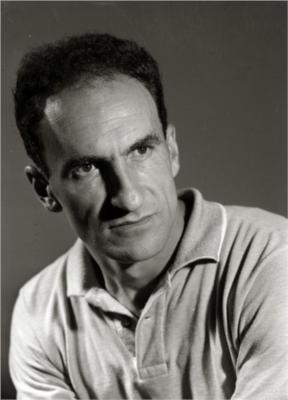
Biography
His mature work grew from that encounter with iron. He beat and twisted the metal into forms that seem to reach outward and grasp: never quite closing, always in conversation with the surrounding space. The Venice Biennale Grand Prize for Sculpture in 1958[1] confirmed his European standing, and through the 1960s he received commissions from Pittsburgh, Berlin, and Gijón. A long friendship with the philosopher Martin Heidegger, which began in 1968, produced a celebrated illustrated edition of 'Der Kunst und der Raum' (Art and Space): Chillida contributing prints that literalise what Heidegger theorised about the void.
The work most visitors connect with Chillida is the 'Peine del Viento' (Comb of the Wind) of 1977[1]: three massive steel sculptures set into the coastal rocks at San Sebastián, designed with architect Luis Peña Ganchegui. The piece does not simply sit on the landscape; it converses with it. The steel combs face the Atlantic, catching wave and wind, turning meteorological force into a kind of slow music. Chillida returned obsessively to the Basque coastline and its light throughout his life, and San Sebastián remains his most lasting monument.
Timeline
- 1924Born in San Sebastián, Spain.
- 1948Moved to Paris to pursue art after abandoning architecture studies in Madrid; at 24.
- 1951Returned to the Basque Country; at 27, he taught himself iron forging.
- 1958Awarded the Venice Biennale Grand Prize for Sculpture; at 34.
- 1968Began a friendship with philosopher Martin Heidegger; at 44.
- 1969Collaborated with Heidegger on an illustrated edition of 'Der Kunst und der Raum' (Art and Space); at 45.
- 1977Designed 'Peine del Viento' (Comb of the Wind) with architect Luis Peña Ganchegui in San Sebastián; at 53.
- 2002Died; at 78.
Notable Works
Tap to view larger.
Next stop
Browse the movements →
Every movement in the collection, from the Renaissance to Pop art.
Related Artists

Frequently Asked Questions
What is Eduardo Chillida known for?
Eduardo Chillida is known for his large-scale steel sculptures, such as 'Peine del Viento' (Comb of the Wind) in San Sebastián. His sculptures often engage with the surrounding space and environment, exemplified by the 'Comb of the Wind' sculptures interacting with the wind and waves of the Atlantic.What is Eduardo Chillida's most famous work?
It is difficult to name one single "most famous" work by Eduardo Chillida (1924[1]-2002[1]). He is known for his abstract sculptures in steel and iron, and also for his collaborations with philosopher Martin Heidegger. Chillida's early work included pieces such as *From Within* (1953[1]), an iron sculpture now held at the Guggenheim Museum. His initial solo exhibition occurred at the Galeria Clan in Madrid (1954), and the city of San Sebastian commissioned a monument to Alexander Fleming from him in 1955. Later, in 1966, Chillida created *Iru Burnt* (also known as *Tres Hierros*), an abstract steel work. That same year, he had his first US retrospective at The Museum of Fine Arts in Houston. Retrospectives of Chillida's work were held in 1969 at museums in Basel, Zurich and Munich.What should I know about Eduardo Chillida's prints?
Eduardo Chillida (1924[1]-2002[1]) was a Spanish[1] Basque sculptor, best known for his abstract public artworks. Although celebrated for his sculpture, Chillida also produced a significant body of graphic work, including etchings, aquatints, and lithographs. Printmaking allowed Chillida to explore similar themes and forms to his sculpture, such as space, mass, and the relationship between form and void. The graphic medium offered him a different set of possibilities, enabling him to create textures and spatial relationships. Like many printmakers, Chillida often created limited editions of his prints. In a limited edition, the artist decides the number of prints produced from a block or set of blocks. Each print in the edition is considered an original, inked and pulled individually from the matrix. The number of prints is decided by the artist, and each print is numbered sequentially (for example, 12/25, meaning the twelfth print in an edition of 25). The practice of numbering prints became standard relatively recently.What style or movement did Eduardo Chillida belong to?
Eduardo Chillida's artistic affiliations are not easily categorised. His work resists simple classification within a single movement. Some writers connect Chillida to abstract art[1], particularly in his later, simplified style. Others note the influence of Minimalism, citing the scale and industrial materials of his sculptures. His use of solid forms and concern with spatial relationships align with some tenets of Minimalism. Chillida's exploration of form and space also has links to Constructivism, an early 20th-century movement that experimented with non-representational sculpture. Direct metal sculpture became a substantial direction in American sculpture, incorporating constructivist ideas. While these associations offer context, Chillida's individual approach to sculpture sets him apart. His work is best understood as a unique synthesis of various influences rather than strict adherence to any one particular artistic movement.What techniques or materials did Eduardo Chillida use?
Eduardo Chillida, born in San Sebastian in 1924[1], is known for his abstract sculptures. He explored various materials, but is particularly associated with iron and steel. Chillida's artistic approach involved directly working with metal, a departure from earlier sculptural practices where artists typically created models in plaster or clay for metalworkers to cast. He saw his materials not just as representational tools, but as integral components of his works' conception and form. His techniques included forging, bending, and joining iron elements. The surfaces of his steel works often have a rough, acid-corroded finish. Chillida's early metal sculptures displayed a Cubist influence, but he soon developed a technique connected to Spanish[1] traditions of ironwork. In 1966[1], he was forging iron bars.What was Eduardo Chillida known for?
Eduardo Chillida (1924[1]-2002[1]) was a Spanish[1], Basque sculptor known for his abstract forms forged in iron and, to a lesser extent, wood. After studying architecture in Madrid from 1943[1] to 1947, Chillida turned to drawing and sculpture. He moved to Paris in 1948, befriending Pablo Palazuelo, with whom he exhibited at the Salon de Mai in 1949. By 1951, his sculpture revealed the importance of his materials. He worked the iron himself, accentuating the physical properties of the metal. The surfaces of his pieces are often rough. His first solo exhibition was at the Galeria Clan in Madrid in 1954. San Sebastian commissioned him to create a monument to Alexander Fleming in 1955. In 1958, he won the International Grand Prize for Sculpture at the Venice Biennale. He also received the Kandinsky Prize in 1960 and the Sculpture Prize at the Carnegie International in Pittsburgh in 1964. The first US retrospective of his work took place at the Museum of Fine Arts in Houston in 1966.When did Eduardo Chillida live and work?
Eduardo Chillida Juantegui (1924[1]-2002[1]) was a Spanish[1], Basque sculptor, best known for his abstract iron and steel constructions. Born in San Sebastián, Spain, Chillida initially pursued architecture from 1943[1] to 1946 at the University of Madrid. He abandoned his studies to play football as a goalkeeper for Real Sociedad. A knee injury ended his football career, and he then turned his attention to art. In 1948, Chillida moved to Paris. There, he began working with plaster and creating figurative sculptures. By 1951, he returned to Spain and settled in the Basque Country. He shifted away from plaster and figuration, experimenting with iron and other materials. Throughout his career, Chillida created monumental public sculptures, often sited in urban environments. Notable examples include "Berlin" (2000) in Berlin, Germany, and "Elogio del Horizonte" (1990) in Gijón, Spain. He also produced a substantial body of graphic work, including etchings and lithographs. Chillida's work is held in major museum collections internationally. He died in San Sebastián, leaving behind a varied body of work that solidified his position as an important figure in 20th-century sculpture.Where can I see Eduardo Chillida's work?
Eduardo Chillida (1924[1]-2002[1]) was a Spanish[1] Basque sculptor known for his abstract steel works. To view his pieces, consider visiting museums that have held significant exhibitions of his work. These include the Galerie Clan in Madrid, where he had his first solo exhibition in 1954[1]; the Galerie Maeght in Paris, which hosted many solo exhibitions beginning in 1966; and The Museum of Fine Arts in Houston, which held his first US retrospective in 1966. His work is also held in the collection of the Solomon R. Guggenheim Museum in New York; their holdings include *Iru burnt* (Tres Hierros) from 1966. Retrospectives were held in 1969 in Basel, Zurich, and Munich. Chillida also created public commissions; in 1955, the city of San Sebastian commissioned a monument to Alexander Fleming. In 1969, he began a sculpture for the UNESCO Building in Paris, followed by a commission for the World Bank in Washington.Where was Eduardo Chillida from?
Eduardo Chillida was born in San Sebastian, Spain, on 10 January 1924[1]. San Sebastian is a coastal city in the Basque region of Spain. Chillida studied architecture at the University of Madrid from 1943[1] to 1947. Afterwards, he shifted his focus to drawing and sculpture. In 1948, he relocated to Paris, where he befriended Pablo Palazuelo; they exhibited together at the Salon de Mai in 1949. By 1950, Chillida was living in Villaines-sous-Bois, France. The following year, he moved to Hernani, near San Sebastian, and formed a friendship with Jose Cruz Iturbe. His first solo exhibition occurred at the Galeria Clan in Madrid in 1954. In 1955, the city of San Sebastian commissioned Chillida to create a monument to Alexander Fleming. He returned to San Sebastian in 1959. Chillida continued to live and work there.Who did Eduardo Chillida influence?
Eduardo Chillida's impact on other artists is complex. He worked in a mode somewhat removed from trends. Chillida's work with abstract sculpture, particularly his use of forged iron and monumental scale, has affinities with some later artists. However, direct lines of influence are hard to establish. Some artists working in public sculpture have noted affinities with Chillida's work. These include sculptors who create large, abstract pieces intended for interaction with the environment. His exploration of form and space has parallels in the work of land artists and those interested in the phenomenology of sculpture. Chillida's emphasis on craftsmanship and his use of industrial materials also connect him to certain streams within contemporary sculpture. These include artists who value process and materiality. However, Chillida's individual approach makes it difficult to identify a specific school of followers. His influence is perhaps more diffuse, apparent in a general sensibility towards materials and space rather than a clearly defined set of aesthetic principles.Who influenced Eduardo Chillida?
Eduardo Chillida, born in San Sebastian in 1924[1], initially studied architecture in Madrid from 1943[1] to 1947. He then turned to drawing and sculpture. In 1948, Chillida moved to Paris, where he befriended Pablo Palazuelo; they exhibited together at the Salon de Mai in 1949. By 1951, Chillida's sculpture showed the importance of his materials. His method of working has roots in the art of Julio Gonzalez, who is generally considered among the first to make metal sculpture directly in the late 1920s. (For a short time, Gonzalez collaborated on some metal sculptures by Pablo Picasso.) Chillida's early metal sculptures were relatively delicate, close to a Cubist linearity. He soon developed a technique related to Spanish[1] traditions of ironwork, especially strong in the Basque region and Catalonia. His abstract sculpture shares a sensibility with art of the late 1940s and 1950s.Who was Eduardo Chillida?
Eduardo Chillida (1924[1]-), was a Spanish[1] Basque sculptor. Born in San Sebastian, he initially studied architecture at the University of Madrid (1943[1]-1947[1]), before turning to drawing and sculpture. In 1948, Chillida moved to Paris and befriended Pablo Palazuelo; they exhibited together at the Salon de Mai in 1949. By 1951, Chillida had relocated to Hernani, near San Sebastian. His first solo exhibition was at the Galeria Clan in Madrid in 1954. Chillida received a commission from San Sebastian to create a monument to Alexander Fleming in 1955. He had his first of many solo exhibitions at Galerie Maeght in Paris in 1966. Chillida won the International Grand Prize for Sculpture at the Venice Biennale in 1958. In 1968, he met the philosopher Martin Heidegger, and illustrated Heidegger's book *Der Kunst und der Raum*. Chillida's sculpture often involved forged iron. His work *From Within* (1953) demonstrates his interest in the material. The bending and joining of iron elements creates tension. The curved, pointed shapes of iron bars form a silhouette that changes from different angles.
Sources
Editorial draws on the following primary and tertiary references for Eduardo Chillida.
- [1] wikipedia Wikipedia: Eduardo Chillida Used for: biography, birth dates, death dates, identifiers, movement attribution, nationality.
- [2] book guggenheim-berriarei00bilb Used for: biography, stylistic analysis.
- [3] book guggenheim-guggenheimintern00frye Used for: biography, stylistic analysis.
- [4] book guggenheim-guhe00solo Used for: biography, stylistic analysis.
Editorial overseen by Solis Prints. Sources verified 2026-09-22. Click a source for details, or hover over [N] in the page above to preview.
Editorial standardsMethodologyCorrectionsAI disclosureAbout the editorial team