



Burgoyne Diller
- abstract art
By 1934[1], Burgoyne Diller had become what scholars now recognise as the earliest American[1] exponent of Mondrian's brand of geometrical abstraction. This was not imitation. Working through his three compositional themes, which he labelled simply First, Second, and Third, Diller developed a systematic investigation of the picture plane in relation to forms in movement and forms in opposition, independent of but running parallel to the De Stijl programme being worked out in Europe.
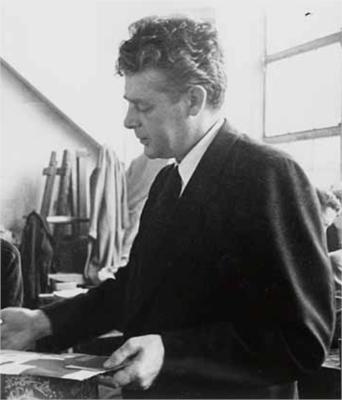
Biography
Born in New York in 1906[1], Diller studied at the Art Students League under Hans Hofmann and Jan Matulka before joining the Works Progress Administration in 1934[1]. As supervisor of the WPA's mural painting division in New York through 1940, he oversaw more than two hundred public murals, including abstract works by Jan Matulka, Stuart Davis, and Paul Kelpe at the Williamsburg Housing Project.
During the war he served in the U.S. Navy, where he invented a Morse code training device. Afterwards he joined Brooklyn College as a professor, a post he held until his death in 1965[1]. His late sculptural work, fabricated in Formica by an industrial shop from his exact plans and drawings, pushed the compositional vocabulary of his paintings into three dimensions: Project for Granite, No. 1 (1963[1]) stands 84 inches and was shown at the Guggenheim International exhibition.
Diller's place in the historical record was long underestimated. His work forms a connecting link between the American[1] geometric abstraction of the 1930s and the Minimalism that emerged three decades later.
Timeline
- 1906Born in New York.
- 1934Became an early American exponent of Mondrian's geometrical abstraction, developing three compositional themes.
- 1934Joined the Works Progress Administration.
- 1934Studied at the Art Students League under Hans Hofmann and Jan Matulka.
- 1940Supervised the WPA's mural painting division in New York, overseeing more than two hundred public murals.
- 1963Created "Project for Granite, No. 1", a sculpture fabricated in Formica.
- 1965Died, while a professor at Brooklyn College.
Notable Works
Tap to view larger.
Next stop
Browse the movements →
Every movement in the collection, from the Renaissance to Pop art.
Related Artists


Frequently Asked Questions
What is Burgoyne Diller known for?
Burgoyne Diller is recognised as the earliest American[1] exponent of Mondrian's geometrical abstraction. He developed a systematic investigation of the picture plane in relation to forms in movement and forms in opposition, independent of but running parallel to the De Stijl programme.What is Burgoyne Diller's most famous work?
It is difficult to name Burgoyne Diller's single most famous work, as his notability rests on his consistent output within a specific style. He is best known for his abstract geometric compositions, particularly those adhering to the principles of Neo-Plasticism, a movement popularised by Piet Mondrian. Diller created a series of "First Theme" works throughout the 1930s and 1940s. These paintings, and related series, explored the relationships between coloured rectangles and lines, arranged on a white ground. These works are often considered high points within his artistic output. Although Diller also produced sculpture and held government arts administration positions during the Great Depression, his paintings remain his most recognised and celebrated achievement. His dedication to geometric abstraction, and his exploration of its possibilities over several decades, has solidified his place in the history of American[1] art.What should I know about Burgoyne Diller's prints?
When considering Burgoyne Diller's prints, understanding the terminology and conventions of the print market is important. "Original prints" are produced by hand, with the artist creating the work directly on the plate, block, stone, or screen. These include woodcuts, engravings, linocuts, mezzotints, etchings, lithographs and serigraphs. Each print is considered an original because it is hand-pulled by the artist. Offset reproductions, also known as posters, are produced by photochemical means. The number of prints may be limited by the publisher to add value, but there is no physical limit. Giclée prints are fine art prints made using inkjet technology. Limited edition prints command higher prices. The plates for original prints are made by hand and can only withstand a limited amount of use. The number of prints pulled is thus restricted. Some publishers impose limits to increase a print’s value; these limits may be as high as 700 to 1,000 impressions, but some prints are limited to 250 to 500. All prints in a limited edition should be numbered (for example, 35/100).What style or movement did Burgoyne Diller belong to?
Burgoyne Diller worked in a non-objective style, although his career also touched on Cubism and abstraction. These movements moved away from traditional representation. Instead, they explored form, colour, and spatial relationships. Non-objective art rejects the depiction of recognisable objects or scenes. The artist does not use memory or knowledge of nature. Instead, the focus is on the intuitive arrangement of shapes and colours to create a harmonious composition. The aim is to convey a sense of rhythm and balance, reflecting a cosmic order. Some practitioners believed non-objective art had an educational power, developing intuition and offering spiritual value. The viewer engages with the artwork on a purely visual level, appreciating the interplay of forms and colours without reference to the external world.What techniques or materials did Burgoyne Diller use?
Burgoyne Diller worked with diverse materials. In his sculpture, he favoured simple shapes moulded from fibreglass. The forms were reminiscent of folded Japanese paper, belying a complex process that he called 'the lost polyurethane method'. This involved twisting sheets of polyurethane into curves, which were then wired or stapled. The shape was sprayed with molten metal and encased in a fibreglass mould. The inner form was removed and replaced with sprayed resin and fibreglass. He restricted these sculptures to black or white, with matte or translucent finishes creating different effects. From 1980, he created 'relief paintings' using oil, epoxy, polystyrene, and fibreglass. These reliefs featured complex colour relationships and varied surfaces, contrasting with the cast fibreglass sculptures.What was Burgoyne Diller known for?
Burgoyne Diller (1906[1]-1965[1]) was an American[1] abstract expressionist artist. He is best known for his constructivist paintings and sculptures, which often featured geometric forms and a limited colour palette. Diller's work was influenced by Piet Mondrian and the De Stijl movement. Throughout his career, Diller explored the possibilities of non-representational art, creating compositions that emphasised balance, harmony and spatial relationships. He worked for the Works Progress Administration (WPA) in the 1930s and 1940s, supervising mural projects. His own art developed through several phases. He moved from early representational work to geometric abstraction, eventually creating his signature series of "constructions" and paintings. These works typically involved arrangements of rectangles and squares in primary colours, reflecting his interest in the principles of geometric abstraction.When did Burgoyne Diller live and work?
Burgoyne Diller was born in New York City in 1906[1]. He studied at the Art Students League of New York between 1928[1] and 1933. During the 1930s, Diller worked for the Works Progress Administration (WPA) Federal Art Project, becoming supervisor of the Mural Division in 1935. He later directed the WPA's Easel and Murals divisions. Diller's artistic career developed through several phases. He initially explored Cubism and Constructivism, before moving toward Neo-Plasticism, inspired by Piet Mondrian. He created paintings, sculptures, and collages, often using geometric forms and a limited colour palette. Diller taught art at Brooklyn College and City University of New York. He continued to produce art until his death in 1965[1].Where can I see Burgoyne Diller's work?
Burgoyne Diller's artworks appear in numerous collections. Several museums in New York City hold examples of his work; these include the Metropolitan Museum of Art, and the Museum of Modern Art (MoMA). Other American[1] museums include the Los Angeles County Museum of Art (LACMA), the Minneapolis Institute of Arts, the Virginia Museum of Fine Arts (Richmond), and the Charles Hosmer Morse Museum of American Art (Winter Park, Florida). Outside the United States, Diller's art can be seen at the Royal Ontario Museum in Toronto. The Hirshhorn Museum and Sculpture Garden in Washington, DC, also possesses works by Diller. The Yale University Art Gallery (New Haven, Connecticut) is another potential venue.Who did Burgoyne Diller influence?
Burgoyne Diller headed the Mural Division of the Federal Art Project in New York from 1940[1] to 1941. He then directed the New York City War Service Art Section of the W.P.A. from 1941 to 1942. Examining the question of influence, it is useful to note that geometric abstraction played a significant role in the genesis of American[1] abstraction during the 1930s. It resurfaced, in a vastly different expression, in the Minimalist painting of artists such as Agnes Martin, Robert Mangold, Brice Marden and Robert Ryman. In the 1980s, it appeared in the work of painters Heidi Gliick and Scott Davis. Some artists appropriated aspects of Cubism; others reinterpreted Abstract Expressionism. Some younger artists consciously rejected the facile and easily imitated, avoiding clean surfaces in favour of roughness, spontaneity and directness.Who influenced Burgoyne Diller?
According to an interview, Burgoyne Diller found the New York art community welcoming. He named Hans Hofmann and David Smith as close friends and colleagues, from whom he drew nourishment and encouragement. Diller felt that Hofmann engaged in friendly competition with him for a time. He believed that having other artists one respects is very important, as art can be a lonely business. Diller stated that the art that helped form him included Analytic Cubist work by Braque and Picasso, early Kandinsky, and Miro. He also looked at Matisse and Mondrian. He exhaustively analysed the structure of their paintings. He specifically mentioned Matisse's *Blue Window* (1913[1]), Miro's *Person Throwing a Stone at a Bird* (1926), Cezanne's *Card Players* (1890-92), and Mondrian's grid paintings. He studied Leger, Renaissance and Quattrocento artists, Old Masters, American[1] masters, and African art.Who was Burgoyne Diller?
Burgoyne Diller (born in New York in 1906[1]; died 1965[1]) was an American[1] artist known for his geometric constructions and paintings. Diller's artistic journey included studies at Michigan State University and the Art Students League in New York. He had several solo exhibitions at the Pinacotheca Gallery in New York during the 1940s. Later, he had shows at the Rose Fried Gallery (1951[1]) and Galerie Chalette (1961, 1964), also in New York. A retrospective of his work was held at the New Jersey State Museum in Trenton (1966). Beyond his personal artistic pursuits, Diller contributed to the Federal Art Project, heading the Mural Division in New York from 1940 to 1941. He then became Director of the New York City War Service Art Section of the W.P.A. (1941-1942[1]). His sculptures were made of formica, fabricated by an industrial shop following his precise plans.
Sources
Editorial draws on the following primary and tertiary references for Burgoyne Diller.
- [1] wikipedia Wikipedia: Burgoyne Diller Used for: biography, birth dates, death dates, identifiers, movement attribution, nationality.
- [2] book guggenheim-artoftomorrowfif1939gugg Used for: biography.
- [3] book guggenheim-guggenh01solo Used for: biography.
- [4] book Post-impressionism : cross-currents in European painting Used for: biography.
Editorial overseen by Solis Prints. Sources verified 2026-10-07. Click a source for details, or hover over [N] in the page above to preview.
Editorial standardsMethodologyCorrectionsAI disclosureAbout the editorial team