

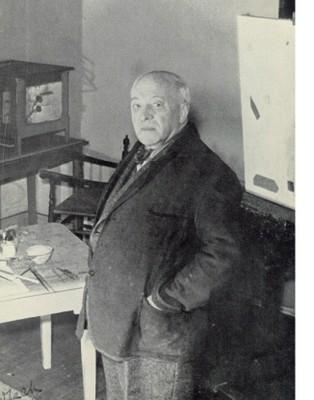
Bart van der Leck
- abstract art
The conventional account of De Stijl gives Mondrian its theoretical centre. The record tells a more complicated story. When Mondrian arrived at Van der Leck's studio in Laren around 1916[2], he encountered a painter already working in pure primary colours on white, and adopted the practice. Van der Leck, born in Utrecht in 1876[2] to a house painter, had arrived there independently, beginning not in a fine art academy but in a stained glass workshop where he learnt the discipline of flat colour and geometric outline.
Biography
When Van der Leck, Mondrian, and Theo van Doesburg co-founded De Stijl in 1917[2], Van der Leck was already developing his signature method: abstraction from representational sources rather than from theory. His Triptych converts observational sketches made at a Spanish mine into forms that read as pure geometric composition. He was, as the critic Jed Rasula described it, literally ab-stracting: pulling observable subjects apart until only geometric coordinates remained.
The movement did not hold him long. Financial support from the art dealer and critic Hendrik Bremmer was central to Van der Leck's survival, and Bremmer's aesthetic tolerance had limits. As Van der Leck's painting became more abstract, Bremmer withdrew his allowance. Unlike Mondrian, who refused the same pressure and permanently lost that support, Van der Leck returned to figurative work to have it restored. He described Bremmer years later in Museumjournaal as generous but also stubborn and domineering, a patron determined to have his own way.
Away from easel painting, Van der Leck worked productively in applied design: interior commissions including the St Hubertus Hunting Lodge (1919[2]-20), textile and packaging work for Metz and Co. from 1930, and a typeface he designed in 1941 for the avant-garde magazine Flax, later digitally revived as Architype van der Leck in 1994. He died in Blaricum in 1958[2], aged 81.
Timeline
- 1876Born in Utrecht to a house painter.
- 1916Met Piet Mondrian in Laren; Mondrian adopted van der Leck's practice of using pure primary colours on white.
- 1917Co-founded De Stijl with Piet Mondrian and Theo van Doesburg.
- 1919Began interior design commissions for the St Hubertus Hunting Lodge (completed 1920).
- 1930Started textile and packaging work for Metz and Co.
- 1941Designed a typeface for the avant-garde magazine Flax.
- 1958Died in Blaricum, aged 81.
Notable Works
Tap to view larger.
Next stop
Browse the movements →
Every movement in the collection, from the Renaissance to Pop art.
Bart van der Leck prints
Hand-finished archival prints from Bart van der Leck's body of work.
 Composition No. 4 (Leaving The Factory) - Bart van der Leck
From £37.00
Composition No. 4 (Leaving The Factory) - Bart van der Leck
From £37.00
 Still life (Bowl with apples) - Bart van der Leck
From £37.00
Still life (Bowl with apples) - Bart van der Leck
From £37.00
 Vrouw met koe (Woman with Cow) - Bart van der Leck
From £37.00
Vrouw met koe (Woman with Cow) - Bart van der Leck
From £37.00
 Woman and Cow - Bart van der Leck
From £37.00
Woman and Cow - Bart van der Leck
From £37.00
 Young Goat - Bart van der Leck
From £37.00
Young Goat - Bart van der Leck
From £37.00
 Billy-Goat - Bart van der Leck
From £37.00
Billy-Goat - Bart van der Leck
From £37.00
Related Artists



Take Bart van der Leck home.
See all Bart van der Leck prints →Frequently Asked Questions
What is Bart van der Leck known for?
Bart van der Leck is known for his abstract art[2] and applied design work. He created interior commissions, textile designs, packaging, and even a typeface for the magazine Flax.What is Bart van der Leck's most famous work?
It is difficult to name Bart van der Leck's single most famous work, but he is well-regarded for his contributions to the De Stijl movement. Van der Leck started as a glass painter. He is known for reducing his compositions to basic forms and primary colours. Though he never achieved the level of recognition of some of his contemporaries, such as Piet Mondrian, his work is included in major museum collections. His style evolved over time, moving from figurative to more abstract compositions. In his later years, he moved away from pure abstraction, reintroducing recognisable elements into his paintings. This shift reflected a desire to balance abstract form with recognisable imagery. He aimed to create art that was both aesthetically pleasing and accessible.What style or movement did Bart van der Leck belong to?
Bart van der Leck was a Dutch[2] painter associated with the De Stijl movement. In 1916[2], Piet Mondrian met Theo van Doesburg; the two discussed their theories. In the following year, van Doesburg gathered artists, designers, poets, and architects, including Mondrian, van der Leck, Vilmos Huszár, Georges Vantongerloo, Gerrit Rietveld, Friedrich Vordemberge-Gildewart, Robert van 't Hoff, and J.J.P. Oud. De Stijl, also known as neoplasticism, aimed to express a new utopian ideal of spiritual harmony and order through abstract forms. Mondrian's vertical and horizontal elements represent opposing forces in life: positive and negative, dynamic and static, masculine and feminine. The dynamism and balance of his compositions reflect what he saw as the comprehensive equilibrium of these forces; the push and pull of the universe. His creation of asymmetrical compositions and a simplified pictorial vocabulary abandoned all references to the outside world.What techniques or materials did Bart van der Leck use?
Bart van der Leck's artistic practice involved a simplification of form and a limited colour palette. He often used primary colours (red, yellow, blue) alongside black, white, and grey. This reductionism was part of his attempt to create universal, non-personal images. Van der Leck began as a glass painter and designer, which influenced his later painting style. He favoured clear, flat areas of colour, separated by strong outlines, a technique reminiscent of stained glass. His application of paint was typically smooth and even, avoiding texture or brushstrokes. Although he experimented with various media, van der Leck is best known for his oil paintings and designs. He also produced lithographs and posters. His move towards abstraction led him to develop a style where recognisable subjects were reduced to their essential geometric components. This approach aimed to create a sense of order and clarity in his compositions.What was Bart van der Leck known for?
Bart van der Leck, a Dutch[2] artist born in Utrecht in 1876[2], is known for his contributions to the De Stijl movement. Initially, van der Leck's style was naturalistic; however, he moved towards abstraction. He simplified his forms into basic shapes and primary colours. This method aligned with the De Stijl objective of creating a universal visual language. Van der Leck's association with De Stijl began around 1916[2], influenced by Piet Mondrian. He sought to create art that reflected the underlying order of the universe, using geometric forms. Although associated with the group, van der Leck maintained an independent course, diverging from its strict tenets. His work often incorporated recognisable elements, unlike the purely non-objective creations of some De Stijl artists. Van der Leck died in 1958[2].When did Bart van der Leck live and work?
Bart van der Leck (1876[2]-1958[2]) was a Dutch[2] painter, designer and ceramicist. He is associated with the De Stijl movement. Van der Leck was born in Utrecht, Netherlands. He began his artistic training in workshops, learning glass painting techniques. Later, he studied at the State Academy of Fine Arts in Amsterdam. His early work was naturalistic, but he soon developed a more abstract style. Around 1916[2], van der Leck met Piet Mondrian and Theo van Doesburg. This encounter led him to embrace the principles of De Stijl. These principles included the use of primary colours, geometric shapes and a focus on pure abstraction. However, van der Leck's interpretation of De Stijl differed from Mondrian's. He retained a connection to the representational world, often basing his compositions on simplified forms derived from observed reality. Van der Leck applied his artistic ideas to various media. He designed furniture, textiles and ceramics, as well as creating paintings and stained glass. His work aimed to integrate art into everyday life. After 1918, he moved away from the strict non-objectivity of De Stijl, developing a more decorative style.Where can I see Bart van der Leck's work?
Bart van der Leck's work can be viewed in several museums. The Rijksmuseum Kröller-Müller in Otterlo, the Netherlands, holds a collection of his pieces. This museum originated as a private collection and is now accessible to the public. It is set among gardens and woods. Other museums with collections of van der Leck's art include the Museum Boymans-van Beuningen in Rotterdam, and the Kunstmuseum Basel in Switzerland. These institutions offer the opportunity to view his work in the context of broader collections. In the United Kingdom, collections can be found at the Manchester Art Gallery, and the Brighton Museum & Art Gallery. The Victoria & Albert Museum in London also holds relevant works.Where was Bart van der Leck from?
Bart van der Leck was Dutch[2]. Several Dutch artists from the 17th century spent time in Italy, including Paulus Bor (from Amersfoort) and Jan van Bylert (from Utrecht). Gerard ter Borch studied in Zwolle and Haarlem before travelling around Europe and settling in Deventer. Other Dutch artists who remained in the Netherlands include Andries de Bray, who was born and spent his life in Haarlem, and Jan van de Capelle, who lived his entire life in Amsterdam. Rotterdam was home to Willem Buytewech, though he spent time in Haarlem. Witte Crasz. de Heem was born and worked in Haarlem. Jan van der Heyden worked in Amsterdam, but travelled widely. Amsterdam was also home to Meindert Hobbema. Pieter de Hooch was from Haarlem and later Delft before moving to Amsterdam.Who did Bart van der Leck influence?
Bart van der Leck (1876[2]-1958[2]) was a Dutch[2] painter, designer, and ceramicist. Although his period of direct influence was relatively brief, it was significant. Van der Leck worked in an abstract style derived from Cubism, but he is mainly associated with the De Stijl movement. He was a member between 1916[2] and 1918. During this period, he influenced the better-known members of the group, Piet Mondrian and Theo van Doesburg. His use of flat, unmodulated areas of colour and simplified forms helped push them toward a more purely abstract style. Mondrian and van Doesburg adopted van der Leck's practice of using only primary colours (red, yellow, blue) plus black and white. However, van der Leck did not pursue pure abstraction as rigorously as Mondrian and van Doesburg. He wished to retain some representational content in his work and left the group in 1918 over these differences. After 1918, his work had little impact on the wider art world. He continued to develop his own style, which combined abstract elements with recognisable imagery.Who was Bart van der Leck?
Bart van der Leck (1876[2]-1958[2]) was a Dutch[2] painter, designer, and ceramicist. He is associated with the De Stijl movement, although his relationship with the group was complex. Van der Leck received early financial support from art critic and collector H.P. Bremmer. Bremmer provided allowances, purchased work, organised exhibitions, and promoted artists including van der Leck, Piet Mondriaan, and Charley Toorop. This patronage system allowed artists to navigate the art market. However, Bremmer's support was contingent on his artistic preferences. As van der Leck's work became more abstract, he, like Mondriaan, faced resistance from Bremmer. While Mondriaan continued independently, van der Leck initially returned to figurative art to maintain Bremmer's backing. After Bremmer's death in 1956[2], van der Leck described him as generous yet also stubborn and domineering.Why are Bart van der Leck's works important today?
Bart van der Leck, a Dutch[2] artist, is significant because of his role in the development of De Stijl, a Dutch artistic movement that included Piet Mondrian and Theo van Doesburg. De Stijl sought a visual language of geometric forms and primary colours. Van der Leck began his career creating stained glass and ceramics. He later moved toward painting, developing a style characterised by simplified forms and flat planes of colour. Although associated with De Stijl, van der Leck diverged from the group's later emphasis on strict abstraction. He preferred to retain some representational elements in his compositions, believing art should remain connected to the world. Some critics suggest that geometrical shapes are a universal property, and their use does not necessarily derive solely from Mondrian or De Stijl. However, van der Leck's contribution to the early stages of the movement is acknowledged as important. His exploration of simplified forms and colour relationships helped to lay the groundwork for later developments within abstract art[2].What was Bart van der Leck's art style?
Van der Leck's signature style involved abstraction from representational sources, rather than from theory. He would take observational sketches and convert them into geometric compositions.
Sources
Editorial draws on the following primary and tertiary references for Bart van der Leck.
- [1] museum Harvard Art Museums Used for: museum holdings.
- [2] wikipedia Wikipedia: Bart van der Leck Used for: biography, birth dates, death dates, identifiers, movement attribution, nationality.
- [3] book Tromp, Henk, A Real Van Gogh Used for: biography.
- [4] book Weisstein, Ulrich., Expressionism As an International Literary Phenomenon Used for: stylistic analysis.
- [5] book Getty, Getty - Hendrik Petrus Berlage Thoughts on Style Used for: stylistic analysis.
- [6] book guggenheim-amsterdamparisdu00solo Used for: stylistic analysis.
- [7] book guggenheim-artoftomorrowfif1939gugg Used for: biography.
- [8] book Metropolitan Museum Of Art, Metropolitan Museum Of Art - Dutch Painting, the Golden Age_ an Exhibition of Dutch Pictures of the Seventeenth Century, under the High Patronage of Her Majesty the Queen of the Netherlands - Metropolitan Museum of Art, Toledo Museum of Art, Art Used for: biography.
- [9] book John Michael Montias, Vermeer and His Milieu _ A Web of Social History Used for: biography.
- [10] book John Michael Montias, Vermeer and His Milieu _ A Web of Social History Used for: biography.
Editorial overseen by Solis Prints. Sources verified 2026-09-30. Click a source for details, or hover over [N] in the page above to preview.
Editorial standardsMethodologyCorrectionsAI disclosureAbout the editorial team