

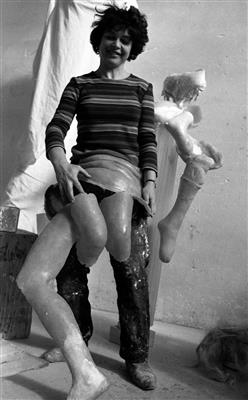
Alina Szapocznikow
- abstract art
- Feminist Art
Alina Szapocznikow survived three concentration camps (Auschwitz, Bergen-Belsen, and Terezín) before channelling that experience into some of the most unsettling sculpture of the postwar decades. Working in Prague and later Paris, she trained under Paul Niclausse and emerged in the late 1950s as an artist whose subject was relentlessly the body: its fragility, its pleasures, and its capacity to betray.
Biography
From the mid-1960s she abandoned traditional materials for polyester resin and polyurethane foam, casting fragments of her own and others' bodies: lips, stomachs, breasts and thighs, in configurations that were erotic and comic yet profoundly disturbing. Her Tumors Personified series (1966[1] onwards) confronted her own breast cancer diagnosis with extraordinary directness, rendering the disease as sculptural form. The Grands Ventres (1968) placed cast abdomens on lamp bases, colliding domestic function with corporeal self-examination.
Szapocznikow died of breast cancer in 1973[1], aged 46, and was largely forgotten for two decades. Her rediscovery came slowly, accelerating after 1989 with Poland's political opening and then dramatically with a MoMA retrospective in 2012–13. Her 1959[1] work Bird set an auction record for Polish sculpture when it sold in 2016.
She occupied a singular position in postwar art: too personal, too female, and too Eastern European for Nouveau Réalisme or Pop Art to absorb her fully. That outsider status may explain why institutions took so long to catch up.
Timeline
- 1926Born in Poland
- 1940Survived Auschwitz concentration camp
- 1945Survived Bergen-Belsen and Terezín concentration camps
- 1950Trained under Paul Niclausse in Prague
- 1960Moved to Paris
- 1966Began 'Tumors Personified' series after breast cancer diagnosis
- 1968Created 'Grands Ventres' series
- 1973Died of breast cancer at age 46
Next stop
Browse the movements →
Every movement in the collection, from the Renaissance to Pop art.
Related Artists


Frequently Asked Questions
What is Alina Szapocznikow known for?
Alina Szapocznikow is known for her sculptures of the body. From the mid-1960s, she cast fragments of her own and others' bodies in polyester resin and polyurethane foam. These configurations were erotic and comic, yet disturbing.What is Alina Szapocznikow's most famous work?
It is difficult to name one single work as Alina Szapocznikow's 'most famous'. She worked across a range of media and her career evolved considerably, making any definitive claim problematic. Early in her career, Szapocznikow created fairly conventional figurative sculptures. Later, she became known for more experimental pieces using materials such as polyester resin and polyurethane. These works often explored the human body, particularly fragments and torsos, in ways that challenged traditional sculptural forms. Her use of unconventional materials and her focus on the body set her apart from many of her contemporaries. While there isn't one single piece that overshadows all others, her later body-focused sculptures are among her most discussed and studied works.What should I know about Alina Szapocznikow's prints?
Alina Szapocznikow (1926[1]-1973[1]) was a Polish artist known for sculpture, but she also produced prints. She studied at the Academy of Fine Arts in Prague, and later in Paris. While she explored various media, her prints offer a unique perspective on her artistic concerns. Like many printmakers, Szapocznikow likely created limited editions of her prints. The size of an edition is determined by the artist, and each print in an edition is considered an original. These are numbered (for example, 12/25) and traditionally signed in pencil. The number indicates its place in the sequence (12th print of 25). Szapocznikow's prints may reflect themes present in her sculptures, such as the human body and its decay. Her work often incorporated unconventional materials, and it is possible that she experimented with printmaking techniques as well. Given her background in sculpture, her prints might explore texture and form in innovative ways.What style or movement did Alina Szapocznikow belong to?
Alina Szapocznikow's artistic affiliations are complex, as her career intersected with several movements, though she is not primarily associated with Feminist Art[1]. Some sources mention her connection to Nouveau Réalisme. This movement, active for about a decade, included artists like Niki de Saint Phalle. Although de Saint Phalle was the only "official" female member, other women artists created work that aligned with its philosophy. Szapocznikow's practice also anticipates aspects of Feminist Art, which gained momentum in the 1960s. Feminist artists address female experience, often employing materials and approaches traditionally considered "women's work", such as sewing or embroidery. Some artists chose explicitly sexual or erotic imagery, while others favoured realism or conceptual approaches. The movement examines themes like birth, motherhood, and the objectification of women.What techniques or materials did Alina Szapocznikow use?
Alina Szapocznikow employed a range of materials and techniques in her sculptural practice. Traditional materials such as bronze and marble appear in her earlier work. Later, she became known for her experimental use of unconventional materials, especially plastics. Szapocznikow explored the possibilities of polyester resin, polyurethane foam, and other synthetic substances. These enabled her to cast body parts and create distorted, fragmented forms. She sometimes combined these with found objects or incorporated photographs into her sculptures. Her methods included casting, moulding, and assemblage. The use of these materials allowed her to explore themes of the body, sexuality, and decay in innovative ways. She challenged traditional notions of sculpture by using ephemeral and industrial materials.What was Alina Szapocznikow known for?
Alina Szapocznikow (1926[1]-1973[1]) was a Polish artist known for her sculptures of organic forms. She explored themes of the body, sexuality, and transience through unconventional materials such as polyester resin, polyurethane foam, and photographs embedded in her sculptures. Szapocznikow's early work reflected socialist realism, but she later developed a more personal and experimental style. She often focused on fragmented body parts, creating casts of breasts, bellies, and legs. These works challenged traditional representations of the female form and explored the impact of illness and decay on the body. Her practice gained attention for its innovative use of materials and its exploration of difficult subjects. Although her career was cut short by her early death, Szapocznikow's work has had a significant impact on contemporary sculpture and feminist art. Her pieces continue to be exhibited and studied internationally.When did Alina Szapocznikow live and work?
Alina Szapocznikow was born in 1926[1] and died in 1973[1]. She was a Polish sculptor, born in Kalisz, Poland. Her career began in the postwar period and continued until her early death at the age of 46. Szapocznikow studied at the Academy of Fine Arts in Prague. Early in her career, her sculptures were mostly figurative, often in bronze. Later, she began incorporating new materials such as polyester resin, polyurethane foam, and found objects. These later works often explored themes related to the body, sexuality, and transience. Szapocznikow's work gained attention in Poland and internationally during the 1960s and 1970s. She represented Poland at the Venice Biennale in 1962[1]. Her art continues to be exhibited and reassessed in the context of feminist and body-centred art histories.Where can I see Alina Szapocznikow's work?
While it is difficult to say exactly where works by Alina Szapocznikow are permanently displayed, many museums include Art Deco works. These include institutions in the United States, the United Kingdom, and Europe. In the United States, you can view Art Deco at the Charles Hosmer Morse Museum of American Art (Winter Park, Florida), the Los Angeles County Museum of Art (Los Angeles), the Metropolitan Museum of Art (New York), the Minneapolis Institute of Arts (Minneapolis), the Museum of Modern Art (New York), the Royal Ontario Museum (Toronto), the Virginia Museum of Fine Arts (Richmond), and the Wolfsonian at Florida International University (Miami Beach). In the United Kingdom, Art Deco pieces are on display at the Bakelite Museum (Williton), the Brighton Museum & Art Gallery (Brighton), the Geffrye Museum (London), the Manchester Art Gallery (Manchester), the National Museums of Scotland, Royal Museum (Edinburgh), and the Victoria & Albert Museum (London). You can also find Art Deco at the Bauhaus Archive-Museum für Gestaltung (Berlin), the Bauhaus Dessau Foundation (Dessau), the Bröhan-Museum (Berlin), the Kunstgewerbe Museum of Decorative Arts (Berlin), the MAK Austrian Museum of Applied Art/Contemporary Art (Vienna), the Museum beim Markt (Karlsruhe), and the Museum für Kunst und Gewerbe (Hamburg).Where was Alina Szapocznikow from?
Alina Szapocznikow was Polish. She was born in Kalisz, Poland, in 1926[1] to a Jewish family. During the Second World War, Szapocznikow and her mother were confined in Nazi concentration camps, including Auschwitz, Bergen-Belsen, and Theresienstadt. After the war, in 1945[1], she studied at the Academy of Fine Arts in Prague before returning to Poland in 1947. She then continued her studies in Paris. Szapocznikow initially produced social realist sculptures, in line with the aesthetic expectations of the Soviet Bloc. By the 1960s, her work shifted towards more personal and experimental forms, often using unconventional materials like polyester resin. She explored themes of the body, transience, and memory in her sculptures. She died in 1973[1].Who did Alina Szapocznikow influence?
Alina Szapocznikow's influence is complex, with no direct line of students or artistic followers. However, her innovative use of materials and her focus on the body, particularly its fragmented and abject forms, have resonated with later artists. Szapocznikow's exploration of the human form connects to the work of Magdalena Abakanowicz, who also created sculptures of human figures, often faceless, using materials like burlap and resin. Abakanowicz's figures convey a loss of individuality. Szapocznikow's interest in unusual materials aligns with the practice of Jean Dubuffet. Dubuffet's use of materials such as sponges, metal foil, and polyurethane served as a model for artists like Yves Klein and Claes Oldenburg. Klein used raw pigment, gold leaf, and sponges; Oldenburg charred his early figures and used plaster-soaked muslin.Who was Alina Szapocznikow?
Alina Szapocznikow (born in Kalisz, Poland, in 1926[1]; died in Praz-Coutant, France, in 1973[1]) was a Polish artist known for her sculptures. Szapocznikow survived imprisonment in concentration camps during the Second World War. After the war, she studied art; first in Prague, then in Paris. Initially, Szapocznikow produced figurative bronzes in a socialist realist style, such as *Friendship* (1953[1]). By the 1960s, her work became more personal and experimental. She began using new materials such as polyester resin and polyurethane foam. These allowed her to cast directly from the human body. Her later sculptures often incorporated fragmented body parts, such as breasts and stomachs, combined with everyday objects. These works explored themes of physicality, sexuality, and mortality. In pieces such as *Tumours Personified* (1971), she directly addressed her own experience with cancer. Szapocznikow's distinctive approach has gained increased recognition since her death.
Sources
Editorial draws on the following primary and tertiary references for Alina Szapocznikow.
- [1] wikipedia Wikipedia: Alina Szapocznikow Used for: biography, birth dates, death dates, identifiers, movement attribution, nationality.
- [2] book guggenheim-masterp00solo Used for: biography.
- [3] book guggenheim-refigur00kren Used for: biography.
- [4] book guggenheim-twopri00weis Used for: biography.
Editorial overseen by Solis Prints. Sources verified 2026-09-30. Click a source for details, or hover over [N] in the page above to preview.
Editorial standardsMethodologyCorrectionsAI disclosureAbout the editorial team