

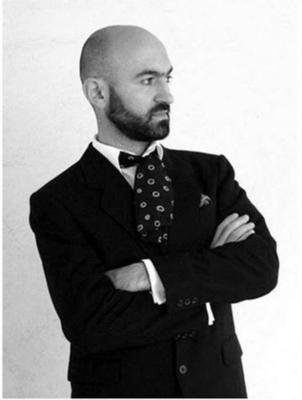
Dumitru Gorzo
Dumitru Gorzo grew up in Ieud, a village in the Maramureș region of northern Romania, an area known for its intact wooden-church architecture and living folk traditions. He studied at the Bucharest National University of Arts, graduating in 1999 after training under painter Florin Mitroi, and quickly became one of the more provocative figures in the Romanian[1] contemporary art scene.
Biography
In 2001 he represented Romania at the Venice Biennale, and two years later staged Cocoons, a guerrilla installation in which he glued 350 plaster larva-like figurines to walls across central Bucharest overnight. Romanian[1] television covered it. In 2006 he had a solo exhibition at the National Museum of Contemporary Art (MNAC) in Bucharest, which toured to the Brukenthal National Museum in Sibiu. He also co-founded Rostopasca, a collective that helped define a generation of Romanian contemporary practice.
His paintings are satirical, sexually explicit, and politically pointed, drawing on imagery that circulates at the margins of official culture: folk carving, graffiti, erotic illustration, religious iconography repurposed for uncomfortable ends. His sculptural work often incorporates found objects and hand-carved wooden reliefs that reference Maramureș folk traditions while pulling against them.
Gorzo divides his time between Bucharest and Brooklyn. His work has been shown internationally, and he remains a figure who courts controversy deliberately, treating it as part of the practice.
Timeline
- 1975Born in Ieud, Maramureș region, Romania, an area known for wooden churches and folk traditions.
- 1999Graduated from the Bucharest National University of Arts after studying with Florin Mitroi.
- 2001Represented Romania at the Venice Biennale.
- 2003Staged "Cocoons", a guerrilla installation in Bucharest, gluing 350 plaster figurines to walls.
- 2006Had a solo exhibition at the National Museum of Contemporary Art (MNAC) in Bucharest, which then toured to the Brukenthal National Museum in Sibiu.
- 2006Co-founded Rostopasca, an art collective.
Next stop
Browse the movements →
Every movement in the collection, from the Renaissance to Pop art.
Related Artists


Frequently Asked Questions
What is Dumitru Gorzo known for?
Dumitru Gorzo is known for his satirical, sexually explicit, and politically pointed paintings and sculptures. His sculptural work often incorporates found objects and hand-carved wooden reliefs that reference Maramureș folk traditions.What is Dumitru Gorzo's most famous work?
It is difficult to name Dumitru Gorzo's single most famous work, as his notability rests on his wider contribution to contemporary art. Born in Romania, Gorzo is known for his expressionistic style and use of colour. He often incorporates found objects and unconventional materials into his sculptures and paintings. This approach results in art that is both visually striking and thought-provoking. Gorzo's body of work includes paintings, sculptures, and installations. His pieces frequently explore themes of identity, memory, and the human condition. He has exhibited extensively in Europe and the United States, securing his place in the international art world. His art can be found in various public and private collections.What should I know about Dumitru Gorzo's prints?
Dumitru Gorzo is a Romanian[1]-American artist known for his sculptures and paintings. He also produces prints, often related to his larger works. Born in Romania in 1975[1], Gorzo studied at the University of Bucharest. He then moved to New York in the early 2000s. His work frequently combines abstraction with figurative elements. Recurring themes include mythology, personal history, and social commentary. Gorzo’s prints share stylistic qualities with his paintings. Expect bold colours, energetic lines, and layered compositions. His imagery often features distorted figures and symbolic objects. Gorzo uses printmaking to explore ideas present in his other works, sometimes creating variations on existing paintings or sculptures. These prints offer collectors a more accessible entry point into Gorzo's artistic vision. They also provide insight into his working methods. Gorzo’s prints have been exhibited in galleries and museums internationally, alongside his paintings and sculptures.What style or movement did Dumitru Gorzo belong to?
Dumitru Gorzo is associated with Neo-Expressionism, a style that emerged in the late 1970s and early 1980s. This movement marked a return to figuration and expressive brushwork after the dominance of Minimalism and Conceptual art. Neo-Expressionist artists often explored themes of alienation, identity, and social commentary through raw, emotionally charged imagery. Their works typically feature bold colours, distorted forms, and a rejection of traditional aesthetic values. The style is characterised by a subjective and often angst-ridden approach to art-making. While Neo-Expressionism was an international phenomenon, it had distinct regional variations. Gorzo's work, created in Romania, reflects the specific cultural and political context of Eastern Europe during that period. His art often incorporates elements of folklore, mythology, and personal experience, resulting in a unique and powerful visual language.What techniques or materials did Dumitru Gorzo use?
The materials an artist uses have a direct influence on the character of their work. Each material requires a specific approach, and the technique employed shapes the work's form and substance. The same colour will appear different depending on whether it is rendered in watercolour, oil, tempera, or fresco. Similarly, media of design, such as lead pencil, charcoal, chalks, and pastels, each have a decisive influence on the formal structure of the work. These materials are not interchangeable; their physical and chemical structure dictates how they must be handled and the effect that can be expected. Artists make choices about materials based on the effect they wish to achieve. The artist is the sole judge of the possibilities inherent in the material they use. However, once a material is selected and integrated into the work, it must be used according to its own nature. The artist's choice of material will significantly determine the character of their future work.What was Dumitru Gorzo known for?
Dumitru Gorzo is a Romanian[1] artist known for his association with the New Figuration movement. This style, which gained prominence in the late 1960s and 1970s, marked a departure from pure abstraction, reintroducing recognisable imagery into painting and sculpture. Gorzo's work often incorporates elements of social commentary and personal narrative. He frequently employs bold colours and expressive brushwork to create works that are both visually striking and emotionally charged. His subject matter ranges from portraits and figures to symbolic representations of contemporary life. Although specific details regarding Gorzo's training and influences are not provided in the reference texts, the broader context of Romanian art during the latter half of the 20th century is relevant. The Romanian avant-garde experienced periods of both suppression and relative freedom under the communist regime. Artists often navigated these constraints through coded symbolism and subtle critiques of authority.Where can I see Dumitru Gorzo's work?
It is difficult to provide a comprehensive list of places where you can view Dumitru Gorzo's work, as gallery holdings are subject to change. However, many major museums and galleries have collections of modern and contemporary art. You could begin by exploring the collections of institutions such as the Metropolitan Museum of Art (New York), the Los Angeles County Museum of Art, the Minneapolis Institute of Arts, or the Museum of Modern Art (New York). In Canada, the Royal Ontario Museum (Toronto) and the Art Gallery of Ontario (Toronto) may hold relevant works. European options include the Victoria & Albert Museum (London), the National Museums of Scotland (Edinburgh), and the Musée d’Orsay (Paris). Several museums in Germany also collect modern art, such as the Bauhaus Archive in Berlin.Where was Dumitru Gorzo from?
Dumitru Gorzo was Romanian[1]. During the Second World War, a series of laws were passed in Romania that aggravated human rights and discriminated against Jewish citizens. Within the Surrealist group, of which Gorzo was a member, three authors were Jewish, and all five were Leftists. Consequently, apart from Gellu Naum, who was drafted, the others were forced to pursue their activities clandestinely. They shared ideas, research topics, obsessions, occult experiments, blind drawings and creative principles, while keeping in sync with what they thought to be the larger methodological and theoretical tenets of Surrealism. At the end of World War Two, the Bucharest Surrealists broke their silence for a short while. Between 1945 and 1947, they took advantage of the political confusion and founded the Surrealist Collection, where they self-published books and plaquettes at the Infra-Noir and Éditions de l’Oubli printing houses. They also organised an eponymous exhibition accompanied by the manifesto Infra-noir.Who did Dumitru Gorzo influence?
Dumitru Gorzo's influence is not well documented. However, abstract expressionist painter Arshile Gorky (1904-1948[1]) had an impact on the New York art scene. Although unappreciated during his life, younger painters in New York invoked and imitated Gorky a few years after his death at age forty-four. These artists wanted to preserve traditional draughtsmanship and elegance for abstract painting. However, some critics have argued that Gorky concluded rather than originated something. They suggest that anyone who imitates him risks academicism. Thomas Couture (1815-1879), an independent artist and teacher, also influenced artists with his unconventional attitudes towards light, shade, and immediacy. His most famous pupil was Édouard Manet (1832-1883), who absorbed Couture's techniques and spontaneity. Couture encouraged his students to work rapidly and simply, capturing the first vivid impression. He often suppressed detail and half-tones to achieve direct spontaneity. His brushwork was lively, with colours dragged in thick confident strokes and forms reduced to broad masses outlined in strong contours.Who influenced Dumitru Gorzo?
A comprehensive list of Dumitru Gorzo's influences is not available in the provided texts. However, the references offer some context regarding artistic movements and individuals that may have connections to his work. Expressionism, Futurism, and Cubism are listed as broad movements with numerous associated figures. Expressionism, as an international literary phenomenon, included writers, composers, and artists such as Guillaume Apollinaire, Ernst Barlach, Max Beckmann, and Marc Chagall. Futurism, an Italian movement, included Umberto Boccioni and Carlo Carra. Cubism included Pablo Picasso and Albert Gleizes. Other artists listed include Paul Gauguin, Francisco Goya, El Greco, Wassily Kandinsky, Ernst Ludwig Kirchner, Paul Klee, Henri Matisse, Michelangelo Buonarroti, and Constantin Brancusi. This list is not exhaustive, and further research would be needed to determine the specific impact, if any, of these individuals or movements on Gorzo's artistic development.Who was Dumitru Gorzo?
Dumitru Gorzo (born 1975[1]) is a Romanian[1] artist working in painting and sculpture. He is associated with the "New Romanian Painting" movement, which emerged in the early 2000s. Gorzo studied at the University of Art and Design in Cluj-Napoca, Romania, a centre for contemporary art education. He graduated in 2000. His work often incorporates found objects and explores themes related to social and political issues in post-communist Romania. He frequently uses recycled materials in his sculptural pieces, reflecting a concern with consumerism and waste. Gorzo's paintings are characterised by bold colours and gestural brushstrokes. His style blends abstraction with figurative elements. He has exhibited his work in solo and group exhibitions internationally, including shows in Vienna, Berlin, and New York. His art can be found in both private and public collections. He currently lives and works in both Bucharest and New York.Why are Dumitru Gorzo's works important today?
Dumitru Gorzo is a Romanian[1] artist who came to prominence in the late 20th century. Born in 1975[1], he is known for his sculptural works and paintings that often incorporate found objects and recycled materials. Gorzo's art is important because it engages with themes of consumerism, waste, and cultural identity in a post-communist society. His practice involves transforming discarded items into artworks, prompting viewers to reconsider their relationship with material culture. This approach aligns with contemporary concerns about sustainability and environmental awareness. His art also reflects on the social and political changes that Romania has experienced since the fall of communism. By using materials that evoke the past, he creates a dialogue between history and the present. Gorzo's work has been exhibited internationally, contributing to discussions about Eastern European art and its place in the global art world. His ability to blend social commentary with artistic innovation makes his work relevant to current audiences.
Sources
Editorial draws on the following primary and tertiary references for Dumitru Gorzo.
- [1] wikipedia Wikipedia: Dumitru Gorzo Used for: biography, birth dates, death dates, identifiers, movement attribution, nationality.
- [2] book Beard, Lee, 1973- author, Butler, Adam, author; Van Cleave, Claire, author; Fortenberry, Diane, author; Stirling, Susan, author, Beard, Lee, 1973- author, Butler, Adam, author; Van Cleave, Claire, author; Fortenberry, Diane, author; Stirling, Susan, author - The Art Book_ New Edition, Mini Format Used for: biography.
- [3] book guggenheim-refigur00kren Used for: biography.
- [4] book Masterpieces of western art : a history of art in 900 individual studies from the Gothic to the present day Used for: biography.
- [5] book Kirsten Strom;, The Routledge Companion to Surrealism Used for: biography.
- [6] book Kirsten Strom, (ed.), THE ROUTLEDGE COMPANION TO SURREALISM Used for: biography.
Editorial overseen by Solis Prints. Sources verified 2026-08-31. Click a source for details, or hover over [N] in the page above to preview.
Editorial standardsMethodologyCorrectionsAI disclosureAbout the editorial team