

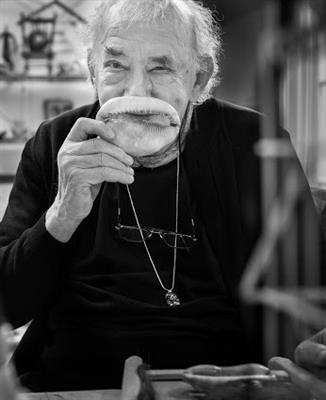
Daniel Spoerri
Born Daniel Isaac Feinstein in Galaţi, Romania, in 1930[1], Spoerri had a childhood shaped by displacement and loss: his father was killed in 1941[1] after Romania joined the Axis, and his mother fled to Switzerland the following year with six children. Adopted by his uncle Theophil Spoerri, he took the family name that would become one of the most idiosyncratic in postwar European art.
Biography
He trained as a classical dancer under Olga Preobrajenska and became a lead dancer at the Bern State Opera in 1954[1], but by the end of the decade he had moved to Paris and settled into Room 13 of the Hôtel Carcassonne on the Rue Mouffetard, using the cramped space as home, studio, and gallery. It was there, in 1960, that he produced his first Tableau-Piège (snare-picture): at the end of a meal, he glued every remaining object to the tabletop and hung the board vertically on the wall, so that plates, cutlery, and leftover food appeared to defy gravity. The first of these, *Kichka's Breakfast*, is now in MoMA's permanent collection. Early viewers, confronted with photographs of the work, reportedly assumed the objects had been painted on, the conceptual leap that the detritus of life could itself be art was not yet obvious.
Spoerri was a founding signatory of Nouveau Réalisme on 27 October 1960[1], alongside Yves Klein, Jean Tinguely, and Arman. His contribution to the movement was a natural extension of his snare-pictures: a conviction that the real world, consumed and used, was already saturated with meaning. This led logically to Eat Art. In 1963 he turned a Paris gallery into a functioning restaurant, with critics as waiters and the meal's leftovers becoming raw material for new work. By 1970 he had opened the Eat-Art-Gallery in Düsseldorf above Restaurant Spoerri, arguing that eating was itself a performative act. The 1964 snare-picture commemorating a meal with Marcel Duchamp sold at auction in 2008 for €136,312.
His 1962[1] publication *An Anecdoted Topography of Chance* catalogued 80 objects on his Hôtel Carcassonne table at a precise moment, 3:47 p.m. on 17 October 1961, each annotated with personal digressions. Emmett Williams translated it into English in 1966 and it became a cult classic of conceptual writing. A 1990 retrospective at the Centre Georges Pompidou toured five European venues. He spent his final decades at Il Giardino di Daniel Spoerri, the 16-hectare sculpture garden he created near Seggiano in Tuscany in 1997, which holds works by Nam June Paik, Meret Oppenheim, and Dieter Roth. He died in November 2024[1], aged 94.
Timeline
- 1930Born Daniel Isaac Feinstein in Galaţi, Romania.
- 1941His father was killed after Romania joined the Axis.
- 1942His mother fled to Switzerland with six children; he was later adopted by his uncle Theophil Spoerri.
- 1954Became a lead dancer at the Bern State Opera.
- 1960Produced his first Tableau-Piège (snare-picture), "Kichka's Breakfast", in Room 13 of the Hôtel Carcassonne in Paris.
- 1960Became a founding signatory of Nouveau Réalisme, alongside Yves Klein, Jean Tinguely, and Arman.
- 1963Turned a Paris gallery into a functioning restaurant, with critics as waiters.
- 1970Opened the Eat-Art-Gallery in Düsseldorf above Restaurant Spoerri.
- 1990A retrospective at the Centre Georges Pompidou toured five European venues.
- 1997Created Il Giardino di Daniel Spoerri, a sculpture garden near Seggiano in Tuscany.
- 2024Died in November, aged 94.
Notable Works
Tap to view larger.
Next stop
Fluxus →
Explore the artists and ideas of Fluxus.
Related Artists


Frequently Asked Questions
What is Daniel Spoerri known for?
Daniel Spoerri is known for his 'snare-pictures' (Tableau-Piège), in which he glued objects, such as leftover meals, to a tabletop and displayed it as art. He is also known for Eat Art; in 1963[1], he turned a Paris gallery into a functioning restaurant, with critics as waiters, and he later opened the Eat-Art-Gallery in Düsseldorf.What was Daniel Spoerri's art style?
Daniel Spoerri's art style involved capturing real-world objects and experiences, such as leftover meals, and presenting them as art. His 'snare-pictures' and Eat Art demonstrate his conviction that everyday life is already saturated with meaning.When was Daniel Spoerri born?
Daniel Spoerri was born in 1930[1].
Sources
Editorial draws on the following primary and tertiary references for Daniel Spoerri.
- [1] wikipedia Wikipedia: Daniel Spoerri Used for: biography, birth dates, death dates, identifiers, movement attribution, nationality.
- [2] book guggenheim-amsterdamparisdu00solo Used for: biography, stylistic analysis.
- [3] book guggenheim-invested00blis Used for: biography, stylistic analysis.
- [4] book Braun, Emily, 1957-; Asor Rosa, Alberto; Royal Academy of Arts (Great Britain), Italian art in the 20th century : painting and sculpture, 1900-1988 Used for: biography.
- [5] book Masterpieces of western art : a history of art in 900 individual studies from the Gothic to the present day Used for: biography, stylistic analysis.
Editorial overseen by Solis Prints. Sources verified 2026-10-07. Click a source for details, or hover over [N] in the page above to preview.
Editorial standardsMethodologyCorrectionsAI disclosureAbout the editorial team