



Dorothea Lange
- social realism
She made the most reproduced photograph in history while working for the US government for ten dollars a day. "Migrant Mother" (1936[1]), taken at a pea-pickers' camp in Nipomo, California, showed Florence Owens Thompson nursing an infant alongside her two older children. Lange submitted the image to a San Francisco newspaper; it prompted emergency food shipments within days.
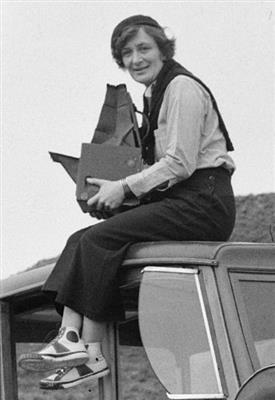
Biography
Born Dorothea Margaretta Nutzhorn in Hoboken, New Jersey in 1895[1], she contracted polio at age seven, leaving a permanent limp she later described as "the most important thing that happened to me." She changed her surname to her mother's maiden name Lange after her father abandoned the family. Training under photographer Clarence H. White in New York, she opened a portrait studio in San Francisco in 1919[1] and built a steady trade photographing the city's elite.
The Depression changed everything. Seeing unemployed men queuing outside a soup kitchen from her studio window, Lange took her camera into the street. The resulting photographs caught the attention of Paul Taylor, a Berkeley economist (whom she would later marry), who helped secure her a position with the Federal Resettlement Administration, later the Farm Security Administration. Between 1935[1] and 1942 she produced thousands of images documenting migrant labourers, tenant farmers, and displaced families across the American[1] West.
When Japanese Americans were forced into internment camps following Pearl Harbor, Lange documented this process for the War Relocation Authority. Her photographs were promptly classified and suppressed by the Army, and most were not seen publicly until decades later. She received a Guggenheim Fellowship in 1952[1] and continued working until cancer curtailed her in 1964. A retrospective at MoMA opened in 1966, the year after her death, cementing her position as one of the twentieth century's defining documentary photographers.
Timeline
- 1895Born Dorothea Margaretta Nutzhorn in Hoboken, New Jersey.
- 1902Contracted polio at age seven, resulting in a permanent limp.
- 1919Opened a portrait studio in San Francisco after training with Clarence H. White in New York.
- 1935Began working for the Federal Resettlement Administration, later the Farm Security Administration, documenting migrant labourers and displaced families.
- 1936Took "Migrant Mother" at a pea-pickers' camp in Nipomo, California.
- 1942Documented the internment of Japanese Americans for the War Relocation Authority; these photographs were classified and suppressed.
- 1952Received a Guggenheim Fellowship.
- 1964Her work was curtailed by cancer.
- 1965Died, aged 70.
- 1966A retrospective of her work opened at MoMA.
Notable Works
Tap to view larger.
Next stop
Browse the movements →
Every movement in the collection, from the Renaissance to Pop art.
Related Artists




Frequently Asked Questions
What is Dorothea Lange known for?
Dorothea Lange is known for her documentary photography, especially her images of migrant labourers, tenant farmers, and displaced families during the Depression. Her photograph "Migrant Mother" is one of the most reproduced photographs in history, and it prompted emergency food shipments when it was published.What is Dorothea Lange's most famous work?
Dorothea Lange is best known for her Depression-era photographs, especially "Migrant Mother, Nipomo, California". Taken in March 1936[1] at the Pea-Pickers Camp in the Nipomo Valley, the image shows a mother with her children. Lange made five exposures of the woman and her children, getting closer with each shot. She did not record the subject's name, but the woman told Lange that she was 32 years old and that her family had been living off frozen vegetables and birds. She had sold her car's tyres to buy food. Lange was working for the Resettlement Administration, and her photographs were available to American[1] newspapers. "Migrant Mother" captured the strength and worry in the face of a young, careworn mother. After it appeared in a San Francisco newspaper, food was rushed to Nipomo to help the workers. Lange's photographs aimed to document the harsh conditions in migrant labour camps and provoke government intervention. Her images had a dramatic impact on public opinion and influenced Franklin Delano Roosevelt's administration to create government camps in California for migrant workers.What should I know about Dorothea Lange's prints?
When considering Dorothea Lange's prints, bear in mind that photographic prints are classified according to when they were made. A 'vintage print' means the photograph was printed around the time the negative was taken. A 'period print' is one made within roughly ten to fifteen years of the shot. Anything printed later is termed an 'old print' or a 'modern print'. An 'original print' is one the artist made themselves, or one made under their direct supervision. A 'facsimile' is a print made by re-photographing a print, or using the original negative, using the same materials as the original. In photography, the status of an 'original' work has some ambiguity, because the process allows for duplicates. However, the market generally considers a print 'original' if the photographer executed it personally. Some photographers did not print their own photographs; however, if they signed the print, it was considered original. The number of prints in a print run was not usually restricted for photographers of Lange's generation.What style or movement did Dorothea Lange belong to?
Dorothea Lange is associated with documentary photography, particularly that which arose from the New Deal era in the United States. After the 1929[1] stock market crash, many photographers turned their attention to the suffering caused by the Great Depression. Lange followed the homeless, especially those displaced from their farms during the Dust Bowl period. Her photographs aimed to capture poignant moments, communicating human experiences and emotions. One example is her well-known photograph, "Migrant Mother, California" (1936). Lange's field notes described the subject as a 32-year-old mother of seven, camped at a pea field after the crop had failed. She had sold the tyres from her car to buy food. Lange's images brought the problems of poverty to a wide audience. Her work, along with other Farm Security Administration photographers, was part of a broader "documentary imagination" that sought to engender cultural nationalism during the New Deal. This documentary style aimed to capture the texture of reality in Depression-era America, connecting the American[1] people with their culture.What techniques or materials did Dorothea Lange use?
Dorothea Lange is best known for her photography documenting the Great Depression. Working for the Resettlement Administration, she captured images of migrant workers and labour camps in California. In March 1936[1], at a Pea-Pickers Camp in Nipomo, California, Lange created her famous photograph, "Migrant Mother, Nipomo, California". She spent about ten minutes taking six shots. Lange stated that she worked closer and closer to her subject with each exposure. Lange's work, along with that of Walker Evans, Arthur Rothstein, and Ben Shahn, aimed to document the experiences of those who had fled the Dust Bowl in Oklahoma and Texas, seeking work on farms in California. Her photographs had a dramatic impact on public opinion. They influenced Franklin Delano Roosevelt's administration to authorise the creation of government camps for migrant workers in California.What was Dorothea Lange known for?
Dorothea Lange is known for her documentary photography, particularly her images of the Great Depression era in the United States. Working for the Farm Security Administration (FSA), she recorded the difficult conditions in the country's agricultural sector. Lange's photographs went beyond simple documentation; they captured the suffering of farm labourers with considerable aesthetic power. Her images had a direct impact on public awareness. One photograph, "Migrant Mother, Nipomo, California", taken in March 1936[1], became an iconic representation of the Depression. Lange described being drawn to the "hungry and desperate mother" at a Pea-Pickers Camp. She made five exposures, and the image, published in a San Francisco newspaper, brought the plight of rural communities to national attention. The image depicts a mother holding a baby, with two older children clinging to her. Lange noted the woman's strength and worry. Following the photograph's publication, food was rushed to Nipomo to aid the hungry workers. Lange's work aimed to provoke change and government intervention, capturing human suffering in an unsentimental way.When did Dorothea Lange live and work?
Dorothea Lange was an American[1] photographer and photojournalist, active from the 1920s until her death in 1965[1]. She was born in 1895[1] and is best known for her Depression-era work. During the Great Depression, Lange worked for the Resettlement Administration (RA). Her job was to document the suffering of migrant workers, many of whom had fled the Dust Bowl region of Oklahoma and Texas. These people sought work in California's farms and orange groves. Lange's work with the RA, alongside photographers such as Walker Evans and Arthur Rothstein, helped to define the era for many Americans. One of her most recognised photographs, 'Migrant Mother, Nipomo, California', was taken in 1936[1]. It captures the despair and hardship of the period. Later, after the Pearl Harbor bombing, Lange documented the forced relocation of Japanese Americans into internment camps. The U.S. Army impounded around 800 of these photographs, fearing public backlash.Where can I see Dorothea Lange's work?
Many institutions hold examples of Lange's photography; however, their holdings may not always be on display. Several museums with significant photography collections include work by Lange. These are the Museum of Modern Art (MoMA) in New York; the National Museum of American[1] History, Smithsonian Institution, in Washington, DC; and the National Museum of Photography, Film & Television, in Bradford, England. Other museums with works by Lange include the Metropolitan Museum of Art, New York; the Minneapolis Institute of Arts; the George Eastman House, International Museum of Photography and Film, in Rochester, New York; the Philadelphia Museum of Art; the National Gallery of Art, Washington; the Library of Congress; and the Yale University Art Gallery in New Haven, Connecticut. Always check a museum's website to confirm that works by a particular artist are on display.Who did Dorothea Lange influence?
Dorothea Lange's work had a demonstrable effect on public opinion and government policy during the Depression era. Her photographs of migrant workers, commissioned by the Resettlement Administration, were widely published in newspapers. They brought the plight of the poor to the attention of a broad audience. Her images spurred the Roosevelt administration to create government camps for migrant workers in California. Beyond direct political effects, Lange's documentary approach influenced later photographers. Her unposed, uncropped images of people, such as "Migrant Mother, California" (1936[1]), captured poignant moments of human emotion. This approach, combined with a strong sense of social justice, impacted photojournalism. The photographers working for *Life* magazine, such as Margaret Bourke-White and Alfred Eisenstaedt, also helped to give photography its identity. Later photographers merged photography with text and media messages.Who influenced Dorothea Lange?
Dorothea Lange (1895[1]-1965[1]) began taking photographs after the 1929[1] stock market crash. She documented the suffering of the poor during the Depression. Her approach, which combined compassion with direct honesty, brought social problems to the attention of a wide audience. Her photographs, such as "Migrant Mother, California" (1936), captured poignant moments in the lives of those displaced from their farms. Lange's work was part of a broader movement of photographers who moved away from pictorialism and toward "straight" unretouched photography. This approach valued the directness of the medium, rather than trying to mimic painting through lens or lighting tricks. Alfred Stieglitz, with his photograph "The Steerage", championed this method. He saw photography as a search for truth. Edward Weston moved away from commercial photography to focus on stark images and simple shapes rendered with exactness.Who was Dorothea Lange?
Dorothea Lange (1895[1]-1965[1]) was an American[1] photojournalist. She is best known for her Depression-era photographs, which captured the suffering of migrant workers and the rural poor. Lange worked for the US Government’s Farm Security Administration, documenting the impact of the Depression on the agricultural economy. The stock market crash of 1929[1] hit the Mid-West particularly hard, with falling prices and infertile soil creating a 'Dust Bowl'. Many families left their farms to seek work elsewhere. Lange's photographs had a dramatic impact. They brought the plight of rural communities to public attention and prompted government intervention. Her photographs, available to all American newspapers, influenced public opinion and led to the creation of government camps in California for migrant workers. Her most famous photograph, "Migrant Mother, Nipomo, California", was shot in March 1936 at a Pea-Pickers Camp. Lange spent only ten minutes taking six shots. The image, published in a San Francisco newspaper, alerted the government to the conditions in the camps and resulted in food aid being sent. Lange's work continues to define the Great Depression for many.What was Dorothea Lange's art style?
According to one passage, Dorothea Lange captured human suffering in unsentimental yet powerful ways.
Sources
Editorial draws on the following primary and tertiary references for Dorothea Lange.
- [1] wikipedia Wikipedia: Dorothea Lange Used for: biography, birth dates, death dates, identifiers, movement attribution, nationality.
- [2] book Jesse Bryant Wilder, MA, MAT, Art History For Dummies Used for: biography, stylistic analysis.
- [3] book Fred S. Kleiner, Gardner's Art through the Ages Used for: biography.
- [4] book Penny Huntsman, Thinking About Art Used for: biography, stylistic analysis.
Editorial overseen by Solis Prints. Sources verified 2026-09-22. Click a source for details, or hover over [N] in the page above to preview.
Editorial standardsMethodologyCorrectionsAI disclosureAbout the editorial team