

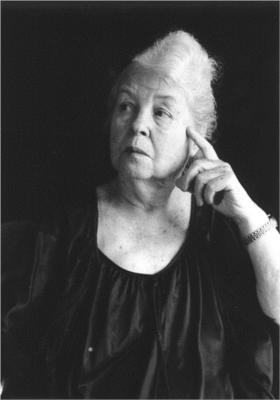
Alice Neel
- Expressionism
- anarchism
- social realism
Alice Neel spent five decades painting portraits the art establishment largely refused to look at. Through the Abstract Expressionist years, when figurative work was unfashionable, she continued depicting the people around her in Spanish Harlem with a directness that sometimes unsettled her sitters. Recognition came only in the mid-1970s, when she was already in her seventies; she went on to have sixty solo exhibitions in the last two decades of her life.
Biography
Neel grew up in Pennsylvania and enrolled at the Philadelphia School of Design for Women, where she was taught by Robert Henri of the Ashcan School. After marrying the Cuban painter Carlos Enríquez in 1925[1], she moved to Havana and became involved with the Cuban Vanguardia movement. Their daughter Santillana died of diphtheria just before her first birthday. When Enríquez left for Paris in 1930 he took their second daughter, Isabetta, back to Cuba. Neel suffered a breakdown and attempted suicide, was hospitalised, and eventually returned to New York.
She supported herself through the Works Progress Administration under Roosevelt's New Deal and used the period to paint street scenes and the lives of working people. She deliberately moved to Spanish Harlem in order to connect with, as she put it, "real people." Her method was demanding: she made subjects sit for hours in silence, waiting for raw emotion to surface. "Even if I'm not working," she said, "I'm still analysing people. If I hadn't been an artist, I could have been a psychiatrist."
Her portrait of the poet Frank O'Hara (1960[1], National Portrait Gallery, Smithsonian) is one of her most discussed works: a narrow vertical canvas at 86 x 41 cm in which the scale gives the figure an uneasy, compressed presence.
Timeline
- 1900Born in Pennsylvania
- 1925Married Cuban painter Carlos Enríquez and moved to Havana
- 1930Suffered breakdown and attempted suicide after husband left for Paris
- 1930Hospitalized and returned to New York
- 1930Daughter Isabetta taken to Cuba by her father
- 1930Daughter Santillana died of diphtheria
- 1930Became involved with the Cuban Vanguardia movement
- 1930Supported herself through the Works Progress Administration
- 1960Painted portrait of Frank O'Hara
- 1970Recognition came in mid-1970s
- 1984Died
Notable Works
Tap to view larger.
Next stop
Expressionism →
Explore the artists and ideas of Expressionism.
Related Artists



Frequently Asked Questions
What is Alice Neel known for?
Alice Neel became known for her portraits and figures, expressing the human condition through line and colour. Recognition only occurred in the last two decades of her life, though, when she had sixty solo shows. Stripes also make a cameo in many of Neel’s paintings, a through line among the subjects of varying backgrounds who sat for her.Who was Alice Neel?
Alice Neel was born in Pennsylvania and studied at the Philadelphia School of Design for Women. After losing one baby and having her Cuban husband take another back to his homeland in 1930[1]-31, she suffered a nervous breakdown and attempted suicide. She went on to have two illegitimate sons by different men, and she continued to paint, though she only gained recognition in her mid-seventies.How did Alice Neel die?
Alice Neel died in 1984[1] at the age of 84.
Sources
Editorial draws on the following primary and tertiary references for Alice Neel.
- [1] wikipedia Wikipedia: Alice Neel Used for: biography, birth dates, death dates, identifiers, movement attribution, nationality.
- [2] book McGraw-Hill, Art In Focus Used for: biography.
- [3] book Beard, Lee, 1973- author, Butler, Adam, author; Van Cleave, Claire, author; Fortenberry, Diane, author; Stirling, Susan, author, Beard, Lee, 1973- author, Butler, Adam, author; Van Cleave, Claire, author; Fortenberry, Diane, author; Stirling, Susan, author - The Art Book_ New Edition, Mini Format Used for: biography.
- [4] book Hodge, Susie, 1960- author, The short story of women artists : a pocket guide to movements, works, breakthroughs, & themes Used for: biography.
Editorial overseen by Solis Prints. Sources verified 2026-09-22. Click a source for details, or hover over [N] in the page above to preview.
Editorial standardsMethodologyCorrectionsAI disclosureAbout the editorial team