

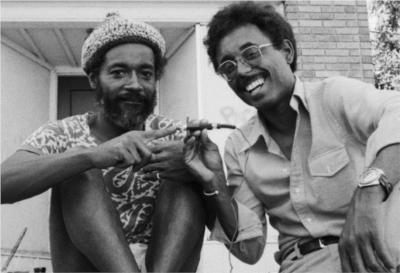
David Hammons
- Postmodernism
- contemporary art
- conceptual art
David Hammons occupies a singular position in American[1] art: a Conceptual artist who spent decades deliberately avoiding the gallery system that would eventually embrace him, preferring to present work in Harlem barbershops and neighbourhood stores. Born in Springfield, Illinois in 1943[1], he moved to Los Angeles as a child and studied at the Chouinard Art Institute before relocating to New York in the late 1960s. His early body prints, made by pressing himself against paper coated with margarine and pigment, established an intimate, physical relationship between the artist's Black body and the mark it left on the world.
Biography
His 1982 installation Higher Goals, originally sited in his Harlem neighbourhood, remains one of the most discussed works in American[1] public art. Forty-foot basketball hoops, too high to be usable, were decorated with bottle caps in geometric patterns evoking African beadwork and wind chimes referencing Native American spirit catchers. The work grew from a conversation with local teenagers who told him that sport was their ticket out; Hammons made the hoop literally unreachable while filling the surrounding air with the cultural references those same teenagers were walking past.
Public Enemy (1991), made for MoMA, worked differently: visitors entered what felt like a festive environment of crunching autumn leaves and drifting helium balloons before encountering large photographs of a Roosevelt monument flanked by a Black man and a Native American[1] man cast as servants, the arrangement ringed by sandbags with guns pointing inward. It is characteristic Hammons: draw you in with sensory pleasure, then confront you with something you cannot unsee.
Through the 1990s and 2000s Hammons remained deliberately hard to exhibit, selling snowballs on a Manhattan pavement and staging events that evaporated before critics could review them. His eventual absorption into the institutional mainstream has not dulled the work's edge, and an auction record stretching into the millions reflects the scarcity he engineered long before he appeared to care about the market.
Timeline
- 1943Born in Springfield, Illinois.
- 1960Studied at the Chouinard Art Institute in Los Angeles.
- 1960Moved to New York in the late 1960s.
- 1982Created the installation "Higher Goals" in Harlem, featuring basketball hoops decorated with bottle caps.
- 1990During the 1990s and 2000s, Hammons sold snowballs on a Manhattan pavement.
- 1991Created "Public Enemy" for MoMA, featuring autumn leaves, helium balloons, and photographs of a Roosevelt monument.
Notable Works
Tap to view larger.
Next stop
Browse the movements →
Every movement in the collection, from the Renaissance to Pop art.
Related Artists




Frequently Asked Questions
What is David Hammons known for?
David Hammons is known for his conceptually driven art that often combines sharp social commentary with sensory elements. He is also known for creating installations that address racism in American[1] society, such as Public Enemy, which was created for an exhibition at the Museum of Modern Art.Who was David Hammons?
David Hammons is a Conceptual artist who spent decades avoiding the gallery system, choosing instead to present his work in Harlem barbershops and neighbourhood stores. Born in 1943[1], he moved to Los Angeles as a child and studied at the Chouinard Art Institute before relocating to New York in the late 1960s. He is known for his unique approach to art and his eventual absorption into the institutional mainstream.What was David Hammons's art style?
David Hammons is a Conceptual artist. He is known for his installations that combine sharp social commentary with sensory elements.When was David Hammons born?
David Hammons was born in 1943[1].
Sources
Editorial draws on the following primary and tertiary references for David Hammons.
- [1] wikipedia Wikipedia: David Hammons Used for: biography, birth dates, death dates, identifiers, movement attribution, nationality.
- [2] book Fred S. Kleiner, Gardner's Art through the Ages Used for: biography, stylistic analysis.
- [3] book Penelope J.E. Davies, Walter B. Denny, Frima Fox Hofrichter, Joseph Jacobs, Ann S. Roberts, David L. Simon, Janson's History of Art_ The Western Tradition (8th Edition) Used for: biography, stylistic analysis.
- [4] book Jordana Moore Saggese, Reading Basquiat: Exploring Ambivalence in American Art Used for: biography.
- [5] book Landauer, Susan, The not-so-still life : a century of California painting and sculpture Used for: biography.
Editorial overseen by Solis Prints. Sources verified 2026-10-07. Click a source for details, or hover over [N] in the page above to preview.
Editorial standardsMethodologyCorrectionsAI disclosureAbout the editorial team