



Christian August Lorentzen
Christian August Lorentzen arrived at history painting by way of a watchmaker's workshop in Sønderborg and a lengthy study tour through the Low Countries. The chronology matters: his three years in the Netherlands, Antwerp, and Paris from 1779[1] to 1782, spent copying Old Masters, gave him the technical grounding that would shape Danish[1] official art for a generation.
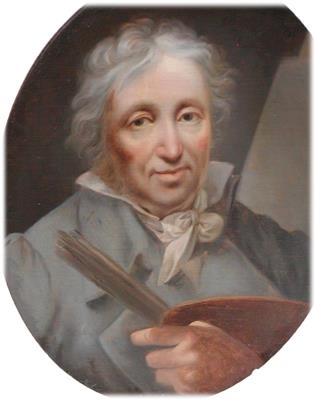
Biography
Back in Copenhagen, Lorentzen settled into the orbit of the Royal Danish[1] Academy of Fine Arts, where he became professor in 1803[1] and then, briefly, director in succession to Nicolai Abildgaard in 1809 to 1810. The timing was not coincidental. Denmark had just endured the British bombardment of Copenhagen in 1807, and Lorentzen was among the artists who attempted to give those events a monumental form.
His Slag på Reden (Battle of Copenhagen, 1801[1]) commemorates the earlier naval confrontation of that year, while Den rædsomste nat (The Awful Night, 1807), now in the National Gallery of Denmark, takes the shelling as its subject directly. Both works show a painter at ease with large-scale composition and the conventions of history painting, even when the events were still raw.
Lorentzen also painted the legend of Dannebrog falling from heaven during the Battle of Lindanise (1809[1]), giving Denmark its flag myth in Neoclassical dress. His portraits and scenes from Ludvig Holberg's comedies round out a career that influenced the following generation, including Martinus Rørbye. He died in Copenhagen in 1828[1].
Timeline
- 1749Born in Denmark.
- 1779Began a three-year study tour through the Low Countries, Antwerp, and Paris to copy Old Masters.
- 1782Returned to Copenhagen from his study tour.
- 1801Painted "Slag på Reden (Battle of Copenhagen, 1801)", commemorating the naval confrontation.
- 1803Became a professor at the Royal Danish Academy of Fine Arts in Copenhagen.
- 1807Painted "Den rædsomste nat (The Awful Night, 1807)", depicting the British bombardment of Copenhagen; it is now in the National Gallery of Denmark.
- 1809Became director of the Royal Danish Academy of Fine Arts in Copenhagen, succeeding Nicolai Abildgaard.
- 1809Painted the legend of Dannebrog falling from heaven during the Battle of Lindanise.
- 1810Ended his term as director of the Royal Danish Academy of Fine Arts.
- 1828Died in Copenhagen at 79.
Notable Works
Tap to view larger.
Next stop
Neoclassicism →
Explore the artists and ideas of Neoclassicism.
Related Artists


Frequently Asked Questions
What is Christian August Lorentzen known for?
Christian August Lorentzen is known for giving monumental form to historical events, particularly those surrounding the British bombardment of Copenhagen in 1807[1]. He is also recognised for his history paintings, portraits, and scenes from Ludvig Holberg's comedies. His work influenced the following generation of artists.What should I know about Christian August Lorentzen's prints?
Christian August Lorentzen (1749[1]-1828[1]) was a Danish[1] painter and printmaker. Prints declared to the Printsellers’ Association included artist proofs (no engraved title, Association stamp on the lower left), lettered proofs (title lightly engraved, Association stamp on the lower right), presentation proofs (maximum of twenty-five), proofs before letters (no title, but with names of artist/engraver), and remarque artist proofs (a device in the margin). Since 1890, photographic halftone illustrations and commercial print technology have evolved, creating high-quality reproductions of images in other forms. Print technology has become increasingly sophisticated; facsimiles, reproductions, and photocopies are readily available, sometimes accompanied by creative marketing techniques that may confuse buyers. It is important to know the difference between a print and a reproduction.What style or movement did Christian August Lorentzen belong to?
Christian August Lorentzen (1749[1]-1828[1]) was a Danish[1] painter who worked during the late Neoclassical period. This movement drew inspiration from the art and culture of ancient Greece and Rome. Neoclassicism[1] emerged as an alternative to the Rococo style. In Denmark, early Neoclassical architecture can be seen in the Amalienborg Palace in Copenhagen, built between 1750[1] and 1754. The architect C.F. Harsdorff was the first Scandinavian to move away from French Rococo elements towards a purer form of Neoclassicism. Another prominent figure was Christian Frederik Hansen, often called the "Palladio of Denmark". Hansen designed the Town Hall and Courts in Copenhagen from 1805 to 1815, providing the latter with a broad facade oriented towards the Kongens Nytorv. The building included an impressive portico with Ionic columns on the central axis.What techniques or materials did Christian August Lorentzen use?
Information regarding Christian August Lorentzen's specific artistic techniques is scarce. However, by looking at the general practices of artists during his period, we can infer some potential methods. During the Renaissance, artists employed diverse materials. Fresco involved painting on wet plaster, while sculpture utilised marble, wood, or clay. Printmaking techniques included woodcut, etching, and engraving. The artist would draw on a woodblock, and a carver would cut away the blank areas, leaving a ridge. The printer would apply ink to the raised image and transfer it to paper. Etching involved applying an acid-resistant ground to a metal plate, scratching a design into it, and then bathing the plate in acid. Engraving used a burin to cut directly into a metal plate. The plate would be inked, wiped, and then transferred to paper. Oil paints were becoming more widespread, offering new possibilities for colour and finish. Artists mixed pigments with oils like linseed or walnut, and sometimes added varnishes to alter transparency and drying times.What was Christian August Lorentzen known for?
Christian August Lorentzen (1749[1]-1828[1]) was a Danish[1] history and genre painter. He trained at the Royal Danish Academy of Fine Arts, winning medals for life drawing in 1769[1] and 1772. Lorentzen is best known for dramatic, large-scale depictions of battles and military scenes. He became a professor at the Academy in 1803 and served as its director from 1822 to 1823. His pupils included such artists as J.C. Dahl and Martinus Rørbye. Among Lorentzen's most recognised works are paintings that present events from Danish and Norwegian military history. These include "The Battle of Copenhagen, 2 April 1801" (painted 1806-1807[1]) which commemorates the British Royal Navy's attack on the Danish fleet. He also produced paintings of more contemporary events, such as scenes from the Napoleonic Wars. Beyond his military subjects, Lorentzen painted genre scenes and portraits.When did Christian August Lorentzen live and work?
Christian August Lorentzen was born on 14 August 1749[1] in Sønderborg, Denmark. He died on 8 August 1828[1] in Copenhagen. Lorentzen's artistic career began with studies at the Copenhagen Academy. He is associated with both Neoclassicism[1] and Romanticism. Lorentzen became a history painter, and he also produced portraits and theatrical designs. He gained recognition for his battle scenes, particularly those depicting naval engagements. Examples include his paintings of the Battle of Copenhagen (1801[1]). He became a professor at the Copenhagen Academy in 1803, influencing a new generation of Danish[1] artists. His work provides a window into the artistic and political climate of Denmark during a period of significant change in Europe.Where can I see Christian August Lorentzen's work?
It is difficult to pinpoint exactly where you can view works by Christian August Lorentzen. However, many major museums hold collections of art from the periods in which he was active. In the United States, you might check the collections of the Metropolitan Museum of Art in New York, the Los Angeles County Museum of Art (LACMA), the Minneapolis Institute of Arts, the Museum of Modern Art in New York, the Virginia Museum of Fine Arts, the Charles Hosmer Morse Museum of American Art, or the Wolfsonian at Florida International University. In Canada, the Royal Ontario Museum could be a place to view his work. In the United Kingdom, possible locations include the Brighton Museum & Art Gallery, the Geffrye Museum, the Manchester Art Gallery, the National Museums of Scotland Royal Museum in Edinburgh, and the Victoria & Albert Museum in London.Where was Christian August Lorentzen from?
Christian August Lorentzen was Danish[1]. Denmark and Sweden experienced tensions between the King, clergy, and nobility following the Reformation. In 1523, the exile of the Catholic King Christian II in Denmark enabled his uncle, Frederick I, to take control and bring Lutheran Protestants to the throne. The monarchy and nobility engaged in political manoeuvring for power in the following decades, with economic and political control eventually secured in a hereditary monarchy. To maintain his rule, the King needed a steady income source. The Sound Dues, a toll on ships passing through the Øresund, the narrow strait between Denmark and Sweden leading to the Baltic Sea, provided up to two-thirds of the monarch’s income in the 16th and 17th centuries. Ships paid up to two percent of their cargo's value, risking cannon fire if they refused. This toll enabled King Frederick II to expand Kronborg, the 15th-century fortress in Helsingør, starting in 1574.Who did Christian August Lorentzen influence?
Christian August Lorentzen (1749[1]-1828[1]) taught at the Academy of Fine Arts in Copenhagen for many years. As a professor, he instructed a generation of Danish[1] painters in the late eighteenth and early nineteenth centuries. Among his pupils were several artists who achieved recognition. These included historical and portrait painter Christian Albrecht Jensen, who later became a well-regarded portraitist. Another student was landscape painter Johan Christian Dahl, although Dahl is better known for his later association with Caspar David Friedrich. The sculptor Hermann Ernst Freund also studied under Lorentzen. Lorentzen's emphasis on history painting and his academic approach shaped the early artistic development of these and other artists. His influence is most evident in the work of those who initially pursued history painting before branching into other genres. His instruction provided a foundation in technique and subject matter that influenced their subsequent careers, even as they moved in different artistic directions.Who influenced Christian August Lorentzen?
Christian August Lorentzen (1749[1]-1828[1]) was a Danish[1] painter who trained at the Royal Danish Academy of Fine Arts. He is often associated with Nicolai Abildgaard, a leading figure in Danish Neoclassicism[1]. Abildgaard, who became a professor at the Academy, certainly impacted Lorentzen's artistic development. Lorentzen's early work shows the influence of French Rococo. Later, he moved toward history painting and battle scenes. These later paintings reflect an interest in dramatic composition and the depiction of movement. Some scholars suggest parallels with French painters such as Jacques-Louis David, particularly in the emphasis on clarity and heroic themes. However, direct evidence of David's impact on Lorentzen is limited. Lorentzen's time in Paris exposed him to diverse artistic styles. This broadened his perspective and contributed to his stylistic range. While specific influences are debated, it is clear that Lorentzen synthesised elements from various sources, including Danish, French, and possibly other European traditions.Who was Christian August Lorentzen?
Why are Christian August Lorentzen's works important today?
Christian August Lorentzen (1749[1]-1828[1]) was a Danish[1] history painter. He is remembered today for his dramatic, Romantic-style depictions of historical events, particularly battles and military scenes. Lorentzen's paintings offer insights into the political and military history of late 18th- and early 19th-century Europe. He trained at the Royal Danish Academy of Fine Arts, winning several medals. Lorentzen became a professor at the Academy in 1803[1] and served as its director from 1822 to 1823. His notable works include paintings of the Battle of Copenhagen (1801) and scenes from the Napoleonic Wars. These paintings captured moments of national importance and contributed to the construction of Danish identity during a turbulent period. His art provides a visual record of significant historical episodes.
Sources
Editorial draws on the following primary and tertiary references for Christian August Lorentzen.
- [1] wikipedia Wikipedia: Christian August Lorentzen Used for: biography, birth dates, death dates, identifiers, movement attribution, nationality.
- [2] book Getty Conservation Institute, Ancient and Historic Metals: Conservation and Scientific Research, part 1 of 3 Used for: biography.
- [3] book Art, the ape of nature : studies in honor of H. W. Janson Used for: biography.
- [4] book Palmer, Allison Lee, Historical Dictionary of Neoclassical Art and Architecture Used for: biography.
- [5] book Masterpieces of western art : a history of art in 900 individual studies from the Gothic to the present day Used for: biography.
Editorial overseen by Solis Prints. Sources verified 2026-10-15. Click a source for details, or hover over [N] in the page above to preview.
Editorial standardsMethodologyCorrectionsAI disclosureAbout the editorial team