



Chris Burden
- conceptual art
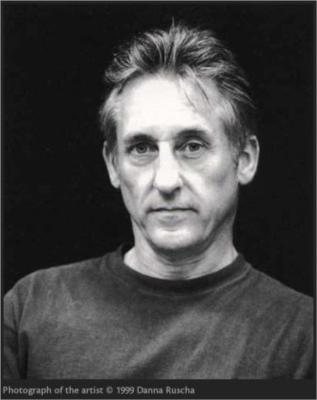
Chris Burden completed his MFA thesis at UC Irvine in 1971[1] by locking himself inside a two-foot-square locker for five days. It was, by any measure, a warm-up. The same year he had a friend shoot him in the left arm with a .22 rifle in front of a live audience at a Los Angeles gallery. The work, titled Shoot, made him almost immediately the most discussed and most contested artist in America.
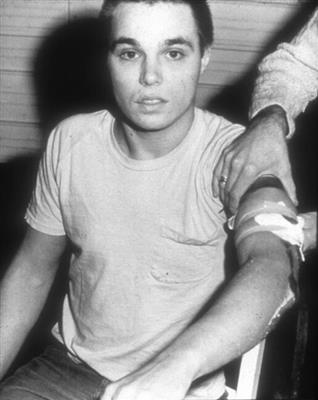
Biography
Throughout the 1970s, Burden tested the limits of what a body could be made to do in the name of art. He had nails driven through his hands while lying on a Volkswagen Beetle (Trans-Fixed, 1974[1]); he lay motionless under a slanted glass sheet at Chicago's Museum of Contemporary Art for more than 45 hours (Doomed, 1975); he fired pistol shots at a Boeing 747 climbing out of LAX (747, 1973). David Bowie, struck by the VW piece, wrote Joe the Lion as a direct response.
By the late 1970s Burden had shifted toward large-scale engineered sculpture. He accepted a Guggenheim Fellowship in 1978[1] and joined UCLA's faculty the same year. His later work is as physically imposing as his early performances, but the violence is now structural. Samson (1988) connected a 100-ton hydraulic jack to a museum turnstile: each visitor who entered fractionally compressed the jack against the supporting walls. Urban Light (2008), 202 restored antique street lamps arranged outside LACMA, has become one of the most photographed public artworks in the United States.
His final decade produced Metropolis II (2011[1]), a kinetic cityscape through which 1,100 toy cars circulate at the equivalent of 240 miles per hour, and Ode to Santos Dumont (2015[1]), a working dirigible completed just before his death. A retrospective, Chris Burden: Extreme Measures, ran at the New Museum in 2013. Burden died in Topanga Canyon, California, on 10 May 2015, eighteen months after a melanoma diagnosis. He was sixty-nine.
Timeline
- 1946Born in 1946.
- 1971Completed his MFA thesis at UC Irvine by locking himself inside a small locker for five days.
- 1971Staged the performance "Shoot" in Los Angeles, where he was shot in the arm with a .22 rifle.
- 1973Staged the performance "747", firing pistol shots at a Boeing 747 at LAX.
- 1974Staged the performance "Trans-Fixed", having nails driven through his hands while lying on a Volkswagen Beetle.
- 1975Performed "Doomed" at Chicago's Museum of Contemporary Art, lying motionless under a glass sheet for over 45 hours.
- 1978Accepted a Guggenheim Fellowship.
- 1978Joined UCLA's faculty.
- 1988Created "Samson", a sculpture connecting a hydraulic jack to a museum turnstile.
- 2015Died in Topanga Canyon, California, aged 69, after a melanoma diagnosis.
Notable Works
Tap to view larger.
Next stop
Browse the movements →
Every movement in the collection, from the Renaissance to Pop art.
Related Artists


Frequently Asked Questions
What is Chris Burden known for?
Chris Burden is known for testing the limits of what a body could be made to do in the name of art. Some of his early performances involved violence, such as having a friend shoot him in the arm with a .22 rifle.What should I know about Chris Burden's prints?
Chris Burden (1946[1]-2015[1]) was an American[1] artist known for his performance, sculpture, and installation work. While he is most recognised for his often dangerous and provocative performance pieces of the 1970s, his practice also included printmaking, though prints are a less well-known aspect of his output. Burden's prints often relate to his larger sculptural projects. For example, his print *Dodge '71* (1998[1]) is a lithograph depicting a modified Dodge truck, a vehicle that featured in several of his sculptures exploring engineering and transportation themes. Another print, *The Velvet Water Tank* (2002), relates to a large-scale installation of the same name. These prints are not mere reproductions; they function as extensions of his sculptural ideas, offering different perspectives on his three-dimensional works. His prints are characterised by technical precision and a conceptual approach. Burden used printmaking to further investigate ideas present in his sculpture, creating works that are both visually compelling and intellectually engaging.What style or movement did Chris Burden belong to?
Chris Burden is associated with Conceptual Art, which gained traction in the late 1960s and early 1970s. Conceptual artists believed the core idea of a work was more important than a finished product. Some even eliminated the art object altogether. As Sol LeWitt stated, 'The idea itself, even if not made visual, is as much a work of art as any finished product.' Conceptual Art is an umbrella term. It covers diverse movements that are neither painting nor sculpture. It emphasises the artist's thinking, not manipulation of materials. Any action or thought can be considered Conceptual Art, as long as the idea, rather than the art object, is paramount. Burden's work involved risk-taking activities. One example is when he had a friend shoot him in the arm with a .22 rifle. Such pieces challenged accepted definitions of art.What techniques or materials did Chris Burden use?
Chris Burden's artistic practice involved a wide array of techniques and materials, often incorporating elements of his background in industrial skills. His early work involved metal, including lead, brass, and aluminium, combined with stone and coral. He employed gas and arc welding, mirroring methods used in locomotive construction, favouring efficiency in achieving a functional form. Burden's approach to materials was not aesthetic, but functional. He aimed to use materials in the most efficient way possible, similar to locomotive building. He had no interest in tool marks or surface decoration. His workshop resembled a small factory, equipped with tools of the same quality as those used in industrial production. His experience as a telephone linesman, including cable work and lead casting, influenced his artistic choices. He also worked in a factory setting, gaining experience with lathes, spot welders, and milling machines. This background informed his later constructions, where he turned to steel for its strength.What was Chris Burden known for?
Chris Burden was an American[1] artist associated with Conceptual art, which gained traction in the late 1960s and early 1970s. Conceptual artists believed the idea behind a work was more important than the object itself; Burden explored this through performance and sculpture. Burden's work often involved risk and physical endurance. To "explore" violence, he once had a friend shoot him in the arm with a .22 rifle in front of an audience at a Los Angeles gallery. In another piece, "Doorway to Heaven" (1973[1]), he grounded live electric wires to his bare chest, creating a display of sparks. Conceptual art encompasses diverse media, including performance, video, earth art, and text. Other conceptual artists include Joseph Beuys, Sol LeWitt, and Bruce Nauman.When did Chris Burden live and work?
Chris Burden was born on 29 July 1950[1] in Gallipolis, Ohio. He appears to have remained active as an artist through the early 1990s. His early work included performance art. One performance from 1971 was titled *Synthetic Ritual*. Another, *Split-Man Bisects the Pacific*, took place in 1974 in the ruins of the Sutro Baths in San Francisco. In 1975, he performed *Splitting the Axis* at the University Art Museum, University of California, Berkeley. In March 1976, he performed *Within the Nucleus* at the San Francisco Museum of Modern Art. In March 1977, he performed *The Principle of the Arch* at The Institute for Art and Urban Resources at P.S. 1, Long Island City, New York.Where can I see Chris Burden's work?
Chris Burden's pieces have been included in many group exhibitions at institutions around the world. In the United States, his work has been seen at the Museum of Modern Art, the Whitney Museum of American[1] Art, and the Hirshhorn Museum and Sculpture Garden (Smithsonian Institution) in Washington, D.C. Other locations include the Los Angeles County Museum of Art, the Seattle Art Museum, the Indianapolis Museum of Art, and the Albright-Knox Art Gallery (Buffalo, New York). Burden's art has also been exhibited internationally. Documenta in Kassel, Germany, has included his pieces, as have the Musée d'Art Moderne de la Ville de Paris, the Stedelijk Museum (Amsterdam), the Tate Gallery (Liverpool), and the Venice Biennale.Where was Chris Burden from?
Chris Burden was born in Boston, Massachusetts, in 1946[1]. He later lived in California, where he received his BFA from Pomona College in 1969[1] and his MFA from the University of California, Irvine, in 1971. Burden's early performance pieces often involved inflicting pain or risk upon himself, testing the limits of the body and the boundaries of art. These actions, such as *Five Day Locker Piece* (1971), where he locked himself in a locker for five days, and *Shoot* (1971), where he had an assistant shoot him in the arm, gained him notoriety. Later in his career, Burden shifted his focus to large-scale sculptures and installations, often incorporating engineering and technology. He lived in Topanga Canyon, California, later in life.Who did Chris Burden influence?
Chris Burden's performance and conceptual works from the 1970s influenced a number of artists who explored the body as a medium, and the relationship between art, the body, and technology. His performances, such as *Shoot* (1971[1]), staged at the F Space Gallery in Santa Ana, California, had a sensational character. Some critics felt that *Shoot* exemplified performance art in general, associating it with brutality and self-mutilation. Burden's explorations of the body and technology also resonate in the work of artists like Bruce Nauman, who used his own body in performance sequences involving video and audio effects. Nauman's *Self-Portrait as a Fountain* (1966-67/1970) echoes the visual punning of Marcel Duchamp's *Urinal*. Other artists influenced by Burden's explorations of the ephemeral and the remote include Roni Horn, with *Vatnasafn / Library of Water* (2007), and Michael Heizer, with *Levitated Mass* (2012).Who influenced Chris Burden?
Chris Burden's work, particularly his performance art of the 1970s, can be viewed in the context of other artists exploring the body as a medium. These include Vito Acconci, Marina Abramovic, Bruce Nauman, and Gina Pane. Burden's practice also relates to Conceptual art, which, according to Scott Burton, freed artists from traditional constraints such as painting or sculpture. Burton saw Conceptual art as enabling his own work, and he felt indebted to Minimal artists such as Judd, Lewitt, and Andre. Other artists who engaged with time-based and embodied art during this period include Hans Haacke, Walter De Maria, Nancy Holt, Dennis Oppenheim, Robert Smithson, Günter Brus, Hermann Nitsch, Rudolf Schwarzkogler, Adrian Piper, and Martha Rosier. Marcel Duchamp's work, specifically his "Tonsure", also had an impact on artists exploring body art.Who was Chris Burden?
Chris Burden (1946[1]-2015[1]) was an American[1] artist working in performance and sculpture. He is often associated with conceptual art[1], where the idea behind the work takes precedence over traditional aesthetic concerns. Burden gained notoriety for his often dangerous and physically challenging performance pieces in the 1970s. These actions were intended to push physical limits and explore themes of violence, pain, and the relationship between the artist and audience. One such performance, titled *Shoot* (1971[1]), involved Burden being shot in the arm with a rifle. In *Transfixed* (1974), he had himself nailed to a car in a crucifixion pose. *Doorway to Heaven* (1973) saw him ground live electrical wires on his chest. His work sought to remove art from what he saw as an elitist sphere, bringing it into a world of danger. Some interpret his explorations of pain as a reflection of broader political concerns, referencing the Vietnam war. Later in his career, Burden created large-scale sculptures and installations.Why are Chris Burden's works important today?
Chris Burden, a California performance artist and sculptor, explored violence and physical limits in his art. He aimed to remove art from elitism, bringing it into what he saw as the real world. Some of his actions involved danger and pain. In his 1971[1] performance piece, *Shoot*, Burden had himself shot in the arm by Bruce Dunlap in front of a small audience. In another work, *Doorway to Heaven* (1973), he grounded live electric wires on his bare chest. *Transfixed*, from 1974, involved him being nailed to a car in a crucifixion pose. Burden's art explored physical pain, drawing attention to the body and its limits. These often extreme acts evoked ideas including religious ritual, the limits of art, and a re-examination of the body. Physical pain was also used to point to broader political concerns. Even in practices not explicitly tied to politics, there was a complication of the lines between public and private experience, informed by the political climate.
Sources
Editorial draws on the following primary and tertiary references for Chris Burden.
- [1] wikipedia Wikipedia: Chris Burden Used for: biography, birth dates, death dates, identifiers, movement attribution, nationality.
- [2] book Carol Strickland and John Boswell, The Annotated Mona Lisa Used for: biography, stylistic analysis.
- [3] book Carol Strickland and John Boswell, The Annotated Mona Lisa Used for: biography, stylistic analysis.
- [4] book Carol Strickland and John Boswell, The Annotated Mona Lisa Used for: biography, stylistic analysis.
Editorial overseen by Solis Prints. Sources verified 2026-10-15. Click a source for details, or hover over [N] in the page above to preview.
Editorial standardsMethodologyCorrectionsAI disclosureAbout the editorial team