


Charles Spencelayh
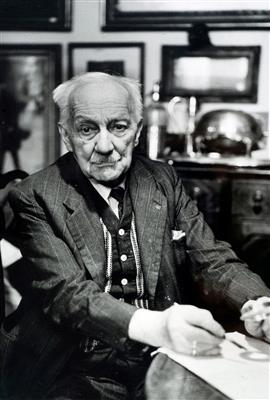
In 1939[1], at the age of 73, Charles Spencelayh won the Royal Academy's Picture of the Year with 'Why War?', a small domestic interior with nothing of propaganda in it. His subject was an old man, alone, reading a newspaper beside a cluttered shelf. It was typical of his approach: ordinary lives made extraordinary through near-photographic detail and patient observation.
Biography
Spencelayh trained at the National Art Training School in South Kensington and spent the bulk of his career documenting the interiors of working-class and lower-middle-class England. He exhibited over 70 paintings at the Royal Academy between 1892[1] and 1958[1], his final submission placed when he was 92. He also showed 129 miniatures at the Royal Society of Miniature Painters. Queen Mary was an avid collector and commissioned him to paint a miniature of George V in 1924 for the famous Lutyens-designed Queen's Dolls' House at Windsor.
His posthumous auction trajectory has been steep. 'The Old Dealer' sold for over £345,000 at Sotheby's in 2009, confirming the appetite among private collectors that had long existed. A retrospective at Rochester's Guildhall Museum in 2015 drew attention to the range of his output across seven decades. He died in 1958[1] having painted almost every year of his adult life.
Timeline
- 1865Born in England.
- 1892Began exhibiting at the Royal Academy.
- 1924Commissioned by Queen Mary to paint a miniature of George V for Queen's Dolls' House at Windsor.
- 1939Won the Royal Academy's Picture of the Year at 73 with 'Why War?', depicting an old man reading a newspaper.
- 1958Exhibited his final submission at the Royal Academy at 92.
- 1958Died in England.
Notable Works
Tap to view larger.
Related Artists
Frequently Asked Questions
What is Charles Spencelayh known for?
Charles Spencelayh is known for his detailed paintings of working-class and lower-middle-class English interiors. He is also known for winning the Royal Academy's Picture of the Year in 1939[1] with his painting 'Why War?'. Queen Mary commissioned him to paint a miniature of George V.What should I know about Charles Spencelayh's prints?
Charles Spencelayh (1865[1]-1958[1]) was a British[1] artist known for his detailed paintings of domestic interiors and everyday life. Although he primarily worked in oil paint, some of his works were reproduced as prints, allowing for wider distribution of his art. Prints of Spencelayh's paintings offer a way to appreciate his meticulous style at a lower price point than original artworks. These prints often capture the charm and nostalgia associated with his depictions of the past. They are collected for their historical interest and their representation of a bygone era. When considering a Spencelayh print, it is important to check its provenance and condition. Factors such as the printing technique (e.g. photogravure, lithograph), the paper quality, and the presence of any damage can affect its value. Prints signed by the artist are, as a rule, more desirable. Collectors should also research the specific image featured in the print, as some of Spencelayh's paintings are more sought after than others.What style or movement did Charles Spencelayh belong to?
Charles Spencelayh (1865[1]-1958[1]) was a British[1] painter associated with the art movements of realism and genre painting[1]. Realism seeks to depict subjects as they appear in everyday life, without idealisation or romanticisation. Genre painting portrays scenes from ordinary life. Spencelayh's work often featured detailed depictions of domestic interiors and everyday activities, executed with careful attention to detail. His style is characterised by its minute detail, small scale, and use of light to create atmosphere. Spencelayh's paintings often evoke a sense of nostalgia for a bygone era. His subjects included portraits, still lifes, and interior scenes, all rendered with a high degree of realism. Although he lived through periods of significant artistic change, Spencelayh remained committed to his representational style, setting him apart from many of his contemporaries who embraced modernism.What was Charles Spencelayh known for?
Charles Spencelayh was an English artist known for his detailed genre paintings, often depicting scenes of domestic life. Born in 1865[1], he developed a distinctive style characterised by its realism and attention to minute details. Spencelayh's paintings frequently featured interiors cluttered with objects, reflecting the everyday lives of ordinary people. He had a meticulous approach to his work, often spending considerable time on each piece to achieve the desired level of accuracy. His subjects ranged from intimate family moments to scenes of elderly people in their homes, capturing a sense of nostalgia and quiet observation. Although he received some recognition during his lifetime, Spencelayh's work gained wider appreciation in later years. His paintings offer a glimpse into the past, providing insight into the social customs and material culture of early 20th-century England. Spencelayh died in 1958[1].When did Charles Spencelayh live and work?
Charles Spencelayh (1865[1]-1958[1]) was a British[1] artist known for his detailed paintings of domestic interiors and everyday life. He was born in Rochester, Kent, and studied at the Royal College of Art in London. Spencelayh's artistic career spanned much of the 20th century. He began exhibiting his work in the late 19th century and continued to do so until his death. His paintings often depicted scenes from his own home and surroundings, featuring meticulously rendered objects and figures. He had a particular interest in depicting elderly people engaged in quiet activities, such as reading or sewing. His style is characterised by its realism and attention to detail. He employed a meticulous technique, building up layers of paint to create a smooth, almost photographic finish. This approach allowed him to capture the textures and surfaces of objects with great accuracy. Although his subject matter was often ordinary, his skill in rendering it elevated his work. He lived and worked primarily in London and later in Northamptonshire.Where can I see Charles Spencelayh's work?
To view the work of Charles Spencelayh, several museums have collections. In the United Kingdom, these include the Brighton Museum & Art Gallery (located in the Royal Pavilion Gardens), the Geffrye Museum (Kingsland Road, London), the Manchester Art Gallery (Mosley Street), the National Museums of Scotland (Royal Museum, Chambers Street, Edinburgh), and the Victoria and Albert Museum (Cromwell Road, London). In the United States, collections can be found at the Charles Hosmer Morse Museum of American Art (Winter Park, Florida), the Los Angeles County Museum of Art (LACMA), the Metropolitan Museum of Art (New York), the Minneapolis Institute of Arts, the Museum of Modern Art (New York), the Virginia Museum of Fine Arts (Richmond), and the Wolfsonian at Florida International University (Miami Beach).Where was Charles Spencelayh from?
Peter Lely, a Baroque-era portraitist, was born Pieter van der Faes in Soest, Westphalia. His parents were Dutch. Lely trained in Haarlem, possibly with Pieter de Grebber. He entered the painters’ guild in 1637. The exact date of Lely's arrival in England is uncertain, but estimated to be between 1641 and 1643. Initially, he worked as a landscapist and history painter. He soon shifted to portraiture, attracting patrons previously served by Anthony van Dyck. Lely adopted van Dyck’s painting style, which included shimmering draperies, loose brushwork, and a colour palette. By 1661, Lely was the principal painter for Charles II of England. His studio was very busy, requiring him to employ numerous assistants to manage commissions. Lely died at his easel after suffering a stroke.Who did Charles Spencelayh influence?
Charles Spencelayh's artistic style did not lend itself to direct imitation. However, he can be situated within a broader artistic context. The Pre-Raphaelite Brotherhood, with its emphasis on detailed realism and literary themes, influenced many subsequent artists. Figures such as Laurence Housman and Charles Ricketts took Pre-Raphaelite illustration in new directions, informing the Private Press movement's aesthetic of tasteful design. Stanley Spencer, a Neo-Primitive painter, shared Spencelayh's interest in depicting everyday life with spiritual undertones. Spencer, like Spencelayh, infused ordinary scenes with personal meaning, although Spencer's style was more stylised. David Jones, influenced by neo-Thomist theology, also explored the sacred in the quotidian, similar to Spencelayh's approach. Georges Rouault, while stylistically distinct, shared Spencelayh's focus on portraying the lives of ordinary people. Rouault aimed to express spiritual and Christian themes through modern aesthetics.Who influenced Charles Spencelayh?
It is difficult to identify specific influences on Charles Spencelayh. Claims of influence are often subjective, based on perceived similarities in style or subject matter. Without direct statements from the artist or detailed analysis from art historians, it is hard to make definitive claims about who influenced Spencelayh's artistic development. Some researchers examine the impact of various movements and artists on a particular artist's output. These can include the examination of the personages that grain pine boards, the grease spots on paper, or the creatures in foliage. Others may look at the statements of nature, the underlying structure, which forms the object, its whole or its parts, related by associations not yet befouled by commerce. However, without further information, it is impossible to state with certainty who influenced Spencelayh.Who was Charles Spencelayh?
Sir Stanley Spencer (1891[1]-1959[1]) was an English painter known for his unconventional approach to religious and figure painting. Born in Cookham, Berkshire, he often used this village as the setting for his works, even calling it 'the holy suburb of Heaven'. Spencer studied at the Slade School of Art in London. His artistic development was interrupted by his service in Macedonia during the First World War, an experience that later inspired some of his important works, including murals for the memorial chapel in Burghclere, Hampshire. During the Second World War, he worked as an official war artist, drawing inspiration from the shipyards of Glasgow. Spencer's paintings often caused controversy due to his unorthodox theology and views on sexual liberation. Examples of his work include *Resurrection, Cookham*. Despite the controversy, he was knighted in 1959, shortly before his death.Why are Charles Spencelayh's works important today?
It is difficult to discuss the importance of Charles Spencelayh without specific reference to his artistic style, themes, and historical context. However, some general observations can be made about the value of studying artists whose work may not be universally well-known today. The recovery of forgotten artists and the reassessment of their work is an ongoing process in art history. Changes in taste, new information, and revised historical perspectives can all contribute to a renewed appreciation for artists who were once overlooked. The dispersal of collections and the movement of artworks across borders mean that paintings can resurface in unexpected places, leading to new discoveries and attributions. Studying lesser-known figures such as Spencelayh can provide a more nuanced understanding of a particular period or artistic movement. Their work may reflect the tastes and concerns of a specific audience or community, offering insights into social and cultural history that are not apparent from the study of more famous artists alone. The accessibility of images and information through modern technology also makes it easier to compare works and trace influences, potentially leading to a re-evaluation of an artist's place in the broader art historical narrative.What was Charles Spencelayh's art style?
Charles Spencelayh's art style involved near-photographic detail and patient observation. He documented ordinary lives in the interiors of working-class and lower-middle-class England.
Sources
Editorial draws on the following primary and tertiary references for Charles Spencelayh.
- [1] wikipedia Wikipedia: Charles Spencelayh Used for: biography, birth dates, death dates, identifiers, movement attribution, nationality.
- [2] book Beard, Lee, 1973- author, Butler, Adam, author; Van Cleave, Claire, author; Fortenberry, Diane, author; Stirling, Susan, author, Beard, Lee, 1973- author, Butler, Adam, author; Van Cleave, Claire, author; Fortenberry, Diane, author; Stirling, Susan, author - The Art Book_ New Edition, Mini Format Used for: biography.
- [3] book Lilian H. Zirpolo, Historical Dictionary of Baroque Art and Architecture Used for: biography, stylistic analysis.
- [4] book Jennifer D. Milam, Historical Dictionary of Rococo Art Used for: stylistic analysis.
- [5] book Mark Lamster, Master of shadows Used for: biography.
- [6] book Post-impressionism : cross-currents in European painting Used for: biography.
- [7] book Beckett, Wendy, Sister Wendy's odyssey : a journey of artistic discovery Used for: biography.
Editorial overseen by Solis Prints. Sources verified 2026-06-22. Click a source for details, or hover over [N] in the page above to preview.
Editorial standardsMethodologyCorrectionsAI disclosureAbout the editorial team