



Aleksandr Deyneka
- still life
- landscape painting
- portrait
- genre painting
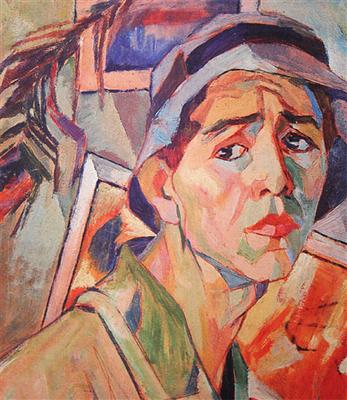
Aleksandr Deyneka was born in Kursk in 1899[1] and trained in Kharkov and Moscow, emerging in the early 1920s as one of the most formally inventive young painters in Soviet Russia. His first major grouping was OST (Society of Easel Artists), which he co-founded in 1925[1] alongside David Shterenberg, Yurii Pimenov, and others. OST positioned itself against both academic inertia and the more purely abstract tendency then dominant, its members, as one critic noted, supported an "almost expressionist presentation" of reality, and Deyneka's early work showed particular interest in German Expressionism, especially Otto Dix. He left OST in 1927, in part because the group's defence of easel painting conflicted with his own interest in applied and industrial art.
Biography
The canvas that defined his early reputation, *Defence of Petrograd* (1927[1], 218 x 359 cm, Central Museum of the Soviet Army), drew its compositional structure from Ferdinand Hodler's *The Departure of the Volunteers in 1813*, two horizontal registers, the top showing weary figures retreating, the lower showing soldiers marching in grim counterpoint. It became one of the canonical precursors of Socialist Realism. Yet Deyneka was never straightforwardly a propagandist. *Female Textile Workers* placed its efficient, trancelike workers against a factory window through which a pre-industrial cowherd was calmly visible; a 1930s painting of a farmwoman cycling through immaculate countryside carried, as Peter Leek observed, "a barely expressed hint of irony."
Deyneka visited Paris in 1935[1], created mosaics for Mayakovskaya metro station, and painted heroic wartime canvases including *The Defence of Sevastopol*. His 1964 reprise of the Petrograd theme abandoned poster-scale heroics for the linear austerity of his 1920s work. He died in Moscow in 1969[1], one of the few artists of his generation to have moved freely between monumental public art and a persistent, slightly oblique personal vision.
Timeline
- 1899Born in Kursk, Russia
- 1920Trained in Kharkov and Moscow
- 1925Co-founded OST (Society of Easel Artists)
- 1927Left OST due to conflicting interests
- 1927Painted *Defence of Petrograd*
- 1930Painted farmwoman cycling
- 1935Visited Paris
- 1941Painted *The Defence of Sevastopol*
- 1964Reprised Petrograd theme
- 1969Died in Moscow
Notable Works
Tap to view larger.
Next stop
Browse the movements →
Every movement in the collection, from the Renaissance to Pop art.
Related Artists

Frequently Asked Questions
What is Aleksandr Deyneka known for?
Aleksandr Deyneka is known for his painting *Defence of Petrograd* (1927[1]), which became one of the canonical precursors of Socialist Realism. He also created mosaics for Mayakovskaya metro station and painted heroic wartime canvases including *The Defence of Sevastopol*.What is Aleksandr Deyneka's most famous work?
Aleksandr Deyneka is known for paintings that depict Soviet life. One of his well-regarded works is *Defense of Petrograd*, from 1927[1]. This oil painting is in the collection of the Central Museum of the Soviet Army, Moscow. Some have noted its graphic, linear qualities. Others have observed that the composition and subject derive from Ferdinand Hodler’s 1908 painting *The Departure of the Volunteers in 1813*. Deyneka also produced poster art. The Lenin Library, Moscow, holds his two-part lithographic poster *Let's Turn Moscow into a Model Socialist City of the Proletariat!*. Deyneka was a member of the Society of Easel Artists (OST). This group rejected both abstraction and superficiality. They called for revolutionary subject matter and technical mastery. The goal was to have art participate in Socialist construction and cultural revolution.What should I know about Aleksandr Deyneka's prints?
Aleksandr Aleksandrovich Deyneka (1899[1]-1969[1]) was a Soviet Russian painter, graphic artist, and sculptor, regarded as a major figure in Socialist Realism. He is known for his depictions of industrial and agricultural labour, as well as scenes of sport and leisure, all rendered in a distinctive and accessible style. Deyneka trained at Kharkov Art School before attending VKhUTEMAS in Moscow. He helped found groups such as October, promoting proletarian art. His early work often employed a simplified, graphic style, influenced by photomontage and Constructivism. Prints after Deyneka's paintings offer a way to engage with his artistic vision at a more accessible price point than original paintings. Many of his most famous works, such as "The Defence of Petrograd" (1928[1]) and "The Battle of Sevastopol" (1942), were reproduced as posters and prints, widely distributed to promote Soviet ideals. These prints often possess historical value as artefacts of Soviet propaganda and visual culture. When considering a Deyneka print, examine its provenance, printing quality, and condition to assess its value and authenticity.What techniques or materials did Aleksandr Deyneka use?
Aleksandr Deyneka's artistic techniques involved a consideration of faktura, or the surface quality of materials. This concept, important to Russian avant-garde artists, involved using materials in a way that exploited their inherent properties. Deyneka, like other artists exploring faktura, may have limited his means to painted wood and metal, resulting in a reduced formal syntax. The forms of painting were to be produced by paint itself. The consistency of paint and the orientation of brushwork created the "reality" of art. The important aspect of this premise is the concept of the literal value of the material as the determinant of form, and thus the meaning the work of art will obtain. The application of paint, including brushstrokes, impasto, glazes, and layering, also contributed to the overall faktura. The use of tools, and the artist's temperament in applying them, further shaped the surface and texture of his works.When did Aleksandr Deyneka live and work?
Aleksandr Aleksandrovich Deyneka (1899[1]-1969[1]) was a Soviet artist, active for over four decades. He taught at the Svomas (Free Art Studios) from 1918[1] to 1930, where he co-directed a studio at Kazimir Malevich's invitation. Deyneka also taught textile design at Vkhutemas-Vkhutein (Higher Art and Technical Studios) and at the Textile Institute in Moscow during 1920-1930[1]. In 1936, he returned to Leningrad, now Saint Petersburg. From 1936 to 1942, Deyneka held a professorship at the Institute of Painting, Sculpture and Architecture, part of the All-Russian Academy of Arts. During this period, he created illustrations for Alexeï Tolstoi’s novel *Peter the Great* (1937) and Lermontov’s *Song of the Merchant Kalashnikov* (1938-39). He also designed the production of Rimsky-Korsakov’s opera *The Tale of Tsar Saltan*. After the Second World War, Deyneka continued to work in Moscow. He died there on 12 June 1969.Where can I see Aleksandr Deyneka's work?
Aleksandr Deyneka's paintings and graphic works can be found in numerous museum collections. In Russia, significant holdings exist at the State Tret'iakov Gallery and the State Russian Museum, both of which possess multiple examples of his work. Other Russian museums include the State Shchusev Museum of Architecture, the State Historical Museum, and the State Art Museums in Kursk, Samara, Omsk, and Nizhnii Novgorod. Outside of Russia, Deyneka's art can be viewed at the Musée national d'art moderne, Centre Georges Pompidou, in Paris, and the Museum Ludwig in Cologne. The Museum of Modern Art in New York also holds pieces. These collections offer opportunities to study the scope of Deyneka's artistic output, from his early avant-garde experiments to his later Socialist Realist paintings.Where was Aleksandr Deyneka from?
Aleksandr Deyneka was a Soviet artist. His 1927[1] painting *Defense of Petrograd* hangs in the Central Museum of the Soviet Army, Moscow. Other artists associated with Moscow include Alexandr Davidovich Drevin, who moved there in late 1914; Pavel Filonov, who was born there; and Alexandra Alexandrovna Exter, who set up a studio in Paris in 1909 and became acquainted with Picasso and Braque. She participated in Jack of Diamonds exhibitions between 1910 and 1916 and in Union of Youth exhibitions in 1910 in Riga and in 1913-14 in St Petersburg. The Four Arts Society was founded in Moscow in 1924 by Lev Bruni, Vladimir Favorsky, Pavel Kuznetsov, Vladimir Lebedev, and others. The Society aimed to unite artists doing practical work in the field of visual arts.Who did Aleksandr Deyneka influence?
Aleksandr Deyneka was part of a new generation of painters who moved away from both reactionary Impressionism and restatements of Cézanne. This group included fellow members of OST (the Society of Easel Painters) such as Iurii Pimenov, Aleksandr Labas, and Petr Vil'iams. They adapted the avant-garde style to easel painting. These artists, some of whom had trained before the Revolution, were taught by members of the Jack of Diamonds group (Il'ia Mashkov, Petr Konchalovskii, Robert Fal'k, Aristarkh Lentulov) as well as Stepanova, Popova, and Aleksandr Vesnin. They were also influenced by the Museum of Painterly Culture, which housed a collection of avant-garde paintings. The museum became a centre of activity for painting students at Vkhutemas (the Higher Art and Technical Studios). Deyneka's work, along with that of other OST members, displayed technical competence and intellectual energy. Some works have a surrealist quality, also seen in the work of Rostislav Barto and Sergei Luchishkin. His industrial and athletic scenes of the mid-1920s show an interest in German Expressionism, especially as interpreted by Otto Dix.Who influenced Aleksandr Deyneka?
Aleksandr Deyneka's artistic development occurred in an environment shaped by both the Russian avant-garde and Western art influences. He studied at Vkhutemas (Higher Art and Technical Studios), where he was exposed to Cézanne, thanks to the Jack of Diamonds artists Il’ia Mashkov, Petr Konchalovskii, Robert Fal’k, and Aristarkh Lentulov. He also studied colour and design with Stepanova, Popova, and Aleksandr Vesnin. His early work shows the influence of Ferdinand Hodler's symbolic figures, which Deyneka adapted to painting graphic devices used in woodcuts and engraving by his professor at Vkhutemas, Favorskii. He was part of a new generation of painting students, who were aware of international art trends through the Museum of Painterly Culture's collection of foreign art journals. This group of artists sought a contemporary approach to painting, distinct from both Impressionism and overworked restatements of Cézanne and Matisse.Who was Aleksandr Deyneka?
Aleksandr Deyneka (1899[1]-1969[1]) was a Soviet artist, known for paintings that celebrated Soviet industry and the dynamism of Soviet people. His works often contained a note of ambiguity or paradox. Deyneka's paintings from the Second World War era often adopted an exaggerated heroic style, similar to poster art, to satisfy demands for patriotic propaganda. One such work is *The Defence of Sevastopol*. *The Defence of Petrograd*, painted in 1964[1], is also heroic, but it marks a return to, or development of, his style from the 1920s. The later painting presents contrasting images: victims of war wearily crossing a bridge are set against comrades rallying to the city's defence. His 1927 painting *Defense of Petrograd* derives its subject and composition from Ferdinand Hodler’s *The Departure of the Volunteers in 1813*, 1908. Other notable works include *Female Textile Workers* and *Building New Factories*. In *Female Textile Workers*, the movements of the workers are light and efficient, yet also trance-like. In *Building New Factories*, the communication between the women contrasts with the geometrical steel girders.Why are Aleksandr Deyneka's works important today?
Aleksandr Deyneka (1899[1]-1969[1]) was a Soviet artist who is important for his distinctive contribution to Socialist Realism. He moved away from traditional easel painting, embracing instead the aesthetics of photomontage and poster design. This approach allowed him to create powerful, accessible images for mass consumption. Deyneka's focus on industrial and urban subjects, such as his 1927[1] painting "The Defence of Petrograd", captured the spirit of Soviet modernisation. He often depicted scenes of labour, sport, and everyday life, idealising the Soviet worker and promoting a sense of collective identity. His work also reflected the political and social changes of the time, including the impact of World War II on Soviet society. His art provides valuable insight into the visual culture of the Soviet Union. Deyneka's style, while aligned with Socialist Realism, possessed a unique dynamism and a graphic quality that set him apart from many of his contemporaries. His influence can be seen in later generations of Soviet and Russian artists, and his images continue to resonate as representations of a specific historical and ideological context.What was Aleksandr Deyneka's art style?
Aleksandr Deyneka's early work showed particular interest in German Expressionism, especially Otto Dix. His 1964[1] reprise of the Petrograd theme abandoned poster-scale heroics for the linear austerity of his 1920s work.
Sources
Editorial draws on the following primary and tertiary references for Aleksandr Deyneka.
- [1] wikipedia Wikipedia: Aleksandr Deyneka Used for: biography, birth dates, death dates, identifiers, movement attribution, nationality.
- [2] book guggenheim-artofavantgardei00rowe Used for: biography.
- [3] book Russian art of the avant-garde : theory and criticism, 1902-1934, with 105 illustrations Used for: biography.
- [4] book Peter. Leek, Russian Painting Used for: biography.
Editorial overseen by Solis Prints. Sources verified 2026-09-22. Click a source for details, or hover over [N] in the page above to preview.
Editorial standardsMethodologyCorrectionsAI disclosureAbout the editorial team