



Aaron Douglas
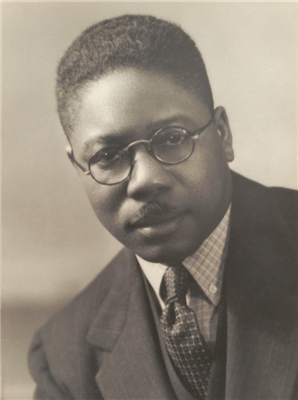
Aaron Douglas arrived in Harlem in 1924[1] with a degree from the University of Nebraska and a conviction that African American art needed its own visual language. Within months, the Kansas-born painter had become one of the most sought-after graphic artists in a neighbourhood electric with creative ambition. Philosopher Alain Locke, the intellectual engine of the Harlem Renaissance, urged Black artists to look to Africa for inspiration. Douglas listened.
Biography
He developed a style that fused Synthetic Cubism with the flat, angular silhouettes of Egyptian reliefs and sub-Saharan sculpture. His figures appear as layered, translucent cut-outs set against concentric circles of light, a technique that gave his compositions both mystical depth and graphic punch. The approach was unlike anything else being produced in American art at the time.
In 1934[1], the Federal Arts Project commissioned Douglas to paint four murals for the 135th Street branch of the New York Public Library in Harlem. The series, Aspects of Negro Life, traces African American history from its African roots through slavery, reconstruction, and the Great Migration north. In From Slavery through Reconstruction, a man on a soapbox holds a ballot aloft while concentric rings radiate outward from the Emancipation Proclamation. Behind him, the Union Army marches away as the Ku Klux Klan rides in from the left. The painting condenses an entire era of hope and menace into a single composition.
Douglas also illustrated books of poetry by James Weldon Johnson and Langston Hughes, and his graphic work appeared in The Crisis and Opportunity magazines throughout the 1920s and 1930s. He later founded the art department at Fisk University in Nashville, where he taught until 1966[1].
Timeline
- 1899Born in Kansas
- 1920Illustrated books of poetry by James Weldon Johnson and Langston Hughes
- 1920Graphic work appeared in The Crisis and Opportunity magazines
- 1924Arrived in Harlem with a degree from the University of Nebraska
- 1934Commissioned to paint murals for the NY Public Library in Harlem
- 1966Taught at Fisk University in Nashville until this year
- 1979Died
Notable Works
Tap to view larger.
Next stop
Browse the movements →
Every movement in the collection, from the Renaissance to Pop art.
Related Artists

Frequently Asked Questions
What is Aaron Douglas known for?
Aaron Douglas is known for using Synthetic Cubism to represent symbolically the historical and cultural memories of African Americans. He is also known for his graphic work, which appeared in magazines such as The Crisis and Opportunity.Who was Aaron Douglas?
Aaron Douglas was a painter and graphic artist who became a significant figure in the Harlem Renaissance after arriving in Harlem in 1924[1]. He is noted for developing a unique visual language for African American art, drawing inspiration from Africa and European modernism. He also founded the art department at Fisk University in Nashville, where he taught until 1966.What was Aaron Douglas's art style?
Aaron Douglas developed a style that fused Synthetic Cubism with the flat, angular silhouettes of Egyptian reliefs and sub-Saharan sculpture. His figures appear as layered, translucent cut-outs set against concentric circles of light, giving his compositions both mystical depth and graphic impact.How did Aaron Douglas die?
Aaron Douglas died in 1979[1] at the age of 80.
Sources
Editorial draws on the following primary and tertiary references for Aaron Douglas.
- [1] wikipedia Wikipedia: Aaron Douglas Used for: biography, birth dates, death dates, identifiers, movement attribution, nationality.
- [2] book Gardner, Helen, 1878-1946, Gardner's art through the ages Used for: biography.
- [3] book Fred S. Kleiner, Gardner's Art through the Ages Used for: biography.
- [4] book Fred S. Kleiner, Helen Gardner, Kleiner & Mamiya, Gardner's Art through the Ages, Western Perspective, 16th edition, Vol. 2, Harcourt Brace Jovanovich, Used for: biography.
Editorial overseen by Solis Prints. Sources verified 2026-10-07. Click a source for details, or hover over [N] in the page above to preview.
Editorial standardsMethodologyCorrectionsAI disclosureAbout the editorial team