



Catherine Murphy
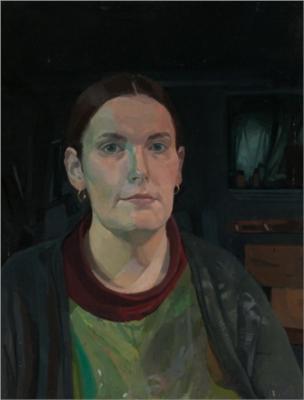
Catherine Murphy arrived on the American[2] art scene in 1971, when the Whitney Museum included her work in its Annual Exhibition of Painting and Sculpture. She was barely twenty-five and had already found her subject matter: the unremarkable domestic and suburban world, backyard grass, sunlit interiors, the view from a window, rendered with a quietness and precision that has made her one of the most respected realist painters of her generation.
Biography
Born in 1946[2] in Cambridge, Massachusetts, Murphy studied at the Pratt Institute in Brooklyn and went on to train with the painter Gabriel Laderman, whose commitment to direct observation shaped her approach to painting from life. Her method is painstaking. She works from direct observation and carefully assembled studies, sometimes spending months on a single canvas. The ordinary becomes luminous: a patch of damp earth, the underside of a table, the play of afternoon light across a kitchen counter. Atmosphere and attention are her real subjects.
Her career has attracted sustained institutional recognition. She received two National Endowment for the Arts grants, a Guggenheim Fellowship in 1982, and the Robert De Niro Sr Prize in 2013. For twenty-two years she served as a Senior Critic at the Yale University Graduate School of Art; she currently holds the Tepper Family Endowed Chair in Visual Arts at Rutgers's Mason Gross School.
Murphy's work sits in a tradition of American[2] realism that prizes looking over statement, refusing both the spectacular and the ironic. Her paintings reward patience: the longer you spend with them, the stranger and more precise they become. That quality, the ordinary world made suddenly specific, is the whole point.
Timeline
- 1946Born in Cambridge, Massachusetts.
- 1971Her work was included in the Whitney Museum's Annual Exhibition of Painting and Sculpture in New York.
- 1982Received a Guggenheim Fellowship.
- 1982Received a National Endowment for the Arts grant.
- 2013Received the Robert De Niro Sr Prize.
Notable Works
Tap to view larger.
Next stop
Browse the movements →
Every movement in the collection, from the Renaissance to Pop art.
Related Artists


Frequently Asked Questions
What is Catherine Murphy known for?
Murphy is known for her realist paintings of unremarkable domestic and suburban scenes. She renders backyard grass, sunlit interiors, and views from windows with quietness and precision. Her paintings reward patience, becoming stranger and more precise the longer one looks at them.Who was Catherine Murphy?
Catherine Murphy is a realist painter who emerged in 1971, when the Whitney Museum included her work in its Annual Exhibition of Painting and Sculpture. She paints unremarkable domestic and suburban scenes with quietness and precision. Murphy's work places looking over making a statement, and it refuses both the spectacular and the ironic.What was Catherine Murphy's art style?
Murphy's method is painstaking, as she works from direct observation and carefully assembled studies, sometimes spending months on a single canvas. Her work sits in a tradition of American[2] realism that prizes looking over statement. She refuses both the spectacular and the ironic.When was Catherine Murphy born?
Catherine Murphy was born in 1946[2].
Sources
Editorial draws on the following primary and tertiary references for Catherine Murphy.
- [1] museum Victoria and Albert Museum Used for: museum holdings.
- [2] wikipedia Wikipedia: Catherine Murphy Used for: biography, birth dates, death dates, identifiers, movement attribution, nationality.
- [3] book guggenheim-australianvision00wald Used for: biography.
- [4] book guggenheim-emergingartists100wald Used for: biography.
- [5] book guggenheim-nineartiststheod00solo Used for: biography.
- [6] book 1892-1968, Panofsky, Erwin,, Tomb sculpture: four lectures on its changing aspects from ancient Egypt to Bernini Used for: stylistic analysis.
Editorial overseen by Solis Prints. Sources verified 2026-09-02. Click a source for details, or hover over [N] in the page above to preview.
Editorial standardsMethodologyCorrectionsAI disclosureAbout the editorial team