



Bill Traylor
- outsider art
Bill Traylor began drawing at approximately 85 years old, sitting on Monroe Street in Montgomery, Alabama, in the summer of 1939[1]. In the three years that followed, he produced nearly 1,500 works on scrap cardboard. He had never received any artistic training. His entire output was made by a man who had been born into slavery.
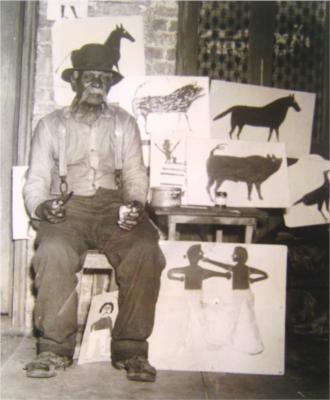
Biography
Born on a cotton plantation in Benton, Alabama, around 1853, Traylor remained in rural Montgomery County as a sharecropper for decades after emancipation. He moved to the city of Montgomery in 1928[1] and worked in factories until rheumatism forced him to stop. By the late 1930s he was sleeping in the back of the Ross-Clayton Funeral Home, spending his days on the street outside.
His drawings came after he met the artist Charles Shannon in 1939[1]. Using pencil and poster paint on cardboard, Traylor developed a visual language of pared-down figures and animals, silhouettes, and scenes of rural and urban life drawn entirely from memory and observation. The work is flat, bold, and compositionally deliberate, displaying an assurance that belies its sudden emergence.
His first exhibition was held in February 1940[1] in Montgomery. He showed briefly in New York in 1942 before fading into obscurity. Recognition returned slowly: a significant New York gallery show followed in 1979-1980[1], and in 2018 the Smithsonian American[1] Art Museum mounted the first retrospective ever presented for an artist born into slavery. He died in 1949[1], aged approximately 95.
Timeline
- 1854Born on a cotton plantation in Benton, Alabama.
- 1928Moved to the city of Montgomery, Alabama.
- 1930Stopped working in factories due to rheumatism.
- 1939Began drawing at approximately 85 years old on Monroe Street in Montgomery, Alabama.
- 1939Met artist Charles Shannon.
- 1940Held his first exhibition in Montgomery, Alabama.
- 1942Showed his work briefly in New York.
- 1949Died in 1949, aged approximately 95.
Notable Works
Tap to view larger.
Next stop
Browse the movements →
Every movement in the collection, from the Renaissance to Pop art.
Related Artists
_%E2%80%93_LOC.jpg)


Frequently Asked Questions
What is Bill Traylor known for?
Bill Traylor is known for his drawings of pared-down figures and animals, silhouettes, and scenes of rural and urban life. These were drawn entirely from memory and observation, using pencil and poster paint on cardboard.What is Bill Traylor's most famous work?
It is difficult to name one single work as Bill Traylor's "most famous". His recognition came posthumously, and his body of work is admired as a whole. Born into slavery in Alabama in 1853, Traylor spent his early life as a farm labourer. Around 1939[1], after moving to Montgomery, he began to produce drawings and paintings on discarded cardboard. These works depict figures, animals, and scenes from his memories and observations of urban life. Traylor's art is characterised by its simplified forms, bold colours, and dynamic compositions. He used readily available materials such as pencils, crayons, and poster paint. His style is considered self-taught, and it has connections with American[1] folk art traditions. Although he did not achieve widespread recognition during his lifetime, Traylor's work has since been celebrated for its unique perspective and its documentation of the African American experience in the Jim Crow South. His art provides insight into a specific time and place.What should I know about Bill Traylor's prints?
Bill Traylor conceived a plan for portfolios of lithographs. Each portfolio contains ten different lithographs, one for each numeral. The lithographs show two rows of numbers, 0 1 2 3 4 above, and 5 6 7 8 9 below. The two rows form a rectangle divided into ten equal parts. A single number of greater size appears centred below, separated by space. The two rectangles are not equal, creating asymmetry. The edition consists of thirty sets. One third are in different colours on white paper, ten are in black on off-white paper, and the rest are in grey on natural linen. All the papers have the artist’s signature as a watermark. The working process used two stones: a larger one showing the two structures, and a smaller one showing the inferior rectangle alone. The stones underwent changes during the process. The smaller stone, given its own colour or value, appears on only one lithograph of a given portfolio, the one with the large number corresponding to the number of that portfolio. Three portfolios exist hors de commerce; these show the total work, each unique, printed in different inks on different papers.What style or movement did Bill Traylor belong to?
Bill Traylor (born in 1853 or 1854[1], died 1949[1]) was an American[1] artist. Because he was self-taught, his work is usually categorised as folk art or outsider art[1]. These terms describe artists working outside academic traditions. The terms "folk art" and "outsider art" are sometimes used interchangeably; however, they have different connotations. "Folk art" can imply a connection to traditional techniques or regional styles. "Outsider art" often refers to art created in isolation, sometimes by artists with mental health conditions. The concept of outsider art gained traction as modern artists looked outside the Western academic tradition for new ideas. Modernists were intrigued by the art of non-Western cultures, children, and the untutored. These sources were seen as more authentic. Traylor's art does not fit neatly into established modern movements such as Abstract Expressionism. However, some connections can be made. The emphasis on gesture and movement in Abstract Expressionism, as seen in the work of Jackson Pollock, offers a point of comparison. Pollock described his paintings as "energy and motion made visible". Traylor's art shares a directness and expressive quality with such works, even though his style is representational rather than abstract.What techniques or materials did Bill Traylor use?
Bill Traylor employed simple materials and techniques, reflecting his background and available resources. Born into slavery in 1853, Traylor was a self-taught artist who began creating art in his late eighties, while living on the streets of Montgomery, Alabama. He primarily used discarded materials, such as cardboard, repurposed as his drawing surface. His drawing implements were equally basic; he favoured pencils and occasionally used crayons or poster paint to add colour to his compositions. Traylor's methods involved direct application, with no preliminary sketches or studies. He worked from memory and observation, creating flat, abstracted figures and scenes. His colour palette was limited, often featuring earth tones, blues, and reds. The simplicity of his materials and techniques is integral to the raw, direct quality of his art. These constraints contributed to his distinctive style, characterised by bold shapes and a unique visual language. Traylor's work provides an important view into the life and experiences of an African American[1] man in the segregated South.What was Bill Traylor known for?
Bill Traylor (circa 1853-1949[1]) was an American[1] artist known for his self-taught, figurative paintings and drawings. Born into slavery in Alabama, Traylor worked as a farmhand for most of his life. In his old age, he moved to Montgomery, Alabama, and began creating art using discarded materials like cardboard and pencils. His artwork often depicted scenes from his rural past, including animals, people, and events he witnessed. Traylor's style is characterised by simplified forms, bold colours, and a unique perspective. His work gained recognition after his death, and he is now considered an important figure in American folk art. His art provides insight into the experiences of African Americans in the rural South during the late 19th and early 20th centuries.When did Bill Traylor live and work?
Bill Traylor was born around 1853 or 1854[1], though the exact date is unconfirmed. He spent the majority of his life as a sharecropper on a plantation near Benton, Alabama. After the American[1] Civil War, he continued working the land as a farmer. It wasn't until later in life, around the late 1930s, that Traylor moved to Montgomery, Alabama, and began creating art. Living on the streets, he started drawing and painting on discarded cardboard using pencils, crayons, and poster paint. His artwork offers a visual record of his memories, observations of street life, and the changing world around him. Traylor continued to produce art until his health declined; he stopped working around 1949[1] before his death that year.Where was Bill Traylor from?
Bill Traylor was born into slavery around 1853 on a cotton plantation near Benton, Alabama. He remained on the plantation after emancipation, working as a farm labourer. Historical records suggest that Traylor may have stayed there until the early 1920s. Around the mid-1920s, Traylor moved to Montgomery, Alabama, where he lived for the rest of his life. Initially, he worked at a shoe factory. However, by the 1930s, he was living on the streets, experiencing homelessness. During this period, in his eighties, Traylor began to produce his art. He created drawings and paintings on discarded cardboard using pencils, crayons, and poster paint. These works depicted scenes from his rural past, memories of plantation life, and observations of the urban environment around him. Traylor's art provides a unique view into the experiences of an African-American[1] man living through slavery, Reconstruction, and the Jim Crow South. He died in 1949[1] in Montgomery.Who did Bill Traylor influence?
It is difficult to identify specific artists who were directly influenced by Bill Traylor. After his death in 1949[1], Traylor's work was exhibited at the Roko Gallery in New York City in 1950, and then at several venues during the 1980s. These exhibitions brought Traylor's art to a wider audience, but documentation of his influence on other artists is limited. Some scholars have noted connections between Traylor's self-taught style and the work of Jean-Michel Basquiat. Basquiat, like Traylor, incorporated personal symbols and direct expression into his art. Basquiat was influenced by a wide range of sources, including art history and contemporary culture. Some have argued that Basquiat's engagement with European and American[1] modernism was a challenge to those models. It is plausible that Basquiat, who taught himself to draw, may have found inspiration in Traylor's work.Who influenced Bill Traylor?
It is difficult to identify specific artists who directly influenced Bill Traylor, as he was a self-taught artist who began creating art later in life. However, some scholars have drawn comparisons between his work and that of other artists. Some see similarities between Traylor's simplified forms and bold use of colour and the work of European modernists, such as Joan Miró. Both artists employed abstracted figures and shapes, and a playful, imaginative approach to composition. Others have noted parallels with the art of children, or with African-American[1] folk art traditions. These traditions often feature storytelling, memory, and a direct, unrefined style. Traylor's art emerged from his personal experiences and observations of the world around him in Alabama. While he may not have had formal exposure to art history, his work resonates with various artistic movements and traditions through a shared interest in simplification, symbolism, and the expression of personal narratives.Who was Bill Traylor?
Bill Traylor (born in 1853 or 1854[1]; died 1949[1]) was an American[1] artist. Born into slavery in Lowndes County, Alabama, he remained a sharecropper after emancipation. Around the mid-1930s, Traylor moved to Montgomery, Alabama, where he was homeless. He began drawing and painting on discarded cardboard, using pencils and poster paints. His subject matter included animals, people, and events he witnessed or remembered from his past. Traylor's art provides insight into the lives of Black people in the rural South during the late 19th and early 20th centuries. His work gained recognition in the late 1930s, and he had a solo exhibition in 1940[1]. Despite this, he lived in poverty and obscurity for the remainder of his life. After his death, his art was rediscovered, and he is now considered an important figure in American folk art.Why are Bill Traylor's works important today?
Bill Traylor's art holds significance due to his unique position as an artist documenting the African American[1] experience in the early 20th century. Born into slavery in 1853, Traylor did not begin his artistic career until his late 80s, after moving to Montgomery, Alabama. His works, created primarily on discarded cardboard, depict figures, animals, and scenes from his memories and observations of urban life. Traylor's self-taught style, characterised by simplified forms and a distinctive visual language, offers an unvarnished view into the realities of the Jim Crow South. His art provides insight into a specific time and place, while also addressing universal themes of identity, community, and survival. Traylor's work also challenges conventional art historical narratives by expanding the definition of who is considered an artist and what constitutes art.
Sources
Editorial draws on the following primary and tertiary references for Bill Traylor.
- [1] wikipedia Wikipedia: Bill Traylor Used for: biography, birth dates, death dates, identifiers, movement attribution, nationality.
- [2] book Ansel Adams; Beaumont Newhall; Nancy Newhall; Louise Dahl-Wolfe; Aaron Siskind; Richard Avedon; Harry Callahan; Lee Friedlander; Tina Modotti; W. Eugene Smith; Paul Strand; Edward Weston; Garry Winogrand; Amy Rule, Ansel Adams; Beaumont Newhall; Nancy Newhall; Louise Dahl-Wolfe; Aaron Siskind; Richard Avedon; Harry Callahan; Lee Friedlander; Tina Modotti; W. Eugene Smith; Paul Strand; Edward Weston; Garry Winogrand; Amy Rule - Original sources _ art and ar Used for: biography, stylistic analysis.
- [3] book Dorling Kindersley, Artists: Inspiring Stories of the World's Most Creative Minds Used for: biography.
- [4] book Carol Strickland and John Boswell, The Annotated Mona Lisa Used for: biography, stylistic analysis.
- [5] book Carol Strickland and John Boswell, The Annotated Mona Lisa Used for: biography, stylistic analysis.
Editorial overseen by Solis Prints. Sources verified 2026-10-07. Click a source for details, or hover over [N] in the page above to preview.
Editorial standardsMethodologyCorrectionsAI disclosureAbout the editorial team