



August Natterer
- outsider art
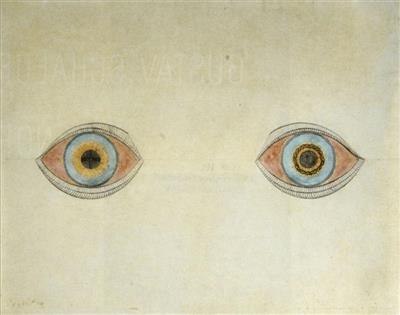
On 1 April 1907[1], August Natterer, a thirty-eight-year-old electrician from Württemberg, experienced a vision of the Last Judgement. He later described seeing ten thousand images flash by in half an hour. Following a suicide attempt, he was committed to the first of several psychiatric institutions and remained there for the rest of his life, dying in Rottweil on 7 October 1933[1], aged 65. During those twenty-six years he produced a body of drawings that would reshape how the twentieth century understood the relationship between art and mental illness.
Biography
Born in Schornreute on 3 August 1868[1], Natterer had trained as an engineer and built a steady career as an electrician before his breakdown. The technical precision of that background is directly legible in his work: his drawings have the clarity and spatial logic of schematics, applied to imagery of cosmic violence and visionary disorder. Hexenkopf (The Witch's Head, c. 1915[1]), held in the Prinzhorn Collection in Heidelberg and rendered in pencil, pen, and watercolour on card measuring roughly ten by thirteen inches, shows this combination of mechanical exactitude and apocalyptic content.
Hans Prinzhorn, the psychiatrist and art historian, selected Natterer as one of ten exceptional patient-artists in his 1922[1] publication on the artistry of the mentally ill. That book reached Jean Dubuffet and the Surrealists. Natterer's Miraculous Shepherd directly influenced Max Ernst's Oedipus Rex, and his Axle of the World with Rabbit (1919) he claimed had predicted the First World War.
The Prinzhorn Collection at the University of Heidelberg remains the primary repository of his work.
Timeline
- 1868Born in Schornreute on 3 August. He later trained as an engineer.
- 1907Experienced a vision of the Last Judgement on 1 April, aged 38. He saw ten thousand images flash by in half an hour.
- 1907Following a suicide attempt, he was committed to a psychiatric institution.
- 1915Created "Hexenkopf (The Witch's Head)", rendered in pencil, pen, and watercolour on card.
- 1919Created "Axle of the World with Rabbit". Natterer claimed it had predicted the First World War.
- 1922Hans Prinzhorn selected Natterer as one of ten exceptional patient-artists in his publication on the artistry of the mentally ill.
- 1933Died in Rottweil on 7 October, aged 65. He had been in psychiatric institutions for 26 years.
Notable Works
Tap to view larger.
Next stop
Browse the movements →
Every movement in the collection, from the Renaissance to Pop art.
August Natterer prints
Hand-finished archival prints from August Natterer's body of work.

Related Artists


Take August Natterer home.
See all August Natterer prints →Frequently Asked Questions
What is August Natterer known for?
August Natterer is known for a body of drawings he produced during his time in psychiatric institutions. His work was selected by Hans Prinzhorn for inclusion in his publication on the artistry of the mentally ill, which influenced artists like Jean Dubuffet and Max Ernst.What is August Natterer's most famous work?
It is difficult to identify a single, definitive "most famous work" by August Natterer (1868[1]-1933[1]). He produced art during his time as a patient in psychiatric institutions. His works are not widely known outside the context of art brut or outsider art[1]. Natterer's practice included drawing, painting, and writing. He often depicted visionary experiences and symbolic imagery. Recurring motifs include "Wunderzeichen" (wonder signs) and self-portraits. These images reflect his internal world and his attempts to communicate his experiences. Reproductions of his works appear in publications and exhibitions related to outsider art. These have increased awareness of his output. However, no individual piece has achieved mainstream recognition. His collective body of work, and its connection to his mental state, is what draws interest.What should I know about August Natterer's prints?
To understand August Natterer's prints, it is helpful to know some basic print terminology. A 'vintage print' is one made around the time the negative was taken. A 'period print' is made within roughly 15 years of the original shooting. Prints made later are termed 'old' or 'modern'. An 'original print' is made by the artist, or under their supervision. A 'facsimile' is a reproduction striving to match the original print's materials and processes. Original prints are often hand-pulled by the artist using techniques such as woodcut, engraving, linocut, mezzotint, etching, lithography, or serigraphy. In this case, the artwork is created directly on the plate, woodblock, stone, or screen. Offset reproductions, also known as posters or image prints, are produced photochemically. Giclée prints are fine art prints made using inkjet technology. Canvas transfers involve transferring the image onto canvas, giving it the appearance of a painting. The art market distinguishes between reproductive engravings and original etchings; the latter are valued for their direct connection to the artist.What style or movement did August Natterer belong to?
August Natterer (1868[1]-1933[1]) was a German[1] artist and psychiatrist patient. He is associated with the art movement of the Prinzhorn Collection. This is art made by asylum patients, collected by psychiatrist and art historian Hans Prinzhorn in the early 20th century. Natterer had a mental breakdown in 1907[1]. He began producing drawings and paintings in the years that followed, while institutionalised. His work often features visionary imagery, geometric patterns, and symbolic elements. These reflect his internal experiences and hallucinations. Other artists associated with the Prinzhorn Collection include Karl Brendel, Emma Hauck, and Franz Karl Bühler. The Prinzhorn Collection became an important source for artists associated with Expressionism and Surrealism. These artists were interested in accessing the unmediated creativity and emotional intensity they saw in the work of psychiatric patients. Natterer's art offers a look into the mind of someone experiencing psychosis. It also raises questions about the relationship between mental illness and creative expression.What techniques or materials did August Natterer use?
August Natterer, also known as Natterer Jakobi, was a German[1] artist and one of the principal figures in the art brut movement. He was diagnosed with schizophrenia in 1907[1] and began producing art while institutionalised. Natterer's artworks include drawings and sketches, often executed with coloured pencils and occasionally watercolour. These pieces frequently incorporate symbolic imagery, geometric patterns, and writing. He also created what he termed "Wunderbilder" or "miracle pictures". These were drawings intended to represent his hallucinations and visions. Natterer believed his art was a medium for conveying messages from the beyond. He often explained the meaning of his symbols and compositions to doctors and visitors. His style is characterised by a combination of precise detail and visionary content. Although he had no formal artistic training, Natterer's work demonstrates a sophisticated understanding of composition and colour theory. His art provides insight into the mind of someone experiencing psychosis and the power of art as a means of communication.What was August Natterer known for?
August Natterer (1868[1]-1933[1]) was a German[1] artist and psychiatrist, known for his visionary art. In 1907[1], Natterer had a psychotic episode, which he described as a "cosmic experience." He believed he had special powers and was in contact with supernatural beings. Following this episode, he was institutionalised in a mental hospital for the rest of his life. While hospitalised, Natterer began producing drawings and paintings that reflected his hallucinations and delusions. These works often featured geometric shapes, symbols, and figures that he claimed were revealed to him in visions. His art is associated with the art movement called Art Brut (or outsider art[1]), because he had no formal training and was working outside of mainstream artistic conventions. His creations provide insight into his internal world.When did August Natterer live and work?
August Natterer was born in 1868[1] and died in 1933[1]. A German[1] artist, he is today regarded as an important Outsider artist. Before becoming an artist, Natterer trained as an electrician and worked as a salesman. Around 1907[1], he experienced a series of intense hallucinations and psychotic episodes, leading to his hospitalisation in a mental institution. He would remain institutionalised for the rest of his life. During his time in the institution, Natterer began producing drawings and paintings, informed by his visions. These works often featured symbolic imagery, geometric patterns, and figures, reflecting his altered perception of reality. He became associated with the art movement known as Art Brut, or Outsider Art, which celebrated art created outside the boundaries of mainstream artistic conventions. Though he lived until 1933, his period of artistic activity appears to have been concentrated between 1907 and the early 1920s.Where can I see August Natterer's work?
August Natterer (1868[1]-1933[1]) was a German[1] artist and psychiatrist, associated with the art brut movement. Finding specific locations of his work can be difficult, as much of it resides in private collections or smaller museums. However, several museums in Germany hold collections of expressionist art and art produced by psychiatric patients; these may include works by Natterer. These include the Ludwig Museum in Cologne, the Kunsthalle in Hamburg, and the Von der Heydt Museum in Wuppertal. The Sammlung Bottcherstrasse in Bremen also holds relevant works. To confirm if a particular museum has works by Natterer currently on display, it is best to check the museum's online catalogue or contact them directly. These resources will provide the most up-to-date information about their collection and exhibitions.Who did August Natterer influence?
It is difficult to establish clear lines of influence from August Natterer to other artists. Natterer was a self-taught artist who worked in relative isolation. He was not part of any established artistic movement, and his work was not widely known during his lifetime. However, Natterer's art has gained recognition posthumously, particularly among those interested in the art of psychiatric patients and what is sometimes termed "outsider art[1]". His visionary imagery and symbolic language may have resonated with later artists interested in exploring the subconscious and unconventional forms of expression. Some scholars have drawn connections between Natterer's work and Surrealism, citing the shared interest in dreams, automatism, and the exploration of the irrational. However, these connections are speculative, as there is no direct evidence that the Surrealists were familiar with Natterer's art. Any influence would have been indirect.Who influenced August Natterer?
August Natterer (1868[1]-1933[1]) was a German[1] self-taught artist and one of the principal figures of the art brut movement. His influences are complex, owing to his mental illness and visions. Natterer had no formal artistic training. Before his mental breakdown, he worked as an electrician and was interested in science and technology. This background may have informed the geometric and symbolic elements that appear in his work. His art was directly shaped by his hallucinations and delusions. Natterer believed he was in contact with supernatural forces and that his art was a means of communicating these experiences. He produced drawings and writings that documented his visions, often incorporating symbols and figures that held personal significance. His imagery includes what he called the "Wrathful Countenance", a recurring motif. Some scholars have noted similarities between Natterer's art and the work of other artists working outside the mainstream, such as Adolf Wölfli. However, Natterer's art remains highly personal. It is primarily a reflection of his internal world, rather than a response to external artistic trends.Who was August Natterer?
August Natterer (1868[1]-1933[1]) was a German[1] artist and psychiatrist patient. Before his institutionalisation, Natterer had a career as an electrician and salesman. In 1907[1], Natterer experienced a series of intense hallucinations and delusions, which he described as a "cosmic event". He believed he had been given divine insight into the future. As a result, he was diagnosed with schizophrenia and spent the rest of his life in various psychiatric institutions. During his time in these institutions, Natterer began to produce a large body of artwork. These works included drawings and collages, often incorporating symbolic imagery and geometric forms. His art became a way for him to express his internal experiences and visions. Natterer's work is now associated with the art brut movement: art created outside the boundaries of official culture. His creations offer a glimpse into the mind of someone experiencing psychosis, and they continue to be studied by both art historians and mental-health professionals.Why are August Natterer's works important today?
August Natterer (1868[1]-1933[1]) was a German[1] artist and psychiatrist. He is noted today for his "outsider art[1]", created during his confinement in mental institutions. Natterer's artistic output began after a series of intense hallucinations and delusions in 1907[1], which led to his initial hospitalisation. He believed he was the "chosen one" and that his visions had cosmic significance. His art became a way to document and communicate these experiences. His works often feature geometric forms, symbolic figures, and cryptic writing. These elements reflect his attempts to understand and represent his internal world. Some common motifs include the "Wunderzeichen" (wonder signs), recurring visual elements that held personal meaning for Natterer. His drawings and paintings offer insight into the mind of someone experiencing psychosis. Interest in Natterer's art grew after his death, particularly through the efforts of psychiatrist and art historian Hans Prinzhorn, who included Natterer's works in his collection of psychiatric patients' art. Today, Natterer's art is valued for its raw expression and unique perspective. It provides a valuable record of a particular type of altered consciousness.
Sources
Editorial draws on the following primary and tertiary references for August Natterer.
- [1] wikipedia Wikipedia: August Natterer Used for: biography, birth dates, death dates, identifiers, movement attribution, nationality.
- [2] book guggenheim-gustavklimtegons00mess Used for: biography.
- [3] book Husslein-Arco, Agnes, editor; Koja, Stephan, editor; Law, Rebecca (Translator), translator; McInnes, Robert (Translator), translator; Somers, Nick, translator; Monet, Claude, 1840-1926. Paintings. Selections; Österreichische Galerie Belvedere, h Used for: biography, stylistic analysis.
- [4] book Masterpieces of western art : a history of art in 900 individual studies from the Gothic to the present day Used for: biography.
- [5] book Neoclassicism and romanticism : architecture, sculpture, painting, drawings, 1750-1848 Used for: biography, stylistic analysis.
- [6] book Anne-Marie O'Connor, The Lady in Gold Used for: biography.
Editorial overseen by Solis Prints. Sources verified 2026-10-07. Click a source for details, or hover over [N] in the page above to preview.
Editorial standardsMethodologyCorrectionsAI disclosureAbout the editorial team