

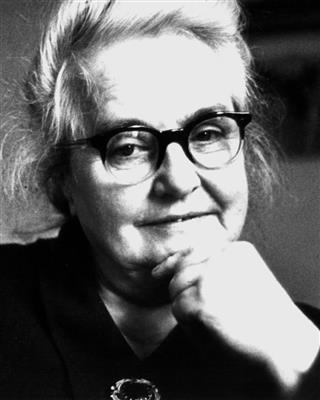
Anna Zemánková
- outsider art
Anna Zemánková began making art in her early fifties, rising before dawn each morning to draw botanical forms that seemed to come from another biological register entirely. Her works depict flora and fauna that do not exist: hybrid organisms hovering between plant and creature, rendered with a precision that owes something to her training as a dentist.
Biography
Born in 1908[1] in Olomouc, then Austria-Hungary, she qualified as a dentist and ran her own clinic before family life absorbed her entirely after the birth of her second son in 1936[1]. It was not until 1960, when her grown sons rediscovered her early paintings and encouraged her to continue, that she returned to making work. She described the experience as a form of art therapy she practised alone, before the household woke.
Her materials expanded steadily from pastel and ink into perforation, textile collage, crochet appliqué, beads, and sequins, each element chosen to render a texture that paint alone could not produce. The work carries an erotic charge inseparable from its botanical language: many pieces carry titles referencing birth and nativity, and the forms suggest reproductive cycles operating at a pace beyond human observation.
Her first exhibition came in 1966[1] at Prague's Na Zábradlí Theatre, and international attention arrived when she was included in the landmark Outsiders exhibition at the Hayward Gallery, London, in 1979. She died in 1986[1]. In 2013 eighteen of her works entered the 55th Venice Biennale. Her work is held in the Collection de l'Art Brut in Lausanne and the American Folk Art Museum in New York.
Timeline
- 1908Born in Olomouc, Austria-Hungary.
- 1936Family life absorbed her after the birth of her second son.
- 1960Returned to making art after her sons encouraged her.
- 1966Had her first exhibition at the Na Zábradlí Theatre, Prague.
- 1979Included in the Outsiders exhibition at the Hayward Gallery, London.
- 1986Died at 78.
Next stop
Browse the movements →
Every movement in the collection, from the Renaissance to Pop art.
Related Artists

Frequently Asked Questions
What is Anna Zemánková known for?
Anna Zemánková is known for her art, which features flora and fauna that do not exist. Her works depict hybrid organisms hovering between plant and creature, rendered with a precision that owes something to her training as a dentist.What is Anna Zemánková's most famous work?
It is difficult to name one single work as Anna Zemánková's 'most famous'. She produced a large body of work from the 1960s until her death in 1986[1]. Zemánková's practice involved automatic drawing, a technique by which the artist suppresses conscious control over the making of the image, allowing the unconscious mind to create the composition. Her art often features biomorphic forms, plant-like structures, and invented alphabets. These combine in colourful, patterned compositions on paper. While not widely known during her lifetime, Zemánková's work has received increased attention in recent years, with exhibitions in Europe and the United States. These shows have introduced her unique artistic vision to a broader audience, securing her place in the history of art brut and outsider art[1].What should I know about Anna Zemánková's prints?
Anna Zemánková's prints are original artworks, conceived and executed as prints, typically in numbered editions signed by the artist. Each print in the edition is an original, created from a plate, stone, screen, block, or other matrix made for that purpose. Each print is individually inked and pulled, making it a 'multi-original' medium. The artist determines the number of prints in an edition, and sequential numbering accounts for the prints; for example, 12/25 indicates the 12th print in an edition of 25. This numbering of prints is a relatively recent convention. Early prints were not always numbered or signed; sometimes the artist signed the plate or stone without a pencilled signature on each print. The edition claim is usually written as a pair of numbers on the left bottom margin of the print, with the print number above or to the left and the edition size below or to the right. The title is written in the middle, and the signature on the right.What style or movement did Anna Zemánková belong to?
Anna Zemánková is generally associated with Outsider Art, also known as Art Brut. This term, meaning 'raw art', was coined by Jean Dubuffet to describe art created outside the established fine art tradition. Dubuffet saw academic art as 'dry' and 'lifeless' compared to the compelling imagery produced by those outside the mainstream, such as the self-taught, the mentally ill, and social outcasts. He felt only amateurs could tap the imagination without self-censorship. Outsider Art describes works of 'outrageous inventiveness' made by inwardly driven, often obsessive artists using whatever materials are at hand. Dubuffet incorporated mud, ashes, banana peels, butterfly wings, and chicken droppings into his paintings. Swiss mental patient Adolf Wolfli compulsively covered any surface in reach with dense drawings, for example. Outsider art stands apart from conventional practices, valuing personal expression over established technique.What techniques or materials did Anna Zemánková use?
Anna Zemánková created her art using a range of techniques and materials. While specific details are scarce, we can infer some aspects of her practice from general art-historical sources. Technique, in art, involves resourcefulness, the ability to utilise certain means, and to foresee effects. Artists choose materials that are relatively constant, subjecting them to their will to create forms. Zemánková likely employed this principle in her work. Various materials can be used, and techniques include painting with oil or tempera. Pigments are mixed with a binding medium on a ground layer, and overpaintings can be added. The application of colour can involve multiple layers and glazing techniques. The love for sheen is a common artistic impulse, with artists often drawn to shining materials.What was Anna Zemánková known for?
Anna Zemánková (1908[1]-1986[1]) was a Czech[1] artist, best known for her botanical-style drawings and paintings. These works often feature imaginary plants and flowers rendered in striking colour combinations. Zemánková began her artistic career later in life, around the age of 50. She had no formal training. Her art is often classified as Art Brut (or Outsider Art), a label applied to art created outside the boundaries of academic tradition. This category includes work by self-taught artists, children, and those on the margins of society. Her practice involved the use of varied media: pencil, pastel, ink, watercolour, and tempera. She combined these in unusual ways on paper and card. Zemánková's pieces frequently have a symmetrical organisation and a complex layering of forms. Her creations evoke a sense of the fantastical, demonstrating a unique perspective on the natural world. Though her work has a botanical appearance, the plant forms are products of her imagination.When did Anna Zemánková live and work?
Anna Zemánková was born in 1908[1] and died in 1986[1]. She was a Czech[1] artist working primarily in Prague. Though she began drawing and painting in childhood, she had no formal artistic training and only began her serious artistic work in the 1940s. Zemánková's practice centred on automatic drawing, a technique associated with Surrealism. She produced colourful, imaginative drawings and paintings of otherworldly figures, plants, and landscapes. Her work was often inspired by spiritualism and the occult, reflecting her interest in the unseen world. She exhibited her art from the 1960s, gaining recognition both in Czechoslovakia and internationally. Her unique artistic vision has made her a significant figure in 20th-century art, particularly within the realm of Art Brut.Where can I see Anna Zemánková's work?
Anna Zemánková's works have been exhibited in various galleries and museums, primarily in Europe. However, due to the delicate nature of her art, which often incorporates unconventional materials, her pieces are not always on permanent display. The Collection de l'Art Brut in Lausanne, Switzerland, holds a number of her pieces. This museum specialises in art brut, a category to which Zemánková's work is often assigned. The abcd collection in Paris, France, also includes her creations. In the Czech[1] Republic, her art has been featured at the Museum Kampa in Prague. The Czech Republic is her country of origin. The Moravská Galerie in Brno has also presented her work. It is advisable to check the museums' websites in advance for current exhibitions or specific pieces on display. These institutions may also have works by Zemánková in their storage, available for viewing by appointment for research purposes.Who did Anna Zemánková influence?
Anna Zemánková taught no students and had no studio assistants. Her work was not widely known during her lifetime. Therefore, it is difficult to trace any direct artistic influence. However, some art historians have noted general similarities between Zemánková's art and the work of the Surrealists. Like the Surrealists, Zemánková employed automatism, a technique of creating art without conscious control, allowing the subconscious mind to guide the hand. Her biomorphic forms and plant-like structures also resonate with aspects of Surrealist imagery. Zemánková's practice of automatic drawing and her interest in visionary experiences align her with other artists working outside the mainstream art world. These affinities may explain the increased attention to her work since the 1990s, as interest in Art Brut and self-taught artists has grown.Who was Anna Zemánková?
Anna Zemánková (1908[1]-1986[1]) was a Czech[1] artist. She is associated with art brut, also called outsider art[1]. This category includes artists who are self-taught or working outside established artistic conventions. Zemánková began creating art in the 1960s. She produced drawings, paintings, and pastels. Her work often features organic forms, plant-like structures, and fantastical figures. These images came to her spontaneously, without preparatory sketches. Zemánková described her process as a type of automatic drawing. She felt guided by an external force while making art. Although not formally trained, Zemánková's art gained recognition during her lifetime. The artist exhibited her pieces in Czechoslovakia and abroad. After her death, her work continued to attract attention. It has been included in major exhibitions of outsider art. Today, Zemánková is recognised as a significant figure in 20th-century art brut. Her unique visual language continues to fascinate viewers.Why are Anna Zemánková's works important today?
Anna Zemánková's works remain important because of their unique approach to art making. Zemánková created art from a position outside the mainstream, developing a singular visual language. Her practice involved automatic drawing and a focus on inner visions, aligning her with Art Brut or Outsider Art. This approach is now appreciated for its authenticity and direct expression of the subconscious. Zemánková's art offers a perspective that challenges conventional artistic norms. Later in life, she explored printmaking, combining techniques like screenprint and photo-offset. This experimentation led to novel results, demonstrating her continued artistic bravery. Her ability to blend different processes in unexpected ways makes her work relevant to contemporary discussions about artistic innovation.
Sources
Editorial draws on the following primary and tertiary references for Anna Zemánková.
- [1] wikipedia Wikipedia: Anna Zemánková Used for: biography, birth dates, death dates, identifiers, movement attribution, nationality.
- [2] book Giovanni Battista Piranesi; Sarah E Lawrence; Exhibition Piranesi as Designer (2007, Giovanni Battista Piranesi; Sarah E Lawrence; Exhibition Piranesi as Designer (2007 - 2008, New York, NY; Haarlem); Cooper-Hewitt Museum of Decorative Arts and Design (New York, N.Y.); Teylers Museum - Piranesi as designer ; [on the occasion of Used for: biography, stylistic analysis.
- [3] book guggenheim-annialbers00webe Used for: biography.
- [4] book guggenheim-frantisekkupka00kupk Used for: biography.
- [5] book Snyder, James, 1928-1990, Northern Renaissance art : painting, sculpture, the graphic arts from 1350 to 1575 Used for: biography.
Editorial overseen by Solis Prints. Sources verified 2026-09-30. Click a source for details, or hover over [N] in the page above to preview.
Editorial standardsMethodologyCorrectionsAI disclosureAbout the editorial team