



Beauford Delaney
- Harlem Renaissance
Henry Miller, who knew Beauford Delaney well, once wrote of watching him paint in his Greenwich Village studio on a bitter cold night: the temperature barely above freezing, the light failing, and Delaney working on with what Miller could only describe as a sanity "one ascribes only to the angels." Born in Knoxville, Tennessee in 1901[1], Delaney had moved north with nothing and spent twenty-five years building a reputation in New York before the most perceptive observers of his generation concluded he was something rare: an artist entirely free of bitterness and envy.
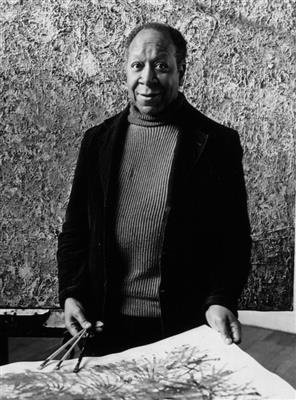
Biography
He lived at 181 Greene Street in Greenwich Village through much of the 1940s and 1950s, painting in near-total poverty, and counted James Baldwin among his closest friends. His early work was Expressionist in character, responsive to the cultural moment around him; after he moved to Paris in 1953[1], his style shifted towards abstraction. Light became his central preoccupation, and yellow in particular recurs through his late canvases with an almost devotional intensity.
In Paris he moved through the circle of African-American[1] expatriates gathered around Baldwin, and exhibited at the Galerie Lambert. He spent the rest of his life in France, dying in Paris in 1979[1]. His paintings are held at the Smithsonian American Art Museum, the National Portrait Gallery, and the Studio Museum in Harlem.
Timeline
- 1901Born in Knoxville, Tennessee.
- 1940Lived at 181 Greene Street in Greenwich Village throughout the 1940s and 1950s.
- 1953Moved to Paris, where his style shifted towards abstraction.
- 1953Began to focus on light, especially the colour yellow, in his paintings after moving to Paris.
- 1979Died in Paris, France, aged 78.
Notable Works
Tap to view larger.
Next stop
Browse the movements →
Every movement in the collection, from the Renaissance to Pop art.
Related Artists
Frequently Asked Questions
What is Beauford Delaney known for?
Beauford Delaney is known as a mentor to James Baldwin, who recognised Delaney's talent. Both men were gay African-Americans who felt drawn to Paris after World War II.What is Beauford Delaney's most famous work?
It is difficult to identify one single 'most famous work' by Beauford Delaney. Throughout his career, Delaney remained dedicated to his art, painting with enthusiasm despite facing numerous personal hardships. Interruptions and challenges did not deter him; instead, he approached each canvas with the same passion as if it were his first. He used his materials generously, maintaining a positive outlook and a strong sense of responsibility for his work. Delaney's unwavering faith and integrity are reflected in his art, and he believed in his ability to overcome any obstacle, even death, to continue his artistic journey. His work embodies a spirit of endurance and a deep connection to his heritage.What should I know about Beauford Delaney's prints?
Beauford Delaney was an American[1] modernist painter known for his use of colour and light. He produced paintings, drawings, and prints throughout his career. Delaney was born in Knoxville, Tennessee, and later moved to New York City, where he became part of the Harlem Renaissance[1]. He eventually settled in Paris in 1953[1], where he remained for the rest of his life. Although Delaney is perhaps best known for his paintings, he also produced lithographs and other print media. These prints often explored similar themes to his paintings, such as abstraction, light, and portraits. Delaney approached each new canvas with enthusiasm, using pigments freely. He worked steadily, painting through various hardships and interruptions.What style or movement did Beauford Delaney belong to?
Beauford Delaney was an American[1] modernist painter. He came of age during the Harlem Renaissance[1], a period when African-American artists began making black Americans the subject of their art. Prior to this, African-American artists created art inspired by their Euro-American counterparts to appeal to market values. The Harlem Renaissance saw artists make racial identity a prominent theme, making the subject of race as important as formal innovation. Many African-American artists worked within the Modernist tradition. They offered an alternative by making racial identity a prominent theme in their work. Some artists focused on the racial mysteries and social realities, such as colour and facial structure. Others reproduced scenes of Harlem, avoiding sentimentality by using the finest painting techniques. Delaney and others translated the African-American experience into the conventions of modern painting.What techniques or materials did Beauford Delaney use?
Beauford Delaney was dedicated to his art, painting unremittingly through varied circumstances. He approached each canvas with enthusiasm, as if it were his first. Delaney used his pigments lavishly, despite not knowing where the next tube would come from. James Baldwin noted that Delaney taught him about light, specifically how it is contained in everything. Baldwin recalled walking with Delaney through New York City, observing how Delaney was always seeing, which, in turn, caused Baldwin to begin to see. Baldwin described seeing a brown leaf on black asphalt and oil moving like mercury in the gutter. He realised that, by observing with Delaney, the colours underwent a change. Baldwin realised that black was not the absence of light, but light trapped within. He also understood that light fell from heaven on everything and that the light was always changing.What was Beauford Delaney known for?
Beauford Delaney (1901[1]-1979[1]) was an American[1] artist, born in Knoxville, Tennessee. He is known for his paintings and works on paper, and for his nearly 40-year friendship with writer James Baldwin. Delaney moved to the Paris suburb of Clamart in 1955[1], and he continued to paint with enthusiasm throughout his life, despite facing numerous challenges. He approached each canvas as if it were his first, using pigments generously, and he assumed full responsibility for the outcome of his work. His work often depicted, was inspired by, or was dedicated to Baldwin, who served as an intellectual and spiritual anchor for Delaney. Delaney, in turn, guided Baldwin in navigating life as a gay man of colour. One example of Delaney's work is his 1944 pastel on paper, *Portrait of James Baldwin*, which presents a clear likeness of the writer.When did Beauford Delaney live and work?
Without specific dates, it's challenging to pinpoint the exact periods when Beauford Delaney lived and worked. However, some insights can be gleaned. One source suggests that for at least 25 years, Delaney dedicated himself to painting, seemingly without interruption, despite facing numerous hardships such as 'rent crises, wars, revolutions, strikes, riots, hunger, despair, denigration, ridicule, humiliation, chagrin and defeat'. Another account describes Delaney's journey from the 'deep South' to overcoming a 'hostile world' through his art. His focus was solely on creation, disregarding external factors like recognition or reward. His perspective transcended geographical and social boundaries, viewing the world as a space for the human soul's evolution. This suggests he worked across different locations and societal contexts, driven by his artistic vision.Where can I see Beauford Delaney's work?
Beauford Delaney's work can be viewed in several museum collections. The Knoxville Museum of Art holds his 1944[1] pastel *Portrait of James Baldwin*. The Toledo Museum of Art (in Ohio) has also acquired Delaney's pieces. A retrospective of Delaney's art was curated by Richard A. Long in 1978 for the Studio Museum in Harlem, New York. A recent exhibition, "Beauford Delaney’s Metamorphosis into Freedom", organised by the Knoxville Museum of Art, was on view at the Asheville Art Museum until June 2021. This exhibition featured over 40 paintings and works on paper, many connected to Delaney's friendship with James Baldwin. These pieces either depict, are inspired by, or are dedicated to Baldwin. The show included works such as *Untitled (Landscape)* (circa 1940) and *Untitled (Knoxville Landscape)* (1969), as well as *Yaddo*, a 1950 pastel.Who did Beauford Delaney influence?
Beauford Delaney had a marked effect on those around him. The writer James Baldwin, for example, had a friendship with Delaney that lasted almost 40 years. They met in 1940[1], when Baldwin was still a teenager. Delaney's works often depict, or are inspired by, Baldwin. According to Baldwin, Delaney served as a guide for how to persevere as a gay man of colour. Delaney completed Portrait of James Baldwin, a pastel on paper, in 1944. Baldwin said that he learned about light from Delaney; the light contained in everything, every surface, every face. Baldwin recalled walking with Delaney through the streets of New York City. He stated that Delaney's way of seeing caused him to begin to see. Baldwin began to apprehend colours in new ways, such as discovering many colours in a brown leaf on black asphalt.Who influenced Beauford Delaney?
Beauford Delaney taught others how to see light and colour in the everyday world. The writer James Baldwin said he learned about light from Delaney, 'the light contained in every thing, in every surface, in every face.' Baldwin recalled walking with Delaney through the streets of New York City, observing how 'the very colours underwent a most disturbing and salutary change'. Baldwin described how Delaney's way of seeing prompted him to notice the many colours in a brown leaf on black asphalt or oil moving in a gutter. He realised that light was always changing and falling on everything. Baldwin also noted Delaney's focus on creation, without concern for reward or recognition. Delaney's vision transcended racial and national boundaries, focusing on the human soul and imagination. Baldwin captured Delaney's likeness in a 1963[1] pastel portrait.Who was Beauford Delaney?
Beauford Delaney (1901[1]-1979[1]) was an American[1] modernist painter. Born in the Deep South, he moved to New York City and later Paris, pursuing his artistic vision despite facing adversity. Delaney's art was his primary concern, and he relentlessly created artworks regardless of external circumstances. He began with nothing and, after twenty-five years of struggle with a hostile world, had emerged superior to the claims of the world. He ignored the great white world. There was no black and white, no master or slave; there was just the endless stretch of vision in which the imagination of all men dwells. He painted enthusiastically, tackling each canvas as if it were his first. He used pigments lavishly, never questioning his fate and assuming responsibility for both success and failure. Delaney's unwavering dedication to his craft defined him. He painted through challenges such as rent crises, wars, revolutions, strikes, riots, hunger, despair, denigration, ridicule, humiliation, chagrin, and defeat.Why are Beauford Delaney's works important today?
Beauford Delaney's art remains important for its exploration of the human condition and his distinctive approach to abstraction. Despite facing adversity, he maintained a compassionate outlook, which is reflected in his work. He saw his own struggles as subjects for his art, approaching them with clarity and understanding. Delaney's focus was on creation itself, rather than external rewards or recognition. His art transcends specific locations or social divisions, instead tapping into universal human experiences. He transformed Greene Street in New York, where he lived, into a representation of the human soul's journey. His ability to capture this state of mind in his paintings could evoke strong reactions, from ridicule to empathy. Delaney's work offers a vision of the imagination, inviting viewers to connect with the deeper aspects of human existence.
Sources
Editorial draws on the following primary and tertiary references for Beauford Delaney.
- [1] wikipedia Wikipedia: Beauford Delaney Used for: biography, birth dates, death dates, identifiers, movement attribution, nationality.
- [2] book Jed Perl, Art in America 1945-1970 Used for: biography, stylistic analysis.
Editorial overseen by Solis Prints. Sources verified 2026-09-22. Click a source for details, or hover over [N] in the page above to preview.
Editorial standardsMethodologyCorrectionsAI disclosureAbout the editorial team