

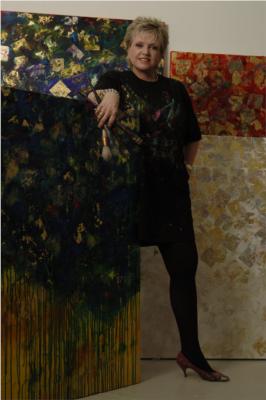
Barbara McGivern
Barbara McGivern made her reputation on gold. The Toronto-based artist incorporated real gold leaf into her acrylic paintings, treating it as a colour rather than a signifier of wealth, and the approach gave her work a luminous quality distinct from most contemporary Canadian[1] painting.
Biography
Her decisive subject matter came from a 1996[1] expedition across approximately 3,000 miles of desert in Oman and Saudi Arabia, following the route taken by the explorer Wilfred Thesiger. The resulting Extraordinary Journey series examined desert light and landscape with the freedom that long-term travel allows, and led to a commission of 22 paintings for the Jumeirah Emirates Towers Hotel in Dubai. The Royal Collection of Sheikh Mohammed bin Rashid Al Maktoum later acquired her work.
Trained at the Ontario College of Art and Design, where she graduated with an Honours degree in Experimental Arts in 1988[1], McGivern had previously spent several years in London in the 1970s and was a member of both The Arts Club and the Chelsea Arts Club. Her earlier work drew comparisons to Beryl Cook's figurative style; after visits to the Hermitage, the Pushkin Museum, and the Barnes Collection in Paris in 1992, her direction shifted towards the colour-saturated landscapes for which she became known.
Her paintings were represented in galleries across Toronto, Montreal, Dubai, Zurich, Berlin, London, and Madrid. Institutional collections include the Museum of Contemporary Canadian[1] Art in Toronto and the Robert McLaughlin Gallery in Oshawa. She died in 2019[1].
Timeline
- 1957Born in 1957.
- 1970Spent several years in London during the 1970s.
- 1988Graduated with an Honours degree in Experimental Arts from the Ontario College of Art and Design.
- 1992Visited the Hermitage, the Pushkin Museum, and the Barnes Collection in Paris; her artistic direction shifted towards colour-saturated paintings.
- 1996Travelled across 3,000 miles of desert in Oman and Saudi Arabia, following Wilfred Thesiger's route.
- 1996Created the Extraordinary Journey series, examining desert light and the desert.
- 1996Commissioned to create 22 paintings for the Jumeirah Emirates Towers Hotel in Dubai.
- 2019Died in 2019.
Next stop
Browse the movements →
Every movement in the collection, from the Renaissance to Pop art.
Related Artists

Frequently Asked Questions
What is Barbara McGivern known for?
Barbara McGivern is known for incorporating real gold leaf into her acrylic paintings. She treated gold as a colour, which gave her work a luminous quality.What should I know about Barbara McGivern's prints?
Barbara McGivern's prints are original artworks, conceived and executed as prints, rather than reproductions of existing works in other media. Each print is created from a plate, stone, screen, or block made specifically for that purpose. The artist inks and pulls each print individually; this makes it a "multi-original" medium. Printmakers often create limited editions, where the artist decides the number of prints. Each print in the edition is numbered sequentially (for example, 12/25, meaning the twelfth print of an edition of twenty-five). This numbering provides an accounting of the prints. The edition number and the print number are typically written on the bottom left margin of the print, in pencil. The title is written in the centre, and the artist's signature appears on the right. The Professional Art Dealers Association of Canada (PADAC) has defined an original print as an image conceived by the artist as a print and executed solely as a print, usually in a numbered edition, and signed.What techniques or materials did Barbara McGivern use?
Barbara McGivern's techniques include both pencil and acrylic methods. When using pencils, she employs hatching (parallel strokes for shading), crosshatching (layered strokes at angles for darker shading), applying heavy pressure for dark shading, and gradating (varying pressure for tonal range). She also blends with tools or tissues and creates textured shading using the pencil's side. McGivern establishes form by initially creating a line drawing to define an object's shape and adds value by observing how light creates highlights and shadows. McGivern also uses acrylic techniques, including flat washes (thin mixtures of paint diluted with water) applied in overlapping horizontal strokes. For her compositions, McGivern draws and redraws her subject, using notes and sketchbook work. She uses photographs, manipulating them to define the geometry in her composition. She often applies a layer of wax to the paper before defining the composition with sable brushes, creating a delicate surface. After adding another layer of wax, she mounts the paper onto thick card so she can work more freely with larger brushes and charcoal.Where can I see Barbara McGivern's work?
I am unable to provide a comprehensive list of exhibition locations for Barbara McGivern's work. However, I can offer some resources that may help you locate her pieces. By Western Hands (BWH) is a non-profit organisation in Cody, Wyoming, dedicated to preserving and promoting Western artisanal traditions. Their Design Centre features a gallery where creations by BWH Artists’ Guild members are sold. The Farnsworth Art Museum in Rockland, Maine, has hosted juried exhibitions of new works by Maine artists. The Springfield Museum of Art in Ohio has also presented exhibitions celebrating female artists from their permanent collection. Checking the museum's website is recommended to see if McGivern's work is currently on display. Additionally, many museums have increased their online presence through social media or virtual exhibitions. It is best to check museum websites for hours, restrictions, and online content.Why are Barbara McGivern's works important today?
Barbara McGivern's works are important because they engage with questions of female identity, representation, and the construction of history. Like other artists, McGivern questions long-held societal values encoded in images and words. Her work can be viewed in the context of feminist art that emerged in the late 20th century. Artists like Judy Chicago sought to reclaim female agency and challenge patriarchal notions of artistic creation. Chicago's "Dinner Party" (1979[1]), for example, aimed to document and honour women's participation in history, offering a direct challenge to male-dominated narratives. McGivern's art shares concerns with artists such as Barbara Kruger and Jenny Holzer, who utilise language and images to question stereotypes and assumptions. These artists prompt viewers to think critically about the messages they consume and the ways in which women are represented in culture. While approaches to feminist art have changed over time, the foundations laid by earlier artists like Chicago continue to influence contemporary practice.When was Barbara McGivern born?
Barbara McGivern was born in 1957[1].
Sources
Editorial draws on the following primary and tertiary references for Barbara McGivern.
- [1] wikipedia Wikipedia: Barbara McGivern Used for: biography, birth dates, death dates, identifiers, movement attribution, nationality.
- [2] book Martin Gascoigne, Rosalie Gascoigne: A Catalogue Raisonné Used for: biography.
Editorial overseen by Solis Prints. Sources verified 2026-10-14. Click a source for details, or hover over [N] in the page above to preview.
Editorial standardsMethodologyCorrectionsAI disclosureAbout the editorial team