



Alex Colville
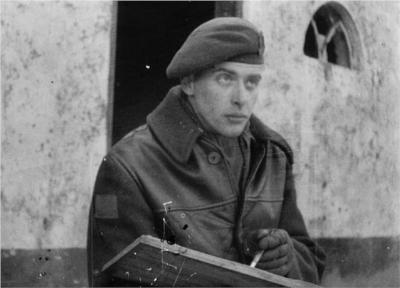
Alex Colville documented the liberation of Bergen-Belsen in the spring of 1945[2]. That experience, which he carried for the rest of his life, feeds the peculiar tension in his civilian paintings: the uncanny stillness, the sense that something is about to happen. A woman on a deserted beach. A horse galloping toward an oncoming train. Scenes from ordinary life that carry the weight of someone who has seen what ordinary life can turn into.
Biography
Colville studied at Mount Allison University in New Brunswick and returned there to teach after the war, remaining on faculty until 1963[2] and helping to establish what became known as Maritime Realism. Among his students were Christopher Pratt and Mary Pratt, both of whom went on to major careers. His best-known painting, To Prince Edward Island (1965), now in the National Gallery of Canada, uses a precise geometric structure to make an everyday ferry crossing feel loaded with meaning.
His work entered the international canon early: the National Gallery of Canada, the Museum of Modern Art in New York, and the Tate Gallery in London all hold examples. Several of his paintings appear in Stanley Kubrick's The Shining (1980[2]). He designed the commemorative coins issued for Canada's centennial in 1965. At auction, Man on Verandah reached C$1.287 million in 2010, and Dog and Bridge achieved C$2.4 million in 2020. Colville was made a Companion of the Order of Canada in 1982 and received the Governor General's Award in Visual and Media Arts in 2003, two years before his death at ninety-two.
Timeline
- 1920Born in Canada
- 1945Documented the liberation of Bergen-Belsen
- 1963Left faculty at Mount Allison University
- 1965Painted 'To Prince Edward Island'
- 1965Designed commemorative coins for Canada's centennial
- 1980Several paintings appeared in Stanley Kubrick's 'The Shining'
- 1982Made a Companion of the Order of Canada
- 2003Received the Governor General's Award in Visual and Media Arts
- 2010'Man on Verandah' reached C$1.287 million at auction
- 2013Died at the age of ninety-two
Notable Works
Tap to view larger.
Where to See Alex Colville
1 museum worldwide.
-
 31 works
Canadian War Museum
Ottawa, Canada
Mon–Wed, Fri–Sun 9:00–17:00, Thu 9:00–19:00 · $23 adults, $21 seniors, $18 students, $16 children, $62 family
Next stop
Browse the movements →
Every movement in the collection, from the Renaissance to Pop art.
Related Artists




Frequently Asked Questions
What is Alex Colville known for?
Alex Colville is known for his paintings that depict scenes from ordinary life, but carry the weight of someone who has seen what ordinary life can turn into. His best-known painting, To Prince Edward Island (1965[2]), uses a precise geometric structure to make an everyday ferry crossing feel loaded with meaning. Several of his paintings appear in Stanley Kubrick's The Shining (1980).What is Alex Colville's most famous work?
It is difficult to identify one single work as Alex Colville's "most famous". His career produced many pieces now held in prominent collections. In 1964[2], Colville completed "Bridge", "Golden Day", "Half Way", and "Three-Thirty". The following year, 1965, saw the completion of "Grave Light", "Nobid", "Saturday Night", "Plunge", and "Largesse". In 1966, he created "Approach", "Dark Sweet Cherry", "Sound", "Shift", "Shade", "Dry Shift", "Deep Pillot", "Strand", "Blue Shift II", "Pause", "Warm and Cool", "Approach", "Untitled", "Must", and "Solar Edge". "Via Blues", "Powder", "Rainbow", "The Time", and "Seamline" were all completed in 1967. These works are held in collections such as The Davidson Family, Toronto; The Edmonton Art Gallery, Edmonton, Canada; and the Robert A. Rowan Collection. Others are in private collections in Toronto, Chicago, Boston, and New York.What should I know about Alex Colville's prints?
When considering Alex Colville's prints, bear in mind the distinction between an original print and a reproduction. An original print is conceived and executed solely as a print, often in a numbered edition, and signed by the artist. Each print is created from a matrix, such as a plate or screen, and is individually inked and pulled. In contrast, a reproduction is a copy of a work initially created in another medium, such as painting or watercolour, often produced photomechanically. Numbering and signing a reproduction does not alter its essence; it remains a copy, not an original print. The Professional Art Dealers Association of Canada (PADAC) has defined these terms, which are accepted by major arts organisations in the country. The intent behind the image is what distinguishes an original print from a reproduction. If the aim is to replicate an image best created as a painting, it is a reproduction, regardless of the technique used.What style or movement did Alex Colville belong to?
Alex Colville is difficult to place within a specific art movement. Colville's career began in the mid-20th century, after the heyday of modern art movements. The Canadian[2] Group of Painters was founded in 1933[2], with the intention of maintaining values of free expression in pursuit of a Canadian style, as put forth by the Group of Seven. The Group of Seven were interested in presenting the possibility of aesthetic involvement to a large number of people. They felt that art societies, with their European-oriented view of the painter's profession, were doing little to foster cultural awareness in Canadian society. What was needed, they felt, was a direct mode of painting derived from Canadian experience. Some general tendencies can be blocked in before we view the assembled works.What techniques or materials did Alex Colville use?
While information on Alex Colville's specific techniques is limited, we can discuss materials and methods common to artists. Artists often prepare their painting surfaces with gesso, applied to canvas or hardboard panels. The gesso provides a suitable ground for the paint. Oil painters frequently use mediums and thinners to modify the consistency and drying time of their paints. Thinners, such as turpentine or mineral spirits, evaporate quickly. Mediums, containing oils or varnishes, alter the paint's composition and texture. A common medium can be created by mixing linseed oil, damar varnish, and turpentine. Sketching is a standard practice. Artists employ sketch pads and pencils for preliminary studies. Canvases come in various textures, with medium-textured canvas being a popular choice. Some artists stretch their own canvases, while pre-made canvases are also available. For rigid supports, Masonite boards can be prepared with multiple coats of gesso.What was Alex Colville known for?
Alex Colville (1920[2]-2013[2]) was a Canadian[2] painter known for his precise, realist style. He often depicted scenes from everyday life in Canada's Maritime provinces, where he lived for many years. Born in Toronto, he moved to Amherst, Nova Scotia, as a child. During the Second World War, Colville served as a war artist, documenting events in Europe. This experience influenced his later work, which often explored themes of conflict and tension. After the war, he taught at Mount Allison University in Sackville, New Brunswick, for many years before retiring to paint full time. His paintings frequently feature animals, figures in sparse settings, and carefully calculated compositions. Works such as *Bridge* (1964[2]) and *Grave Light* (1965) illustrate his use of acrylic on canvas. Colville developed a meticulous technique, using mathematical ratios to determine the placement of elements within his pictures. His work can evoke a sense of stillness, but also of underlying unease.When did Alex Colville live and work?
Alex Colville was born in Montreal, Canada, in 1920[2]. Shortly after his birth, his family relocated to Amherst, Nova Scotia, where he spent his childhood. Colville received his formal art training at Mount Allison University, graduating in 1942[2]. His studies were interrupted by military service during the Second World War, where he served as a war artist. This role saw him documenting events in Europe. After the war, Colville returned to Mount Allison University, this time as a faculty member. He taught there from 1946 until 1963. During this period, he developed his signature style of precise realism. In 1963, Colville resigned from his teaching position to devote himself fully to painting. He moved to his home in Sackville, New Brunswick, where he continued to live and work until his death in 2013[2]. Throughout his career, Colville received numerous awards and honours, solidifying his position as one of Canada's most important artists.Where can I see Alex Colville's work?
Alex Colville's work can be seen in many public collections. In Canada, the National Gallery of Canada (Ottawa) and the Art Gallery of Ontario (Toronto) hold examples. Other locations include the Mackenzie Art Gallery (Regina, Saskatchewan). In the United States, museums with Colville's pieces include the Baltimore Museum of Art, the Hirshhorn Museum and Sculpture Garden (Washington, D.C.), the Los Angeles County Museum of Art, and the Metropolitan Museum of Art (New York). His art is also held by the Art Institute of Chicago. Outside North America, Colville's work has been displayed at the Australian National Gallery in Canberra and at the Tate Gallery in London. These galleries provide opportunities to view selections of Colville's paintings, prints, and other media.Where was Alex Colville from?
Alex Colville was born in Toronto, Ontario, on 24 August 1921[2]. However, he spent a significant portion of his childhood elsewhere; in 1929, his family moved to Amherst, Nova Scotia. Colville's connection to the Maritimes remained strong throughout his life. He returned to the region to study at Mount Allison University in Sackville, New Brunswick. There, he met his future wife, Rhoda Wright. Although he travelled and exhibited his work internationally, Colville’s artistic inspiration often came from the landscapes and people of Nova Scotia. He lived and worked in the province for many years. He eventually settled in his hometown of Wolfville, Nova Scotia, where he died on 16 July 2013[2].Who did Alex Colville influence?
A.Y. Jackson, a member of the Group of Seven, supported the development of younger Canadian[2] artists. In 1966[2], Jackson suggested that Robert McMichael acquire work from artists such as Ogilvie, York Wilson, Alan Collier, Colville, Forestall, Comfort, and Lemieux. Jackson appeared to dislike some modern artists, such as Paul-Émile Borduas, but he still supported artists from across Canada. Many young artists who began their careers between 1925 and 1930, during the height of the Group of Seven, comprised the Canadian Group of Painters. The Group of Seven's struggle with tradition gave hope and direction to these younger painters. The Canadian Group of Painters' main purpose was to sustain the values of the Group of Seven. The Canadian Group of Painters' creative years occurred during a difficult time for art, and few of its members achieved fame.Why are Alex Colville's works important today?
Alex Colville (1921[2]-2013[2]) was a Canadian[2] painter known for his precise, realist style. His images often evoke a sense of stillness or tension, exploring themes of contemporary life, human relationships, and the natural world. Colville's importance lies partly in his departure from earlier Canadian art movements, such as the Group of Seven. While the Group of Seven focused on romanticised, uninhabited wilderness, Colville situated his work in the everyday. His paintings include modern settings and ordinary people, marking a shift in Canadian art away from pure nationalism toward a more nuanced reflection of lived experience. Colville's work is also important because of his technical skill and unique vision. He used precise geometry and careful observation to create compositions that are both realistic and subtly unsettling. His paintings are widely recognised and continue to resonate with audiences.What was Alex Colville's art style?
Maritime Realism is the art style that Alex Colville helped to establish.
Sources
Editorial draws on the following primary and tertiary references for Alex Colville.
- [1] museum Canadian War Museum Used for: museum holdings.
- [2] wikipedia Wikipedia: Alex Colville Used for: biography, birth dates, death dates, identifiers, movement attribution, nationality.
- [3] book O'Brian, John; White, Peter; , Beyond Wilderness Used for: biography.
- [4] book guggenheim-kennethnolandret00wald Used for: biography.
Editorial overseen by Solis Prints. Sources verified 2026-09-30. Click a source for details, or hover over [N] in the page above to preview.
Editorial standardsMethodologyCorrectionsAI disclosureAbout the editorial team