



Arne Jacobsen
The Series 7 chair, which Arne Jacobsen produced for Fritz Hansen in 1955[1], became one of the most widely reproduced objects of the twentieth century. Lewis Morley's 1963 photograph of Christine Keeler seated astride one brought the chair into public consciousness during the Profumo Affair, and Stanley Kubrick dressed his moonbase sets with Jacobsen's flatware in 2001: A Space Odyssey. Neither piece of cultural currency would have surprised Jacobsen, who believed architecture and industrial design were continuous disciplines.
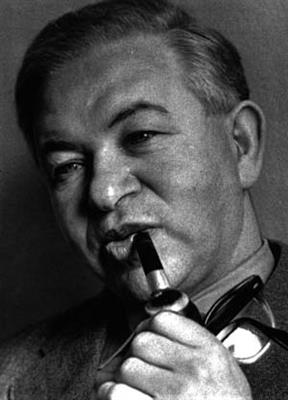
Biography
Born in Copenhagen in 1902[1], Jacobsen studied at the Royal Danish[1] Academy of Fine Arts under Kay Fisker, winning a silver medal at the 1925[1] Paris Art Deco Exhibition for a chair design before completing his degree. His early career produced a series of Functionalist buildings around Copenhagen: the Bellevue Beach complex (1932), the Bellavista housing development (1931-34), and the Bellevue Theatre with its retractable roof (1935-36). The Aarhus City Hall, completed with Erik Møller in 1942, established him nationally.
In 1943[1] Jacobsen fled Denmark ahead of the Nazi occupation's racial laws and spent the war years in Sweden designing textiles and wallpaper. He returned in 1945 and resumed with the work for which he is best remembered: the SAS Royal Hotel in Copenhagen (1956-60), conceived as the world's first total-design hotel, with the Egg Chair and Swan Chair produced specifically for its interiors. St Catherine's College Oxford followed in 1964-66, earning Grade I listing.
He received the Grand Prix at the Milan Triennale in 1957[1] and was appointed an Honorary Fellow of the American Institute of Architects. The VOLA tap fittings (1968) and Cylinda Line tableware remain in production. Jacobsen died in Copenhagen in March 1971[1], having insisted throughout his career that he was primarily an architect, a distinction the world has largely declined to observe.
Timeline
- 1902Born in Copenhagen.
- 1925Won a silver medal at the Paris Art Deco Exhibition for a chair design, while studying at the Royal Danish Academy of Fine Arts.
- 1942Completed the Aarhus City Hall with Erik Møller, establishing him nationally.
- 1943Fled Denmark ahead of the Nazi occupation and spent the war years in Sweden.
- 1955Produced the Series 7 chair for Fritz Hansen.
- 1956Began work on the SAS Royal Hotel in Copenhagen, conceived as the world's first total-design hotel.
- 1957Received the Grand Prix at the Milan Triennale.
- 1960Completed the SAS Royal Hotel in Copenhagen, including the Egg Chair and Swan Chair.
- 1964Began work on St Catherine's College, Oxford.
- 1971Died in Copenhagen in March.
Notable Works
Tap to view larger.
Next stop
Browse the movements →
Every movement in the collection, from the Renaissance to Pop art.
Related Artists


Frequently Asked Questions
What is Arne Jacobsen known for?
Arne Jacobsen is known for his architecture and industrial designs, such as the Series 7 chair, produced for Fritz Hansen in 1955[1]. He is also recognised for designing the SAS Royal Hotel in Copenhagen, St Catherine's College Oxford, and the VOLA tap fittings.What is Arne Jacobsen's most famous work?
Arne Jacobsen (1902[1]-1971[1]) was a Danish[1] architect and designer. He is celebrated for his contribution to architectural functionalism and for simple, but effective, chair designs. While he designed many notable buildings, such as St Catherine's College, Oxford (1962[1]-1964[1]), he is perhaps best known for his chairs. These include the Ant Chair (1955), the Series 7 Chair (1955), the Egg Chair (1958), and the Swan Chair (1958). Jacobsen originally designed the Egg and Swan chairs for the SAS Royal Hotel in Copenhagen. Both are characterised by their organic shapes and use of synthetic materials. The Series 7 chair, also known as the 3107, is a plywood chair. It is an updated version of the Ant chair, and is arguably Jacobsen's most commercially successful design. Its mass-produced form made it accessible and popular.What should I know about Arne Jacobsen's prints?
Arne Jacobsen (1902[1]-1971[1]) was a Danish[1] architect and designer. Although best known for his furniture, he also produced drawings and botanical watercolours. Jacobsen studied at the Royal Danish Academy of Fine Arts, graduating in 1927[1]. His early architectural work included the Bellavista housing estate (1934) north of Copenhagen, and Århus City Hall (1937-1941[1]), designed with Erik Møller. After World War II, he designed a range of buildings, from the SAS Royal Hotel (1960) in Copenhagen to the National Bank of Denmark (1971). His furniture designs include the Ant Chair (1955), the Egg Chair (1958), and the Swan Chair (1958), all of which remain popular. These pieces often feature organic shapes and a minimalist aesthetic. Less well known are Jacobsen's prints. These consist mainly of detailed botanical studies. These watercolours display his draughtsmanship and eye for detail. They are often printed as giclée reproductions. Jacobsen's botanical art shares some aesthetic qualities with his furniture: a clarity of line and form, combined with an appreciation for natural shapes.What style or movement did Arne Jacobsen belong to?
Arne Jacobsen was a proponent of modernism, specifically within architecture and industrial design. In the 1930s, Scandinavian countries saw the introduction of "functionalist" architecture. Jacobsen's work aligned with this movement, which emphasised clean lines and functionality. After World War II, a renewed interest in international contacts influenced artists like Jacobsen. His designs often merged functionalist tenets with biomorphic forms, seen in the work of sculptors such as Jean Arp and Henry Moore. This sculptural influence was particularly evident in furniture design, with curved wooden and glass forms. While Jacobsen was part of the broader modernist movement, his designs also reflected a Scandinavian sensibility, which valued simplicity, natural materials, and a close relationship with the environment.What techniques or materials did Arne Jacobsen use?
Arne Jacobsen's artistic techniques encompassed a range of approaches, from graphic caricature to exploration of materials. In the late 1930s, Jacobsen employed a graphic line to create caricature images, which some critics found satirical. He also experimented with motifs and compositions inspired by artists such as Kandinsky and De Stijl. These sketches, created with a ruler and compass in India ink, explored planes, basic forms, and the tensions between straight and curved lines. Jacobsen also adopted techniques such as collage, frottage, and colour spraying. He used collage for illustrations in Jens August Schade's book *The Stolen Chest of Drawers*. In his drawings, Jacobsen dissolved shapes using an overlay technique, rather than evoking clashes between them. Later, Jacobsen moved from oil paint to acrylic paints, which promote flatness and colour contrast.When did Arne Jacobsen live and work?
Arne Jacobsen (1902[1]-1971[1]) was a Danish[1] architect and designer. He is remembered for his contribution to architectural Functionalism, as well as his simple but effective chair designs. Jacobsen was born in Copenhagen, and he studied at the Royal Danish Academy of Fine Arts from 1924[1] to 1927. In 1930, he established his own architectural practice. His early work included the Bellavista housing estate (1934) north of Copenhagen, and the Århus City Hall (1937-1942[1]), which he designed in partnership with Erik Møller. During the Second World War, Jacobsen, who was Jewish, fled to neutral Sweden. He returned to Denmark after the war, and he capitalised on the post-war building boom. His later architectural projects include the SAS Royal Hotel (1958-1960) in Copenhagen. He designed every element of the hotel, from the structure to the furniture. Jacobsen also designed furniture, lighting, textiles, and ceramics. His most famous furniture designs are the Ant Chair (1952), the Series 7 Chair (1955), the Egg Chair (1958), and the Swan Chair (1958). These chairs are characterised by their simple, organic forms, and they remain popular today.Where can I see Arne Jacobsen's work?
Arne Jacobsen's work can be viewed in museums around the world. In Denmark, his designs are held by the Aarhus Kunstmuseum; Fyns Stifts Kunstmuseum (Fyn County Museum of Fine Arts), in Odense; and the Louisiana Museum of Modern Art, in Humlebaek. Other European museums with his works include the Arkiv for Dekorativ Konst, Lund, Sweden; Nasjonalgalleriet, Oslo; Nationalmuseum, Stockholm; Graphische Sammlung Albertina, Vienna; Kunstmuseum Bern; Kunstmuseum Luzern; Museum am Ostwall, Dortmund; and the Henie-Onstad Art Center, Hovikodden, Norway. In Germany, Jacobsen's pieces can be seen at the Bauhaus Archive Design Museum, Berlin; the Bröhan-Museum (State Museum for Art Nouveau, Art Deco, and Functionalism), Berlin; the Kunstgewerbe Museum of Decorative Arts, Berlin; the Museum beim Markt (Badisches Landesmuseum), Karlsruhe; and the Museum für Kunst und Gewerbe, Hamburg. In the United States, notable collections are held by the Art Institute of Chicago; the Busch-Reisinger Museum, Harvard University, Cambridge, Massachusetts; the Cincinnati Art Museum; the Cleveland Museum of Art; the Solomon R. Guggenheim Museum, New York; the Metropolitan Museum of Art, New York; the Museum of Modern Art, New York; the Museum of Art, Carnegie Institute, Pittsburgh; the Charles Hosmer Morse Museum of American Art, Winter Park, Florida; and the Los Angeles County Museum of Art (LACMA).Where was Arne Jacobsen from?
Arne Jacobsen was Danish[1]. He was born in Copenhagen in 1902[1], and he died there in 1971[1]. Jacobsen is remembered as an architect and designer. He combined architectural practice with product design, such as furniture and homewares. He is associated with the international modern movement, but he also had his own distinct aesthetic. Many of his best-known buildings are in Denmark. These include the Bellavista housing estate (1934[1]) north of Copenhagen, and the Aarhus City Hall (1937-42), which he designed with Erik Møller. Other important architectural projects include St Catherine's College, Oxford (1962-64), and the Danish National Bank in Copenhagen (1961-71). Jacobsen's furniture designs are also well known. The Ant chair (1955), the Egg chair (1958), and the Swan chair (1958) are still in production. These designs were originally created for specific architectural projects, but they became popular on their own.Who did Arne Jacobsen influence?
Arne Jacobsen's influence is complex. In the 1930s, Jacobsen was part of a young Danish[1] art scene that looked to Paris and the Bauhaus movement. They found inspiration in artists such as Kandinsky, Klee, Mondrian, and the Russian avant-garde. This group, known as Linien (The Line), played a role in the Danish resistance during the war. After 1945[1], they renewed international contacts. Robert Jacobsen and Richard Mortensen, two important members, moved to Paris. Parallel to this abstract movement was the COBRA group, led by Asger Jorn. The avant-garde activities of the 1960s and 1970s, including Fluxus, also left traces. Contacts with German art, particularly with Beuys, influenced young Danish artists such as Bjørn Nørgaard and Per Kirkeby. However, some argue that the success of the abstract movement and COBRA has overshadowed later developments in Danish art.Who influenced Arne Jacobsen?
Arne Jacobsen's artistic development occurred in a milieu influenced by several modern movements. In the 1930s, young Danish[1] artists mounted exhibitions in Copenhagen that presented modern European art to a Danish audience. These included works by Kandinsky, Mondrian, Klee, Arp, Dali, Tanguy, Ernst and Miro. The exhibitions merged Cubism and Surrealism, treating them as parallel movements. The younger generation in Denmark saw no need to choose between the schools of the 1920s. Kandinsky's abstract works, Tanguy's unreal beaches, Giacometti's figures and Miro's signs were all equally appealing. The group Linien, which included Richard Mortensen, Ejler Bille, Carl-Henning Pedersen, Egill Jacobsen and Sonja Ferlov Mancoba, also included the young Asger Jorn. Jorn, who would later be a prime mover in the COBRA group, was influenced by Leger and Le Corbusier.Why are Arne Jacobsen's works important today?
Arne Jacobsen (1902[1]-1971[1]) was a Danish[1] architect and designer. He is remembered for his contribution to architectural modernism, and for designs that combined functionalism with a concern for aesthetics. Jacobsen's architecture demonstrates a sensitivity to context. His best-known building is probably the SAS Royal Hotel (1960[1]) in Copenhagen; he designed not only the structure but also the interior fittings, furniture, lighting, and even cutlery. This holistic approach is a hallmark. His furniture designs, such as the Egg and Swan chairs, are still in production. Their organic shapes contrast with the rectilinear forms of much modernist design. They also demonstrate Jacobsen's interest in new materials and industrial production techniques. These chairs, along with his Series 7 chair, remain popular items. Jacobsen's designs are significant because they represent a Scandinavian interpretation of modernism. They combine functionality with a sense of humanism. This approach continues to influence designers today.What was Arne Jacobsen's art style?
During his early career, Arne Jacobsen produced a series of Functionalist buildings around Copenhagen. During the war, he designed textiles and wallpaper.
Sources
Editorial draws on the following primary and tertiary references for Arne Jacobsen.
- [1] wikipedia Wikipedia: Arne Jacobsen Used for: biography, birth dates, death dates, identifiers, movement attribution, nationality.
- [2] book guggenheim-guggenheimintern1964allo Used for: biography.
- [3] book guggenheim-guhe00solo Used for: biography, stylistic analysis.
- [4] book guggenheim-handboo00pegg Used for: biography, stylistic analysis.
- [5] book guggenheim-northernvisionss03solo Used for: biography, stylistic analysis.
Editorial overseen by Solis Prints. Sources verified 2026-10-14. Click a source for details, or hover over [N] in the page above to preview.
Editorial standardsMethodologyCorrectionsAI disclosureAbout the editorial team