

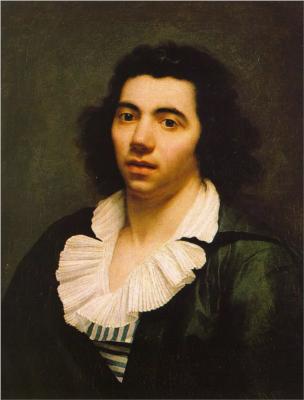
Antoine-Jean Gros spent his career waging a losing war against himself. Trained by Jacques-Louis David and assigned to carry on the Neoclassical tradition after his master went into exile, Gros produced paintings that laid the foundations for Romanticism while publicly declaring his opposition to everything they implied. By the time he was in his sixties, he was old enough to have inspired Géricault and Delacroix and isolated enough to feel it. In 1835[6], at the age of sixty-four, he drowned himself in the Seine, reportedly having told friends 'Actually I am already dead.'
Key facts
- Lived
- 1771–1835, French[6]
- Movements
- [6]
- Works held in
- 37 museums[1]
- Wikipedia
- View article
Biography
Born in Paris in 1771[6], Gros became Napoleon's official war painter and was personally awarded the Legion of Honour by the emperor for his vast canvas of the Eylau battlefield (1808[6], 5.2 x 7.8 metres, Louvre), which depicted the aftermath of a battle in which roughly 25,000 soldiers died. The commission required him to portray Napoleon with a 'consoling gaze' over the enemy wounded, a political fiction the painting executes with such emotional force that the lie itself became art. Earlier, the Plague at Jaffa (1804, Louvre) had served a similar function: Napoleon reaching out, ungloved, to touch a sore of a plague victim in a Jaffa mosque, echoing the Doubting Thomas iconography while simultaneously rehabilitating an emperor who had ordered his own plague-stricken troops to be poisoned rather than evacuated.
His breakthrough came even earlier: the portrait Napoleon Bonaparte on the Bridge at Arcole (1796[6], Louvre; larger version in the Hermitage) was the first commission Napoleon gave him and the first painting in which, scholars agree, all trace of David's Neoclassicism[6] had gone. The brushwork is loose, almost impressionistic; the surrounding scene is deliberately unclear; Napoleon's face was painted from life.
Gros attempted in his final years to return to the Neoclassical manner, by then dominated by Ingres rather than David. He had lost his audience and knew it.
Timeline
- 1771Born in Paris.
- 1796Received his first commission from Napoleon, resulting in the portrait "Napoleon Bonaparte on the Bridge at Arcole".
- 1804Completed "The Plague at Jaffa", depicting Napoleon visiting plague victims.
- 1808Awarded the Legion of Honour by Napoleon for his painting of the Eylau battlefield.
- 1808Completed the vast canvas of the Eylau battlefield, measuring 5.2 x 7.8 metres; it is now located in the Louvre.
- 1835Died by drowning himself in the Seine at 64.
Notable Works
Tap to view larger.
Where to See Antoine-Jean Gros
4 museums worldwide.
-
27 works
Louvre
Paris, France
-
4 works
Musée des beaux-arts de Marseille
Palais Longchamp, France
-
1 works
Musée des Beaux-Arts de Bordeaux
Bordeaux, France
-
1 works
Musée Magnin
Hôtel Lantin (Dijon), France
Related Artists




Frequently Asked Questions
What is Antoine-Jean Gros known for?
Antoine-Jean Gros is known for his paintings of Napoleon Bonaparte, particularly Napoleon Bonaparte on the Bridge at Arcole and Napoleon on the Battlefield at Eylau. He is also known for The Plague at Jaffa.What is Antoine-Jean Gros's most famous work?
Antoine-Jean Gros is best known for his large-scale history paintings that combine Neoclassical and Romantic elements. He was a student of Jacques-Louis David, and he initially worked in a Neoclassical style. Gros's most celebrated painting is *Napoleon Visiting the Plague-Stricken in Jaffa*, completed in 1804[6]. The painting depicts Napoleon Bonaparte during the French[6] campaign in Egypt. Napoleon is shown visiting his soldiers infected with the bubonic plague at a hospital in Jaffa. The scene is meant to portray Napoleon as a heroic figure, unafraid of disease and concerned for his troops' welfare. The painting departs from Neoclassical conventions through its emotional intensity and exotic setting. It is an example of French Romanticism. The composition, use of colour, and dramatic lighting contribute to the painting's emotional impact. Gros received commissions from Napoleon and other members of the French government. He produced other works depicting Napoleon's military campaigns. These paintings solidified Gros's reputation as a leading painter of the Napoleonic era.What should I know about Antoine-Jean Gros's prints?
Antoine-Jean Gros (1771[6]-1835[6]) trained with Jacques-Louis David, but moved toward Realism and Romanticism. Napoleon made him an official war painter. Gros is known for paintings of Napoleon such as *Napoleon Bonaparte on the Bridge at Arcole* (1796[6]) and *Napoleon on the Battlefield at Eylau, February 9, 1807* (1808). Gros's *Napoleon at Arcola* depicts Napoleon leading his troops. The Musée National du Louvre holds *Napoleon at Arcola* (1796) and *Napoleon on the Battlefield at Eylau* (1808). For the latter, Napoleon specified that the painting should portray him with a consoling gaze. Although medical staff only aided the French[6] wounded, Gros depicted Napoleon caring for enemy soldiers, presenting Napoleon as a reluctant warrior. Napoleon awarded Gros the cross of the Legion of Honour for this work. Gros also made drawings. Thomas Crow argues that Gros’s drawing, *Burning of Moscow*, possesses an immediacy absent from his finished canvases.What style or movement did Antoine-Jean Gros belong to?
Antoine-Jean Gros (1771[6]-1835[6]) was a French[6] painter whose career spanned the Neoclassical and Romantic periods. Initially, he worked in a Neoclassical style, studying with Jacques-Louis David. David's influence is visible in Gros's early works, which display an emphasis on clear lines and classical subjects. However, Gros moved away from strict Neoclassicism[6]. He developed a more Romantic approach, characterised by dramatic compositions, intense emotion, and the use of colour to create atmosphere. This shift is apparent in paintings such as "Napoleon Visiting the Plague-Stricken in Jaffa" (1804[6]). The painting depicts Napoleon's visit to his troops during the plague outbreak. It emphasises the horror and pity of the scene. Gros's style is often considered a bridge between Neoclassicism and Romanticism. He retained some elements of Neoclassical training, such as a focus on historical subjects, but infused these with Romantic characteristics. Later in his career, Gros returned to a more classical style, which was not well received. He struggled to reconcile his earlier Romantic tendencies with the prevailing Neoclassical tastes of the time.What techniques or materials did Antoine-Jean Gros use?
Antoine-Jean Gros is known for his history paintings and portraits, produced during the Neoclassical and Romantic periods. He studied with Jacques-Louis David, absorbing David's emphasis on precise drawing and formal composition. Gros moved away from strict Neoclassicism[6], however, by incorporating a greater interest in colour and dramatic lighting effects. He achieved this through the use of oil paints, applied in layers to create luminosity. His handling of paint became looser and more expressive than that of his Neoclassical predecessors. Gros often made preparatory sketches in pencil or chalk before beginning a painting. These studies helped him to work out the composition and the poses of his figures. He also studied anatomy to ensure the accuracy of his depictions of the human form. Gros's use of colour and his attention to detail contributed to the emotional impact of his paintings, such as "Napoleon Visiting the Plague-Stricken in Jaffa" (1804[6]). He aimed to capture the drama and intensity of historical events.What was Antoine-Jean Gros known for?
Antoine-Jean Gros (1771[6]-1835[6]) was a French[6] painter who moved away from Neoclassicism[6], becoming a leader in Realism and Romanticism. Although he was a student of Jacques-Louis David, Gros developed his own style. His naturalistic compositions and sombre palette were a reaction against the theatricality of the Neoclassicists. Gros gained recognition as Napoleon's official war painter. He is known for capturing the atmosphere of the moment in his paintings of Napoleon's battles and victories. Napoleon commissioned Gros to paint *Napoleon at the Pesthouse at Jaffa* (1804[6]), which depicts Napoleon's visit to his plague-stricken soldiers during the Near Eastern campaigns of 1799. The painting served to rehabilitate Napoleon's public image. Gros's paintings combined elements of Neoclassicism and Romanticism. He structured his compositions in a manner reminiscent of David, but his emphasis on death, suffering, and emotional rendering of scenes foreshadowed aspects of Romanticism. His moral conception of the battle picture was innovative. He portrayed war from a humanitarian point of view, showing the unspectacular sides of battle.When did Antoine-Jean Gros live and work?
Antoine-Jean Gros was born in Paris in 1771[6] and died in Bas-Meudon in 1835[6]. Gros trained with Jacques-Louis David, a painter associated with Neoclassicism[6]; however, Gros moved toward Realism and Romanticism. He became an official war painter for Napoleon. Gros's paintings include *Napoleon Bonaparte on the Bridge at Arcole*, painted in 1796[6], and *Napoleon on the Battlefield at Eylau*, created in 1808. Gros received the cross of the Legion of Honour from Napoleon for his work. In 1810, his painting *La Bataille des Pyramides* won second prize at the Salon. Later in his career, Gros attempted to return to a more Neoclassical style, but his popularity decreased. He eventually slipped into obscurity.Where can I see Antoine-Jean Gros's work?
Antoine-Jean Gros (1771[6]-1835[6]) was a French[6] painter who moved toward Realism and Romanticism. Although he trained with Jacques-Louis David, a Neo-Classical painter, Gros reacted against Neo-Classicism. He is known for his naturalistic compositions and capturing the atmosphere of a moment. Several museums hold examples of Gros's paintings. The Musée National du Louvre in Paris possesses Napoleon at Arcola, November 17, 1796[6] (1796) and Napoleon on the Battlefield at Eylau, February 9, 1807 (1808). The Hermitage Museum in St Petersburg has Napoleon Bonaparte on the Bridge at Arcole (1796). In this painting, Gros depicts Napoleon's victory over the Italians at the battle of Arcole in 1796. Gros served as an official war painter for Napoleon, and he received the cross of the Legion of Honour from Napoleon.Where was Antoine-Jean Gros from?
Antoine-Jean Gros was born in Paris in 1771[6]. His artistic education began early; his father, Jean-Antoine Gros, was a painter of miniatures, who gave him his initial training. Gros entered the studio of Jacques-Louis David in 1785[6]. Gros's early career coincided with the French[6] Revolution. He left France for Italy in 1793, partly to avoid conscription. In Genoa, he supported himself by painting portraits. It was in Italy that he encountered Napoleon Bonaparte in 1796, which led to his role as a military painter. Although he travelled extensively throughout Europe because of his work for Napoleon, Gros remained based in France for most of his life. He died in Meudon, near Paris, in 1835[6]. Throughout his career, Gros maintained close ties to Paris, exhibiting regularly at the Salon and teaching at the École des Beaux-Arts.Who did Antoine-Jean Gros influence?
Antoine-Jean Gros (1771[6]-1835[6]) trained with Jacques-Louis David, a leading Neoclassical painter. David's studio was popular; he taught and influenced many artists. David encouraged his students to study Latin and to draw subject matter from Plutarch. Despite this rigid classical foundation, David allowed his students to develop their own styles. Gros, along with Anne-Louis Girodet-Trioson and Jean-Auguste-Dominique Ingres, moved away from Neoclassicism[6] and towards Romanticism. These artists explored exotic and erotic themes, often using fictional narratives for their paintings. Gros gained recognition as an official war painter for Napoleon, capturing the atmosphere of the moment in paintings such as *Napoleon Bonaparte on the Bridge at Arcole*. Gros's naturalistic compositions and sombre palette contrasted with the theatricality of Neoclassical art. Although Gros inspired the French[6] Romantic movement, he attempted to return to a Neoclassical style later in his career. David named Gros as his successor when he went into exile. Gros's influence can be seen in the works of Théodore Géricault, Eugène Delacroix, and Thomas Lawrence.Who influenced Antoine-Jean Gros?
Antoine-Jean Gros (1771[6]-1835[6]) was a student of Jacques-Louis David, the foremost Neoclassical painter. David had a large studio and greatly affected many artists of the period. He encouraged his students to study Latin so they could understand classical culture; initially, he even demanded they take their subjects from Plutarch's *Lives of the Great Greeks and Romans*. David was not authoritarian, however, and encouraged his students to develop their own artistic identities. Gros moved away from Neoclassicism[6] and helped lay the foundations for Romanticism. He and other David pupils, such as Anne-Louis Girodet-Trioson and Jean-Auguste-Dominique Ingres, explored exotic and erotic themes, often using fictional narratives as subjects. Gros, like David, understood the advantages of being favoured by those in power. Following David's example, Gros created paintings that contributed to the myth of Napoleon Bonaparte. He became an official war painter, capturing the atmosphere of the moment. Gros's naturalistic compositions and sombre palette were a reaction against the theatrical set-pieces of the Neoclassicists.Who was Antoine-Jean Gros?
Antoine-Jean Gros (1771[6]-1835[6]) was a French[6] painter working in the late 18th and early 19th centuries. He trained with Jacques-Louis David, a leading Neoclassical painter, but Gros moved toward Realism and Romanticism. Napoleon Bonaparte recognised Gros's talent early, and in 1797[6], commissioned *Bonaparte on the Bridge at Arcole*. This painting, depicting Napoleon's victory over the Italians, marked a shift away from David's Neoclassicism[6], with its dynamic energy and focus on a contemporary event. Gros became an official war painter for Napoleon, successfully capturing the atmosphere of the moment in paintings such as *Napoleon on the Battlefield at Preussisch-Eylau* (1808) and *The Victims of the Plague in Jaffa* (1804). Gros received the cross of the Legion of Honour for his services. After Napoleon's fall, Gros struggled. Although he had inspired the Romantic movement, he tried to revive Neoclassicism, creating inner conflict. In 1835, convinced he belonged to the past, Gros committed suicide.
Sources
Editorial draws on the following primary and tertiary references for Antoine-Jean Gros.
- [1] museum Musea Brugge Used for: museum holdings.
- [2] museum Château de Compiègne Used for: museum holdings.
- [3] museum Musée Magnin Used for: museum holdings.
- [4] museum Musée des Beaux-Arts de Bordeaux Used for: museum holdings.
- [5] museum Musée des beaux-arts de Marseille Used for: museum holdings.
- [6] wikipedia Wikipedia: Antoine-Jean Gros Used for: biography, birth dates, death dates, identifiers, movement attribution, nationality.
- [7] book Beard, Lee, 1973- author, Butler, Adam, author; Van Cleave, Claire, author; Fortenberry, Diane, author; Stirling, Susan, author, Beard, Lee, 1973- author, Butler, Adam, author; Van Cleave, Claire, author; Fortenberry, Diane, author; Stirling, Susan, author - The Art Book_ New Edition, Mini Format Used for: biography, stylistic analysis.
- [8] book Fred S. Kleiner, Helen Gardner, Kleiner & Mamiya, Gardner's Art through the Ages, Western Perspective, 16th edition, Vol. 2, Harcourt Brace Jovanovich, Used for: biography, stylistic analysis.
- [9] book Masterpieces of western art : a history of art in 900 individual studies from the Gothic to the present day Used for: biography, stylistic analysis.
- [10] book Neoclassicism and romanticism : architecture, sculpture, painting, drawings, 1750-1848 Used for: biography.
Editorial overseen by Solis Prints. Sources verified 2026-06-18. Click a source for details, or hover over [N] in the page above to preview.
Editorial standardsMethodologyCorrectionsAI disclosureAbout the editorial teamCitation ledger