



Angelo Inganni
- genre painting
- landscape painting
It was Marshal Radetzky, the Austrian commander in northern Italy, who changed Angelo Inganni's trajectory. Noticing the young soldier's draughtsmanship during his military service, Radetzky secured him a place at the Brera Academy in Milan in 1833[1]. The path from Brescia conscript to the city's most attentive chronicler of street life was improbable, but Inganni took it without hesitation.
Biography
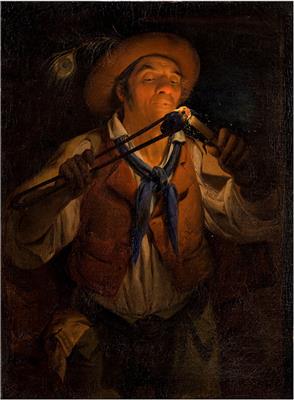
Born in Brescia on 24 November 1807[1], he trained initially with his father and brother in fresco decoration before military service interrupted his studies. At the Brera he found his subject: the city of Milan, its piazzas, porticoes, and the layered social life of its streets. His urban views earned sustained critical and public approval through regular Brera exhibitions from 1834[1] to 1859, and in 1839 he received a commission from the Austrian emperor himself.
The paintings are notable for their documentary precision. Inganni handled architectural perspective with care and populated his scenes with figures that feel observed rather than arranged: shopkeepers, clergy, and street vendors caught mid-routine. "Night on the Piazza del Duomo" is among the best-known examples, a candlelit nocturne that captures Milan's cathedral square with the patient attention of a diarist. He also frescoed several Milanese churches, including San Marco and San Carlo.
After returning to Brescia in the 1850s, his palette shifted toward rural genre subjects in the Flemish tradition, a quieter register suited to the domestic scale of his final decades. In 1856[1] he married his pupil Amanzia Guérillot. He died in December 1880[1].
Timeline
- 1807Born in Brescia on 24 November. He initially trained in fresco decoration with his father and brother.
- 1833Secured a place at the Brera Academy in Milan, thanks to Marshal Radetzky.
- 1834Began exhibiting at the Brera exhibitions, showcasing urban views of Milan.
- 1839Received a commission from the Austrian emperor.
- 1850Returned to Brescia.
- 1856Married his pupil, Amanzia Guérillot.
- 1880Died in December, aged 73.
Notable Works
Tap to view larger.
Next stop
Browse the movements →
Every movement in the collection, from the Renaissance to Pop art.
Related Artists


Frequently Asked Questions
What is Angelo Inganni known for?
Angelo Inganni is known for his paintings of Milan, particularly his urban scenes depicting the city's piazzas and streets. His paintings are noted for their documentary precision, careful handling of architectural perspective, and realistic portrayal of everyday life.What is Angelo Inganni's most famous work?
Information on Angelo Inganni's most famous work is difficult to verify. However, Annibale Carracci (1560-1609[1]) was the most talented of the famous Bologna family of artists. After studies in Bologna, he went to Venice, where he joined his brother Agostino (1558-1602) and studied the Venetian painters. On their return to Bologna, they founded with their cousin Lodovico (1556-1619) the Accademia degli Incamminati (1582); it became the most popular. Carracci's painting Hercules at the Crossroads was originally mounted at the centre of the vaulted ceiling of Cardinal Odoardo Farnese's camerino (study) in the Palazzo Farnese, Rome. It is the keystone of an allegory of the young cardinal's virtues that Annibale elaborated in fresco on the remaining area of the vault. Reynolds's Garrick between Tragedy and Comedy was based on this picture.What should I know about Angelo Inganni's prints?
Angelo Inganni was an Italian[1] painter active in the 19th century, mainly producing scenes of daily life and architecture. Prints of his work are likely to be reproductions, created using photochemical or digital methods. These differ from original prints, which the artist produces by hand using techniques such as etching, woodcut, or lithography. Original prints are considered artworks in their own right. The artist creates the image directly on a plate or block. Each impression is unique. Reproductions, on the other hand, are copies of existing artworks, such as Inganni's paintings. The Professional Art Dealers Association of Canada defines a reproduction as a copy of a work conceived in another medium, made by photomechanical means. The market value of a print depends on factors such as the artist's reputation, the image's popularity, and the quality of the materials. Original prints, produced in limited editions, generally command higher prices than reproductions. Some publishers transfer images to canvas to give them the appearance of paintings; these may be sold in limited editions.What style or movement did Angelo Inganni belong to?
Angelo Inganni (1794-1879[1]) was an Italian[1] painter, active mainly in Lombardy. He is best known for his genre paintings and vedute (city views), particularly of Milan. Inganni's artistic style is often associated with the Biedermeier movement, a style that focused on detailed, realistic depictions of everyday life, often with a sentimental or nostalgic tone. This is evident in his paintings of Milanese cityscapes, which capture the atmosphere of the city and the activities of its inhabitants with great precision. While Inganni's work shares some characteristics with Realism, such as its focus on ordinary subjects, it lacks the social commentary often found in Realist art. Instead, his paintings tend to idealise the scenes they depict, presenting a harmonious and picturesque view of urban life. He also has links to the tradition of historical genre painting[1], which aimed to appeal to bourgeois sensibilities through realistic depictions of the past.What techniques or materials did Angelo Inganni use?
Angelo Inganni was a painter. His techniques included the use of pale grounds, which were unusual for Neoclassical figure painting. These lighter preparations helped ensure luminosity in the finished work. Artists had long been aware that oil paint becomes more transparent as it ages; darker grounds could cause a picture to "sink" as the ground became increasingly visible. Inganni also used strong, coarse canvas, when the convention was that figure painting should be done on finely woven canvas with an invisible weave. He further broke with tradition by using white in his shadows. Earlier chiaroscuro painters thought transparency essential for producing depth. Inganni's innovative use of white created a new, low-relief flatness. His opaque shadows reflect his preference for soft, full-faced lighting, which differed from the dramatic cross-light found in the work of earlier Neoclassicists. Inganni's paint was thin and fluid, and his touch was lively. Although he was often considered a 'monochrome' painter who used colour as an afterthought, his flat areas of bright colour had a powerfully emotive and visually seductive effect.What was Angelo Inganni known for?
Angelo Inganni (1807[1]-1880[1]) was an Italian[1] painter, active mainly in Lombardy. He is best known for his paintings of urban views and genre scenes, often depicting daily life in towns and cities. Inganni's works often feature detailed architectural elements and careful attention to the effects of light and atmosphere. His cityscapes provide valuable documentation of the urban environment of his time. He captured the atmosphere of bustling streets, markets, and historical buildings. While some Rococo painters gained attention for portraits or fantasies, Inganni focused on observed reality. Rococo artists valued novelty, but Inganni's approach was more documentary. His paintings are not idealised visions; instead, they present a realistic portrayal of 19th-century life.When did Angelo Inganni live and work?
Angelo Inganni was born in Brescia in 1807[1] and died in 1880[1]. He spent much of his career depicting scenes of daily life, particularly in the Lombard region of Italy. Inganni is best known for his genre paintings and vedute (cityscapes), often capturing views of Milan and other northern Italian[1] cities. His work provides a window into the architecture and social customs of 19th-century Italy. Although he was active during a period of significant artistic change, Inganni maintained a relatively conservative style, focusing on realistic representation and careful attention to detail. He documented the transformation of Milan from a medieval city into a modern metropolis. His paintings offer valuable historical information about the urban development of the area.Where can I see Angelo Inganni's work?
It is difficult to determine exactly where Angelo Inganni's work can be viewed. However, several museums and galleries exhibit art and design from the Art Deco period, during which Inganni was active. These collections may include examples of his paintings.  In the United States, you might check the collections at the Charles Hosmer Morse Museum of American Art (Winter Park, Florida), the Los Angeles County Museum of Art, the Metropolitan Museum of Art (New York), the Minneapolis Institute of Arts, the Museum of Modern Art (New York), the Royal Ontario Museum (Toronto), the Virginia Museum of Fine Arts (Richmond), or the Wolfsonian at Florida International University (Miami Beach). In the UK, possible locations include the Bakelite Museum (Williton), the Brighton Museum & Art Gallery, the Geffrye Museum (London), the Manchester Art Gallery, the National Museums of Scotland (Edinburgh), and the Victoria & Albert Museum (London). In Italy, try the Fondazione Regionale Cristoforo Colombo (Genova), the Museo del Bijou di Casalmaggiore, or the Museo Richard-Ginori della Manifattura di Doccia (Sesto Fiorentino).Where was Angelo Inganni from?
Angelo Inganni was from Brescia, in the Lombardy region of Italy. He was born there in 1794. Brescia is a city with a rich history, dating back to ancient times, and it has been an important artistic centre for centuries. Inganni's artistic training took place at the Accademia di Belle Arti in Venice, a leading art academy in Italy. Venice, like Brescia, has a long and important artistic tradition. Inganni's time in Venice exposed him to the work of Venetian masters, which had an impact on his artistic development. After his studies, Inganni returned to Brescia, where he spent most of his career. He became a respected figure in the local art scene, producing paintings that captured the atmosphere of the city and its surroundings. Although he travelled and worked elsewhere, Brescia remained his home. He died there in 1871[1].Who did Angelo Inganni influence?
It is difficult to say exactly who Angelo Inganni influenced directly. However, we can discuss the influences of an earlier artist, Raphael, who had a wide-ranging effect on those who followed. Raphael's work impacted many artists, including those who came after him. Annibale Carracci showed a particular interest in Raphael's artistic style. The artist Maratti was also influenced by Raphael, according to Bellori. Even artists who were critical of Raphael acknowledged his importance. Bellori, while praising Raphael, also critiqued his paintings for appearing "too studied". Despite some criticism, Raphael's impact on the art world is clear. His work set a standard that many artists after him aspired to, and his influence can be seen in the art of subsequent generations.Who influenced Angelo Inganni?
It is difficult to name specific individuals who directly influenced Angelo Inganni. However, some contextual information can be provided. Inganni was active as a painter in Brescia, Italy, during the 19th century. He is best known for genre scenes and views of his native city. He was part of a Brescian artistic tradition that included painters such as Giuseppe Pellizza da Volpedo. Without specific biographical information that names Inganni's influences, it is difficult to say with certainty which artists shaped his style. A general understanding of the artistic trends in 19th-century Italy suggests he would have been aware of academic painting, as well as the rise of Realism and early Impressionism. Further research into Brescian art history may reveal more specific influences.
Sources
Editorial draws on the following primary and tertiary references for Angelo Inganni.
- [1] wikipedia Wikipedia: Angelo Inganni Used for: biography, birth dates, death dates, identifiers, movement attribution, nationality.
- [2] book Elizabeth Gilmore Holt; Project Muse, A Documentary History of Art, Volume 2 _ Michelangelo and the Mannerists, The Baroque and the Eighteenth Century Used for: biography.
- [3] book Elizabeth Gilmore Holt; Project Muse, A Documentary History of Art, Volume 2 _ Michelangelo and the Mannerists, The Baroque and the Eighteenth Century Used for: biography.
- [4] book Elizabeth Gilmore Holt; Project Muse, A Documentary History of Art, Volume 2 _ Michelangelo and the Mannerists, The Baroque and the Eighteenth Century Used for: biography.
Editorial overseen by Solis Prints. Sources verified 2026-10-07. Click a source for details, or hover over [N] in the page above to preview.
Editorial standardsMethodologyCorrectionsAI disclosureAbout the editorial team