



Daniel Ridgway Knight
- genre painting
- landscape painting
Born in Chambersburg, Pennsylvania, on 15 March 1839[1], Daniel Ridgway Knight crossed the Atlantic in his mid-twenties and never quite came back. He trained in Paris at the École des Beaux-Arts under Gleyre, then worked in the private studio of Ernest Meissonier, an apprenticeship that sharpened his feel for tonal precision and outdoor light. By 1872[1] he had established a permanent base at Poissy on the Seine, painting along the riverbanks and in the surrounding fields with the methodical attention to natural detail that would define his mature work.
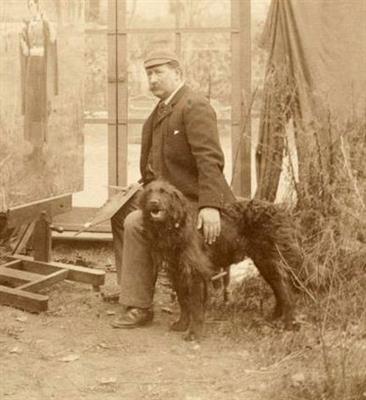
Biography
Knight's subjects were the women of rural France: laundresses, harvesters, girls gathering flowers along the water's edge. He was not a social realist but a painter of pastoral serenity, and his scenes carry something of Bastien-Lepage's plein-air clarity without the political undercurrent. His breakthrough at the 1882[1] Paris Salon came with the large canvas *Un Deuil*. Seven years later, at the 1889 Exposition Universelle, he won the silver medal and was awarded the Cross of the Legion of Honour.
Further recognition followed: a knighthood in the Royal Order of St. Michael of Bavaria in 1893[1], a gold medal from the Pennsylvania Academy of the Fine Arts the same year. He also, in a career footnote that delights those who find it, competed as a sailor at the 1900 Paris Olympics, racing a vessel called *Sans-Gêne* in the 3-to-10-ton event.
Knight remained in France until his death at Neuilly-sur-Seine on 9 March 1924[1], three days before his eighty-fifth birthday. His son Louis Aston Knight (1873[1]-1948[1]) followed him into painting.
Timeline
- 1839Born in Chambersburg, Pennsylvania, on 15 March.
- 1864Moved to Paris, in his mid-twenties, to train at the École des Beaux-Arts under Gleyre.
- 1872Established a permanent base at Poissy on the Seine, France, painting rural scenes.
- 1882Achieved a breakthrough at the Paris Salon with the large canvas "Un Deuil".
- 1889Won the silver medal at the Exposition Universelle and was awarded the Cross of the Legion of Honour.
- 1893Received a knighthood in the Royal Order of St Michael of Bavaria and a gold medal from the Pennsylvania Academy of the Fine Arts.
- 1900Competed as a sailor at the Paris Olympics, racing a vessel called *Sans-Gêne*.
- 1924Died at Neuilly-sur-Seine on 9 March, three days before his eighty-fifth birthday.
Notable Works
Tap to view larger.
Next stop
Browse the movements →
Every movement in the collection, from the Renaissance to Pop art.
Related Artists

Frequently Asked Questions
What is Daniel Ridgway Knight known for?
Daniel Ridgway Knight is known for his paintings of women in the French countryside. His breakthrough came at the 1882[1] Paris Salon with his canvas *Un Deuil*.What is Daniel Ridgway Knight's most famous work?
Daniel Ridgway Knight is best known for his paintings of peasant women in rural France. Although he produced many works in this vein, no single painting can be definitively called his "most famous". Knight's popular works often depict women in gardens or fields, engaged in everyday activities like washing clothes or tending to flowers. These paintings often present an idealised view of rural life, focusing on the beauty of the surroundings and the simple dignity of the figures. Some of his better-known paintings include "Hailing the Ferry" (1888[1]), which depicts women on a riverbank calling for a boat; "The Gleaners", showing women gathering leftover grain after a harvest; and "Waiting for the Ferry", another river scene. These paintings, and others like them, established Knight's reputation and were widely exhibited and collected during his lifetime. While it is difficult to single out one definitive "most famous" work, the paintings mentioned above are representative of Knight's most popular and recognisable themes. They continue to be admired for their idyllic depictions of French country life.What should I know about Daniel Ridgway Knight's prints?
Daniel Ridgway Knight's paintings were popular, and print publishers reproduced them in large numbers for sale to the public. Print-collecting was common in the Victorian period, and prints were expected to be large enough to fill a wall. Publishers often chose appealing titles to attract buyers to printsellers' catalogues. Before title copyrights, variations on popular works were common, as publishers recognised the opportunities offered by printed reproductions. Original prints in limited editions command higher prices than posters, which are not numbered. Plates for original prints are made by hand and can only withstand a certain amount of use. The number of prints pulled is limited by the number of impressions that can be made before the plate wears out. Some publishers impose their own limits to increase a print’s value. These limits may be set as high as 700 to 1,000 impressions; some prints are limited to just 250 to 500, making them highly prized by collectors.What style or movement did Daniel Ridgway Knight belong to?
Daniel Ridgway Knight is best associated with the academic and realist styles, with a focus on rural genre scenes. Academic art refers to artwork produced under the influence of European academies of art. Knight studied at the Pennsylvania Academy of Fine Arts, and later in Paris with artists such as Alexandre Cabanel, who was a noted academic painter. Academic painters often focused on historical or mythological subjects, but Knight applied his academic training to scenes of everyday peasant life. Realism, which emerged in the mid-19th century, sought to depict subjects truthfully, without idealisation. Knight's paintings often portrayed French peasant women in outdoor settings, going about their daily routines. His attention to detail, light, and the natural environment aligns with the realist approach. He lived in France for many years, and his work often reflected the French countryside and its inhabitants.When did Daniel Ridgway Knight live and work?
Daniel Ridgway Knight was born on 15 March 1839[1] in Chambersburg, Pennsylvania. He died on 9 March 1924[1] in Paris, France. Knight spent much of his career working in France. He became known for his paintings of peasant women in garden settings. Knight began his artistic training at the Pennsylvania Academy of the Fine Arts. In 1861[1], he travelled to Paris, where he studied with Alexandre Cabanel. He returned to the United States for a time but went back to France in 1871. He then settled in the French countryside, near Paris. Knight gained considerable success during his lifetime, particularly in the United States, and his works were popular with collectors.Where can I see Daniel Ridgway Knight's work?
While it is difficult to say exactly which galleries currently hold work by Daniel Ridgway Knight, several museums have American[1] art collections that may include his paintings. These include institutions in the United States, such as the Metropolitan Museum of Art in New York, the Los Angeles County Museum of Art, the Minneapolis Institute of Arts, the Virginia Museum of Fine Arts, and the Charles Hosmer Morse Museum of American Art in Winter Park, Florida. In Canada, the Royal Ontario Museum in Toronto also has relevant holdings. You may wish to consult the online collections catalogues of these museums for more information. Other museums may hold his work, but were not named in the provided passages.Who did Daniel Ridgway Knight influence?
Daniel Ridgway Knight's artistic influence is not well documented. However, some historical context can be drawn from the influences of Knight's contemporaries. During Knight's era, several American[1] painters emulated British styles. John Singleton Copley and Gilbert Stuart, for example, actively mirrored their British counterparts in their portraiture. Benjamin West, another contemporary, painted American historical scenes, adopting a style akin to French historical painters like Jacques-Louis David and Jean-Auguste-Dominique Ingres, possibly filtered through British imitators. Later, Fuller and Morse showed influences from both the Munich school and British art. These influences were further expressed in the work of Thomas Eakins, Frank Duveneck, and William Merritt Chase. Winslow Homer, initially an illustrator, was influenced by Eakins, while George Bellows is considered a successor to Chase. Albert Pinkham Ryder's style, a blend of Florentine and Pre-Raphaelite elements, stands somewhat apart, yet all these artists collectively shaped an American artistic tradition.Who influenced Daniel Ridgway Knight?
Daniel Ridgway Knight, an American[1] artist known for his paintings of peasant women in rural France, was influenced by several artists and movements. As a young artist, Knight studied at the Pennsylvania Academy of the Fine Arts, where he was exposed to academic training. Later, he moved to Paris and enrolled at the École des Beaux-Arts, where he studied with artists such as Alexandre Cabanel. Cabanel was a successful academic painter, and his emphasis on technical skill and classical ideals had an impact on Knight's early work. Knight was also drawn to the Barbizon school of painting, which emphasised direct observation of nature and the depiction of rural life. Artists such as Jean-François Millet and Jules Breton, who focused on peasant subjects, influenced Knight's choice of subject matter and his naturalistic style. Knight's paintings often feature women working in fields or gardens, reflecting the Barbizon school's interest in the lives of ordinary people.Who was Daniel Ridgway Knight?
Daniel Ridgway Knight was not the Asa Knight born in 1793 in Dummerston, Vermont. Asa was the son of Joel and Esther Farr Knight, and his grandfather was among Dummerston's earliest settlers in 1774. At 21, Asa was commissioned as an orderly sergeant in the Vermont militia. Asa married Susan Miller in 1822, and they moved to Newfane, where he became the county jail keeper. In 1826, Knight bought Adin Thayer's store on Dummerston common, trading butter and cheese from local dairies in Boston. Knight was active in local government, serving as a Dummerston selectman for seven years, justice of the peace from 1831 to 1848[1], Windham County's Judge of Probate for two years, and a state representative for four years. In the mid-1830s, he expanded his store. Around 1832, Zedekiah Belknap painted portraits of Asa Knight and his wife, Susan Miller Knight. Asa's portrait includes a daybook and ledger, symbols of his business. His customers received store credit for produce like poultry, butter, cheese, and later, palm leaf hats. Knight died in July 1851.Why are Daniel Ridgway Knight's works important today?
Daniel Ridgway Knight (1839[1]-1924[1]) was an American[1] artist who spent much of his career in France. He is best known for his paintings of peasant women in rural settings. Knight trained at the Pennsylvania Academy of the Fine Arts and later in Paris with artists such as Alexandre Cabanel and Charles Gleyre. Knight's popularity grew during his lifetime, and his works were widely exhibited and collected. His focus on rural life and the depiction of women engaged in everyday activities appealed to audiences seeking a romanticised view of the countryside. This was at a time when industrialisation and urbanisation were rapidly changing society. Today, Knight's paintings offer insight into the artistic tastes of the late 19th and early 20th centuries. They provide a visual record of rural life in France during that period. His works are appreciated for their technical skill and their portrayal of light and atmosphere, reflecting the influence of Impressionism, though Knight maintained a more academic style. They are also valued as examples of American artists finding success and inspiration abroad.What was Daniel Ridgway Knight's art style?
Daniel Ridgway Knight's style is characterised by a methodical attention to natural detail. His scenes have a pastoral serenity, reminiscent of Bastien-Lepage's plein-air clarity, but without the political undertones.
Sources
Editorial draws on the following primary and tertiary references for Daniel Ridgway Knight.
- [1] wikipedia Wikipedia: Daniel Ridgway Knight Used for: biography, birth dates, death dates, identifiers, movement attribution, nationality.
- [2] book Beard, Lee, 1973- author, Butler, Adam, author; Van Cleave, Claire, author; Fortenberry, Diane, author; Stirling, Susan, author, Beard, Lee, 1973- author, Butler, Adam, author; Van Cleave, Claire, author; Fortenberry, Diane, author; Stirling, Susan, author - The Art Book_ New Edition, Mini Format Used for: biography.
- [3] book Isabelle Baudino, Eighteenth-Century Engravings and Visual History in Britain Used for: stylistic analysis.
- [4] book Lilian H. Zirpolo, Historical Dictionary of Baroque Art and Architecture Used for: biography.
- [5] book Allison Lee Palmer, Historical Dictionary of Neoclassical Art and Architecture Used for: biography.
- [6] book Palmer, Allison Lee, Historical Dictionary of Neoclassical Art and Architecture Used for: biography.
- [7] book Engen, Rodney K, Pre-Raphaelite prints : the graphic art of Millais, Holman Hunt, Rossetti and their followers Used for: biography, stylistic analysis.
- [8] book Rococo : art and design in Hogarth's England Used for: stylistic analysis.
- [9] book Christensen, Erwin Ottomar, 1890-, The history of Western art Used for: biography.
Editorial overseen by Solis Prints. Sources verified 2026-09-22. Click a source for details, or hover over [N] in the page above to preview.
Editorial standardsMethodologyCorrectionsAI disclosureAbout the editorial team