

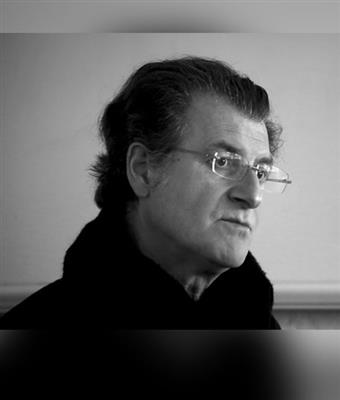
Alfredo Jaar
Trained as an architect and filmmaker in Santiago, Alfredo Jaar has spent his career making work that most architects and filmmakers would be afraid to touch: photographs, installations, and public interventions that press into atrocity, political indifference, and the way images shape what the world allows itself to know.
Biography
In 1980, during the Pinochet dictatorship, he covered Santiago's streets with billboards asking "¿Es usted feliz?" (Are you happy?). At the Museum of Fine Arts, viewers were given mints to place into jars labelled with their answers; those who abstained could pocket them instead. The question was, in context, incendiary. He arrived on the international stage in 1987 with A Logo for America, a three-panel Spectacolor billboard in Times Square. The panels read: "This is not America," then "This is not America's flag" over the U.S. flag, then the word "America" with its R replaced by a map of North and South America. It challenged the quiet violence of a nation claiming an entire continent's name.
Four years later, Jaar spent four years responding to the 1994 Rwandan genocide, producing The Rwanda Project (1994-1998[1]). The work is notable less for the atrocity photographs it contains than for those it withholds: one installation sealed one million slides of victims' eyes in a light box. In October 2000, he staged The Cloud at the San Diego/Tijuana border, reading the names of border-crossing victims aloud while a cellist played on the U.S. side and 3,000 balloons were released on the Mexican side. In 2011, a two-screen installation showed the White House Situation Room during the killing of Osama bin Laden on one screen; the other was left blank, standing in for the viewer's exclusion from the image.
Born in Santiago in 1956[1], Jaar has been based in New York since the early 1980s. He has shown at the Venice Biennale and Documenta, and received the Guggenheim Fellowship and the Alpert Award.
Timeline
- 1956Born in Santiago, Chile
- 1980Covered Santiago streets with billboards asking '¿Es usted feliz?'
- 1980Moved to New York City
- 1987Created 'A Logo for America' billboard in Times Square
- 1994Began responding to the Rwandan genocide
- 1998Completed 'The Rwanda Project'
- 2000Staged 'The Cloud' at the San Diego/Tijuana border
- 2011Created two-screen installation about Osama bin Laden killing
Notable Works
Tap to view larger.
Next stop
Browse the movements →
Every movement in the collection, from the Renaissance to Pop art.
Related Artists



Frequently Asked Questions
What is Alfredo Jaar known for?
Alfredo Jaar is known for photographs, installations, and public interventions that press into atrocity, political indifference, and the way images shape what the world allows itself to know. One notable work is The Rwanda Project (1994-1998[1]), responding to the 1994 Rwandan genocide.What is Alfredo Jaar's most famous work?
Alfredo Jaar is a Chilean[1] conceptual artist based in New York. He trained as an architect and filmmaker. His works often consist of photographs, installations, and happenings. These works analyse unequal contemporary political, social, and economic power relations. One of Jaar's best-known works is A Logo for America (1987). This electronic billboard in New York City’s Times Square emblazoned the statement “This is not America” across a map of the United States. The work reminds viewers that "America" refers not only to the United States. It also refers to the hemispheric mass comprising North, South, and Central America; what is more correctly designated by the plural las Americas in Spanish. Inequality is also at the centre of May 1, 2011 (2011). This installation consists of two large screens. The right-hand screen depicts the Situation Room of the White House as President Obama, Secretary of State Hillary Clinton, and other members of the cabinet watch Osama Bin Laden’s assassination. The left-hand screen is left blank, symbolising our powerlessness to witness the action directly.What techniques or materials did Alfredo Jaar use?
Alfredo Jaar is known for installations, often incorporating light and text, that address complex socio-political issues. His practice is not defined by a single medium; instead, he selects materials appropriate to the message he wishes to convey. Jaar frequently uses light boxes to present photographic images or textual statements. These light boxes can be large-scale, dominating architectural spaces, or smaller, more intimate in scale. He also employs mirrors to create disorienting or reflective environments, prompting viewers to consider their role in the issues presented. In some projects, Jaar has used simple materials like soil or seeds to allude to themes of growth, decay, and displacement. He also incorporates documentary photographs and film, often focusing on under-reported or marginalised communities. The selection of material is always conceptually driven, with the goal of creating a powerful and thought-provoking experience for the viewer.When did Alfredo Jaar live and work?
Alfredo Jaar was born in Santiago, Chile, in 1956[1]. He trained as an architect and filmmaker. He is now based in New York. Jaar's work often takes the form of photographs, installations, and happenings. These works analyse unequal power relations, particularly political, social, and economic imbalances. One example is *A Logo for America* (1987), an electronic billboard in New York City's Times Square. It displayed the statement "This is not America" across a map of the United States. This work aimed to remind viewers that the term "America" refers to the whole hemispheric mass, not only the United States. Another work, *The Cloud* (2000), was performed at the San Diego/Tijuana border. It honoured victims of border crossings. It involved a cellist on the US side and three thousand balloons on the Mexican side. Inequality is also central to *May 1, 2011* (2011). This installation consists of two screens. One screen depicts the White House Situation Room during the assassination of Osama Bin Laden. The other screen is blank, symbolising the viewer's powerlessness to witness the event directly.Where can I see Alfredo Jaar's work?
Alfredo Jaar's artwork has been exhibited in many locations. These include the Museum of Modern Art in New York; the Royal Ontario Museum in Toronto; and the Musée d’Art Moderne de la Ville de Paris. Other museums that have displayed Jaar's work include the Metropolitan Museum of Art (New York), the Los Angeles County Museum of Art, and the Minneapolis Institute of Arts. The Virginia Museum of Fine Arts in Richmond, Virginia, and the Wolfsonian in Miami Beach, Florida, have also exhibited his pieces. In the United Kingdom, you might find Jaar's art at the Manchester Art Gallery or the National Museums of Scotland, Royal Museum (Edinburgh). The Victoria & Albert Museum in London is another possibility.Who was Alfredo Jaar?
Alfredo Jaar is a Chilean[1] conceptual artist who is based in New York. He trained as an architect and filmmaker, but his works consist of photographs, installations, and happenings.What was Alfredo Jaar's art style?
Alfredo Jaar's art style incorporates photographs, installations, and happenings. His installations often display photographs in light boxes and slides.When was Alfredo Jaar born?
Alfredo Jaar was born in 1956[1].
Sources
Editorial draws on the following primary and tertiary references for Alfredo Jaar.
- [1] wikipedia Wikipedia: Alfredo Jaar Used for: biography, birth dates, death dates, identifiers, movement attribution, nationality.
- [2] book guggenheim-hugo00newy Used for: biography.
- [3] book Patrick Frank, Readings in Latin American Modern Art Used for: biography.
- [4] book Zabala, Santiago, Why Only Art Can Save Us _ Aesthetics and the Absence of Emergency Used for: biography.
Editorial overseen by Solis Prints. Sources verified 2026-10-07. Click a source for details, or hover over [N] in the page above to preview.
Editorial standardsMethodologyCorrectionsAI disclosureAbout the editorial team