



Alexander Ivanov
For twenty years, Alexander Ivanov worked on a single painting. The Appearance of Christ Before the People, begun in Rome in 1837[1] and still unfinished when he returned to St Petersburg in 1858[1], measures 540 by 750 centimetres and absorbed almost his entire adult life.
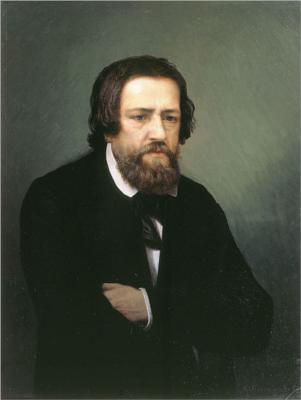
Biography
The son of Andreï Ivanov, a professor of historical painting at the Imperial Academy of Arts in St Petersburg, Alexander left for Italy in 1831[1] and stayed for nearly three decades. His immersion in Rome was total: he painted in the countryside around Albano and Frascati, producing careful oil studies of water, stones, and light that critics would later compare to Pre-Raphaelite naturalism. Works such as Appian Way at Sunset and Water and Stones near Pallazzuolo have an almost scientific fidelity to observed nature. Many art historians argue these studies, along with the individual preparatory figure sketches for the great canvas, are his finest achievements. A preparatory head of John the Baptist from the project is considered a masterpiece in its own right.
The problem with the magnum opus was one Ivanov himself recognised. He never regarded the finished work as complete, and the laboured quality of the final canvas contrasts with the vitality of the sketches. To escape commissions he considered distractions, he declined to paint the interior of St Isaac's Cathedral, pleading a more demanding project: a series of over 250 watercolour Biblical Sketches intended as studies for an ideal temple encompassing all human spiritual experience. Neither the temple nor the cathedral decoration was realised.
Ivanov died in St Petersburg in 1858[1], weeks after finally returning home. The great canvas went to the Tretyakov Gallery, where it remains.
Timeline
- 1806Born in Russia.
- 1831Left for Italy, stayed for nearly three decades.
- 1837Began painting 'The Appearance of Christ Before the People' in Rome.
- 1858Returned to St Petersburg.
- 1858Died in St Petersburg.
Notable Works
Tap to view larger.
Next stop
Neoclassicism →
Explore the artists and ideas of Neoclassicism.
Alexander Ivanov prints
Hand-finished archival prints from Alexander Ivanov's body of work.
 The Appearance of Christ to the People - Alexander Ivanov
From £28.00
The Appearance of Christ to the People - Alexander Ivanov
From £28.00
 Italian Landscape - Alexander Ivanov
From £28.00
Italian Landscape - Alexander Ivanov
From £28.00
 Head of John the Baptist - Alexander Ivanov
From £28.00
Head of John the Baptist - Alexander Ivanov
From £28.00
 A Girl from Albano Standing in the Doorway - Alexander Ivanov
From £28.00
A Girl from Albano Standing in the Doorway - Alexander Ivanov
From £28.00
 Noli Me Tangere - Alexander Ivanov
From £28.00
Noli Me Tangere - Alexander Ivanov
From £28.00
 Olive Trees at Albano - Alexander Ivanov
From £28.00
Olive Trees at Albano - Alexander Ivanov
From £28.00
Related Artists


Take Alexander Ivanov home.
See all Alexander Ivanov prints →Frequently Asked Questions
What is Alexander Ivanov known for?
Alexander Ivanov is known for his painting, The Appearance of Christ Before the People, on which he worked for twenty years. He is also known for over 250 watercolour Biblical Sketches intended as studies for an ideal temple encompassing all human spiritual experience, though neither the temple nor the cathedral decoration was realised.What is Alexander Ivanov's most famous work?
Alexander Ivanov (1806[1]-1858[1]) was a Russian[1] painter, and arguably the most influential religious painter of his day. Ivanov's father, Andrei Ivanov, was a professor of historical painting at the Academy. Alexander Ivanov made his mark early with works such as *Apollo, Hyacinth and Zephyr* and *The Appearance of Christ to Mary Magdalene* (1836[1]). His most famous, though never completed, work is *The Appearance of Christ to the People*. He dedicated much of his energy to this large canvas for twenty years, from 1837 until 1857. Ivanov was never satisfied with the painting and considered it unfinished. Some think it has a laboured quality. Many of his preparatory studies, including portraits and nature studies, possess a vitality absent from the final painting. One study, a head of John the Baptist, is considered a masterpiece.What should I know about Alexander Ivanov's prints?
Alexander Ivanov (1806[1]-1858[1]) was a Russian[1] painter associated with the Academic style. While Ivanov was primarily a painter, prints of his work exist in various forms, as is typical for artists of his stature. Original prints, such as woodcuts, engravings, or lithographs, are produced by hand, with the artist creating the artwork directly on the plate or block. These are considered original works of art and are usually sold in limited editions, which increases their value. The number of prints in an edition is limited either by the wear of the plate or by the publisher to enhance the print's worth. Offset reproductions (also known as posters) are produced photochemically and are not limited by plate wear, though publishers may still limit quantities. Giclée prints are a more recent development, using inkjet technology to create fine art prints. Canvas transfers, where the image is transferred to canvas, offer the look of a painting. When buying a limited edition print, check how it is signed and numbered. Typically, the print number and edition number are written on the bottom left margin, the title in the centre, and the signature on the right, all in pencil.What style or movement did Alexander Ivanov belong to?
Alexander Ivanov (1806[1]-1858[1]) was a Russian[1] painter of religious and historical subjects. Although his father was a professor of historical painting at the Academy, and Ivanov was a contemporary of Karl Briullov, Ivanov is regarded as the most significant Russian religious painter of his era. His artistic education included time in Paris and Rome. Ivanov's body of work includes paintings such as *Apollo, Hyacinth and Zephyr* and *The Appearance of Christ to Mary Magdalene* (1836[1]). He spent two decades, from 1837 until 1857, working on *The Appearance of Christ to the People*. Despite this extensive effort, Ivanov was never satisfied with the painting, and it was never considered finished. Many of his preparatory studies, including portraits and nature studies, possess a quality absent from the final painting.What techniques or materials did Alexander Ivanov use?
Alexander Ivanov (1806[1]-1858[1]) was a Russian[1] painter who dedicated much of his career to the study of historical painting and biblical subjects. Ivanov's early training at the Imperial Academy of Arts in Saint Petersburg provided him with a solid foundation in academic drawing and painting techniques. His initial works, such as "Priam Asking Achilles for the Body of Hector" (1824[1]), demonstrate a mastery of composition, anatomical accuracy, and the use of chiaroscuro to create dramatic effects. In Rome, where he spent a significant portion of his career, Ivanov meticulously studied classical art, Renaissance masters, and the Italian landscape. He aimed to achieve historical accuracy and emotional depth in his paintings. He employed oil paints on large canvases, building up layers of colour to create luminous effects. His studies of light and atmosphere are evident in his sketches and preparatory drawings, many of which were executed in watercolour and pencil. Ivanov's magnum opus, "The Appearance of Christ Before the People", occupied him for two decades. For this painting, he made countless studies of figures, drapery, and facial expressions, striving for realism and psychological insight. He hoped to convey a spiritual message through his art, combining technical skill with moral purpose.What was Alexander Ivanov known for?
Alexander Ivanov (1806[1]-1858[1]) was a Russian[1] painter, and arguably the most influential religious painter of his time. His father, Andrei Ivanov, was a professor of historical painting at the Academy. Ivanov is known for large historical and religious paintings. Early in his career, he made his mark with works such as *Apollo, Hyacinth and Zephyr* and *The Appearance of Christ to Mary Magdalene* (1836[1]). From 1837, he devoted two decades to *The Appearance of Christ to the People*. Ivanov was never satisfied with the painting, and it was never considered finished. Some critics find it has a laboured quality; many of his preparatory studies, such as the head of John the Baptist, possess a vitality absent from the final work. During the last decade of his life, Ivanov produced over 250 *Biblical Sketches*. Many are remarkable for their limpid colours and spiritual intensity. Ivanov wanted to convert these watercolour studies into murals for a temple encompassing every aspect of human spirituality. He avoided working on the interior of St. Isaac’s Cathedral to concentrate on the ideal temple taking shape in his mind.When did Alexander Ivanov live and work?
Alexander Andreyevich Ivanov (1806[1]-1858[1]) was a Russian[1] painter who adhered to a historical, religious, and academic style of painting. Ivanov was born in St Petersburg, the son of Professor Andrey Ivanov, who taught at the Imperial Academy of Arts. From 1817[1] to 1824, Alexander Ivanov studied at the Academy under his father's tutelage. He won a silver medal for a sketch of Priam begging Achilles for the body of Hector, followed by a gold medal for Joseph interpreting the dreams of prisoners. This latter award qualified him for a stipend to study abroad. Ivanov arrived in Rome in 1830, where he befriended the sculptor Bertel Thorvaldsen and was inspired by the German Nazarene movement. Karl Brullov's The Last Day of Pompeii provided another important influence. Ivanov spent most of his subsequent life in Italy. His most important work, The Appearance of Christ Before the People (1837-1857[1]), occupied him for twenty years. He hoped that this large painting would make a spiritual impact on viewers. Ivanov returned to St Petersburg in 1858 to exhibit the painting, but he died of cholera soon after its arrival.Where can I see Alexander Ivanov's work?
Alexander Ivanov's artwork can be found in numerous museums and collections, both in Russia and internationally. Many Russian[1] museums hold his pieces. These include the All-Russian Museum of Decorative and Folk Art and the Central State Archive for Literature and Art, both in Moscow; the Astrakhan Kustodiev Picture Gallery; the Irkutsk Regional Art Museum; and the Ivanovo State Museum of History and the Revolution. Outside of Russia, you can find his work at the Albright-Knox Art Gallery in Buffalo, New York; the Dallas Museum of Art; the Los Angeles County Museum of Art; the Peggy Guggenheim Collection in Venice; and the Solomon R. Guggenheim Museum in New York. The British Library also holds some of his pieces. During the early Soviet era, the Museum Bureau of IZO-Narkompros organised exhibitions and distributed artworks to provincial museums. These included museums in Vitebsk, Samara, Astrakhan, Penza, and Simbirsk. The Vyatka Art Museum has a collection that includes pieces by Ivanov, as well as works by other avant-garde artists.Where was Alexander Ivanov from?
Alexander Andreyevich Ivanov (1806[1]-1858[1]) was a Russian[1] painter. He was associated with the Academic style, and he spent most of his working life in Italy. Ivanov was born in St Petersburg. His father, Andrei Ivanovich Ivanov, was a professor at the Imperial Academy of Arts. From 1817[1] to 1824, Alexander Ivanov studied at the Academy under his father’s tutelage. He won a silver medal for a sketch of Priam Asking Achilles for the Body of Hector, then a gold medal for Joseph Interpreting the Dreams of the Prisoners. In 1830, Ivanov travelled to Italy on a grant from the Society for the Encouragement of Artists. He arrived in Rome, where he befriended the sculptor Bertel Thorvaldsen. Ivanov remained in Italy for the rest of his life, though he returned to St Petersburg briefly shortly before his death. He is buried in the Novodevichy Cemetery in St Petersburg.Who did Alexander Ivanov influence?
Alexander Ivanov (1806[1]-1858[1]) was a Russian[1] painter associated with the academic style. His most important work is the enormous canvas, *The Appearance of Christ Before the People* (1837[1]-1857[1]), now in the collection of the Tretyakov Gallery, Moscow. Ivanov's influence is complex. While he had students, his impact is more visible in the later development of Russian art through his dedication to historical and religious subjects, and his intense, if sometimes laboured, approach to painting. Some later artists, such as Ilya Repin (1844-1930), reacted against the academic formalism that Ivanov represented. Others found inspiration in his ambitious themes and the scale of his artistic vision. Ivanov's focus on moral and spiritual questions resonated with artists seeking to express deeper meanings in their work. His studies of light and his attempts to capture human emotion also provided a point of reference for those who followed. Ivanov's work encouraged Russian artists to engage with significant philosophical and ethical issues in their art, even if they rejected his specific stylistic choices.Who influenced Alexander Ivanov?
Alexander Ivanov's artistic development occurred during a period when Russian[1] painting was heavily influenced by European trends. Initially, the staff at the Academy (where Ivanov's father was a professor) were primarily French and Italian, which meant that Russian art often followed European fashions, albeit with some delay. Catherine the Great's art acquisitions for the Hermitage, which included French, Italian, and Dutch masterpieces, also provided opportunities for Russian artists to study Western art. Reproductions, such as engravings and lithographs, further aided in familiarising artists with both Russian and international art. Like many Russian painters of the first half of the 19th century, Ivanov travelled to Italy. Nestor Kukolnik, a poet and aesthete, even claimed that Russian painting had become an extension of the Italian school. Ivanov's *Appian Way at Sunset* and *Water and Stones near Pallazzuolo* show a Pre-Raphaelite aesthetic. Although Ivanov was indisputably the most influential religious painter of his day, he was influenced by the Italian Renaissance.Who was Alexander Ivanov?
Alexander Ivanov (1806[1]-1858[1]) was a Russian[1] painter, and arguably the most influential religious painter of his era. His father, Andreï Ivanov, was a professor of historical painting at the Academy. Ivanov is known for paintings such as *Apollo, Hyacinth and Zephyr* and *The Appearance of Christ to Mary Magdalene* (1836[1]). He spent roughly twenty years, from 1837 until 1857, working on *The Appearance of Christ to the People*. Despite this extensive effort, Ivanov was never satisfied with the painting and considered it unfinished. Some find that it has a laboured quality. Many of his preparatory studies, including nature studies, portraits, and a head of John the Baptist, possess a vitality absent from the final painting. During the last decade of his life, Ivanov produced over 250 *Biblical Sketches*. These watercolour studies are notable for their spiritual intensity and limpid colours. Ivanov hoped to convert them into murals for a temple encompassing every aspect of human spirituality, drawing on both Christian ideas and mythology. This ambition consumed him so much that he avoided working on the interior of St. Isaac’s Cathedral to concentrate on his ideal temple.
Sources
Editorial draws on the following primary and tertiary references for Alexander Ivanov.
- [1] wikipedia Wikipedia: Alexander Ivanov Used for: biography, birth dates, death dates, identifiers, movement attribution, nationality.
- [2] book Peter. Leek, Russian Painting Used for: biography.
Editorial overseen by Solis Prints. Sources verified 2026-09-14. Click a source for details, or hover over [N] in the page above to preview.
Editorial standardsMethodologyCorrectionsAI disclosureAbout the editorial team