



Adolf Eberle
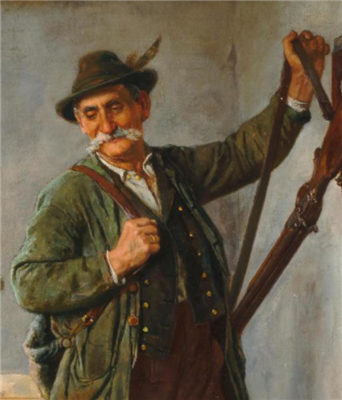
Munich-born Adolf Eberle came from a painter's household (his father Robert was also an artist) and arrived at the Academy of Fine Arts in 1860[1] under the formidable Karl von Piloty. Within a year he had his first public success: Pfändung der letzten Kuh (Mortgaging the Last Cow) attracted enough attention that William Unger chose to engrave it in 1861, placing the eighteen-year-old before a wider audience.
Biography
For some time he worked in an entirely different register, painting episodes from the Thirty Years' War and Seven Years' War. He returned eventually to what he knew best: the daily life of Bavarian and Tyrolean farmers, huntsmen, and their animals. His 1879[1] painting Erster Rehbock (First Stag) was well received at Munich's international exposition that year, and his genre scenes continued to sell steadily throughout his long career.
Two auction results give a sense of the market for his work: Childhood Fun brought $16,800 at Bonhams San Francisco in 2007, and The Day's Bag fetched £7,500 at Christie's London in 2012. The city of Munich recognised his contribution in 1952 by naming Eberlestraße in the Solln neighbourhood after him, nearly four decades after his death.
Timeline
- 1843Born in Munich, Germany
- 1860Entered the Academy of Fine Arts under Karl von Piloty
- 1861First public success with 'Pfändung der letzten Kuh'
- 1879'Erster Rehbock' well received at Munich's international exposition
- 1914Died
Notable Works
Tap to view larger.
Next stop
Browse the movements →
Every movement in the collection, from the Renaissance to Pop art.
Related Artists



Frequently Asked Questions
What is Adolf Eberle known for?
Adolf Eberle is known for his genre scenes depicting the daily lives of Bavarian and Tyrolean farmers, huntsmen, and their animals. His painting Erster Rehbock (First Stag) was well received at Munich's international exposition in 1879[1].What is Adolf Eberle's most famous work?
There is no consensus regarding Adolf Eberle's single most famous work; his output was consistent rather than focused on one specific piece. He is best known for genre paintings, often depicting scenes of everyday life in rural Bavaria. Eberle's paintings frequently feature peasants, farmers, and hunters in detailed, anecdotal situations. These works are characterised by careful attention to detail, particularly in the rendering of costumes and settings. Examples of his popular works include scenes of village life, hunting expeditions, and interactions within rural communities. While no single painting overshadows his other works, his body of work collectively provides a valuable insight into 19th-century Bavarian life. Eberle's paintings are appreciated for their realistic portrayal of rural existence and their contribution to genre painting.What should I know about Adolf Eberle's prints?
Adolf Eberle (1843[1]-1914[1]) was a German[1] genre painter. Prints of his work are most likely to be offset reproductions, canvas transfers, or giclée prints, rather than original prints. Original prints, such as woodcuts, engravings, or lithographs, are produced by hand, with the artist creating the artwork directly on the plate or block. Each print is considered an original. These are sold through specialist galleries, frame shops, and fine-art galleries. Offset reproductions are produced by photochemical means. There is no physical limit to the number of prints that can be made. Giclée prints are fine-art prints made using colour-copier technology. Canvas transfers involve transferring the image onto canvas, giving it the appearance of a painting. When buying prints, look for a signature; this testifies to the authenticity of a print and the artist's approval. Artists often number their prints, for example 35/100, where 100 is the total number of prints in the edition, and 35 is the sequential number of that particular print.What style or movement did Adolf Eberle belong to?
Adolf Eberle (1843[1]-1887[1]) was a German[1] painter associated with genre painting, a style that gained popularity in the 19th century. Genre art focuses on scenes from everyday life, often depicting ordinary people engaged in common activities. Eberle's works frequently portrayed Bavarian peasants, village life, and hunting scenes, capturing the customs and costumes of the time. These paintings often had anecdotal or sentimental qualities. Genre painting emerged as a significant movement in the 19th century, reflecting a growing interest in realism and the lives of the middle and lower classes. Artists like Eberle contributed to this trend by creating accessible and relatable images of contemporary life, which appealed to a broad audience. His attention to detail in costume and setting provides insight into Bavarian culture during this period.What was Adolf Eberle known for?
Information on Adolf Eberle is not present in the reference passages. However, the passages do contain information on other artists working in Germany and Austria in the early 20th century. Adolf Hengeler produced a watercolour and pencil work, "Hoopoe" (1908[1]), now held in the Deutsches Theatermuseum, Munich. Rolf Hoerschelman created a cover for Sclnvabinger Schattenspiele (1908), which is now in the Stadtbibliothek, Munich. Adolf Holzel created pen and ink drawings, such as "The Battle" and "Figure Ornament with Edging Strip". These works are part of the Pelikan-Kunstsammlung, Hannover. Ernst Ludwig Kirchner painted "Portrait of Alfred Döblin" (1912); the painting is in the Busch-Reisinger Museum, Harvard University. Fritz Erler created stage designs (circa 1908) as lithographs. These are part of the collection of the Münchner Stadtmuseum, Munich. Egon Schiele, an Austrian Expressionist artist from Vienna, created drawings focusing on emotional states. His works display technical mastery and psychological penetration.Where can I see Adolf Eberle's work?
It is difficult to provide a comprehensive list of locations holding works by Adolf Eberle. However, some European museums with collections of German[1] art may hold his paintings. These include the Brucke Museum and Nationalgalerie in Berlin, the Kunsthalle and Sammlung Bottcherstrasse in Bremen, the Ludwig Museum and Wallraf-Richartz Museum in Cologne, the Folkwang Museum and Gesellschaft Kruppsche Gemaldesammlung in Essen, and the Kunsthalle in Hamburg. Additional museums are the Niedersachsisches Landesmuseum in Hanover, the Stadtische Kunsthalle in Mannheim, the Bayerische Staatsgemaldesammlungen in Munich, the Stiftung Ada und Emil Nolde in Seebull, and the Von der Heydt Museum in Wuppertal. It may be useful to consult museum databases, specialist catalogues, and auction records to ascertain the current locations of particular works by Eberle.Where was Adolf Eberle from?
Adolf Eberle was from Munich. In the middle of the nineteenth century, Munich became a major European centre for academic training, second only to Paris. Young men and women from various countries went to the Bavarian capital to pursue traditional studies at the Academy and other art schools. They also went to witness modern developments in visual and performing arts. Munich had long been a focus of cultural activity. The Catholic church and the Wittelsbach family, who had ruled Bavaria since the twelfth century, were major patrons of the arts in Munich during the early modern era. Munich's location near the Alps made it a crossroads into Central Europe for both Italian art and Roman faith.Who did Adolf Eberle influence?
It is difficult to say precisely who Adolf Eberle influenced. However, Albrecht Dürer had a wide-ranging effect on artists of the 16th century and beyond. Limewood sculptors borrowed from his prints, and Italian artists responded to his work. During the "Dürer Renaissance" (approximately 1570 to 1630), Hans Hoffmann produced faithful replicas of Dürer's drawings. In the 17th century, artists such as Caravaggio and Diego Velázquez appear to have drawn inspiration from Dürer's woodcuts and engravings. Rembrandt owned Dürer's book on proportion and adapted figures from his prints. In the 19th century, Dürer's importance rose with nationalistic revivalism. Twentieth-century artists, including Otto Dix, Lucian Freud, and Norman Rockwell, engaged with Dürer's work in various ways. Dürer's graphic style also influenced stained-glass design. Hans Baldung, Hans Schäufelein, and Hans Leu the Younger carried his legacy to other cities. Hans von Kulmbach, who worked in Dürer's circle, adopted his graphic language for monumental windows. Sebald Beham and Georg Pencz also emulated Dürer's style in their designs.Who was Adolf Eberle?
Adolf Eberle (likely born in 1843[1], date of death unknown) was a painter active in Munich. During Eberle's time, Munich underwent considerable transformation. Formerly a centre of Counter-Reformation Catholicism, it became the administrative capital of a secular state. Its Gothic and Baroque core was surrounded by boulevards and neo-classical buildings housing royal offices and cultural landmarks. Maximilian II, who ruled from 1848[1] to 1864, aimed to modernise Bavaria and improve living conditions through technology and science. He also supported applied arts and modern architecture. The Kunstgewerbeverein was founded in 1851, and Munich's Glaspalast showcased advanced iron-and-glass construction. Maximilian II patronised Gothic and Northern Renaissance styles, considered bourgeois styles, in architecture and design. This paralleled a shift from classicism and romanticism to realism at the Munich Academy of Art. Students included German[1] artists, as well as American realists like William Merritt Chase and Frank Duvenek.How did Adolf Eberle die?
Adolf Eberle died in 1914[1] at the age of 71.
Sources
Editorial draws on the following primary and tertiary references for Adolf Eberle.
- [1] wikipedia Wikipedia: Adolf Eberle Used for: biography, birth dates, death dates, identifiers, movement attribution, nationality.
- [2] book Husslein-Arco, Agnes, editor; Koja, Stephan, editor; Law, Rebecca (Translator), translator; McInnes, Robert (Translator), translator; Somers, Nick, translator; Monet, Claude, 1840-1926. Paintings. Selections; Österreichische Galerie Belvedere, h Used for: biography.
- [3] book Masterpieces of western art : a history of art in 900 individual studies from the Gothic to the present day Used for: biography.
Editorial overseen by Solis Prints. Sources verified 2026-09-30. Click a source for details, or hover over [N] in the page above to preview.
Editorial standardsMethodologyCorrectionsAI disclosureAbout the editorial team