



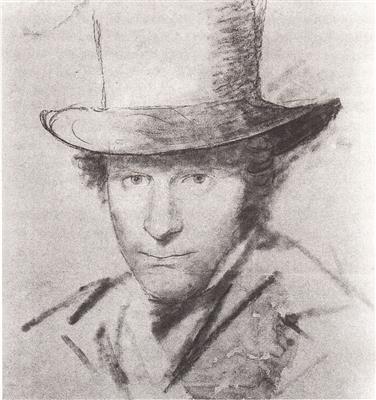
Albrecht Adam
- landscape painting
In the summer of 1812[1], Albrecht Adam rode east with Napoleon's Grande Armée as official artist to Prince Eugène de Beauharnais, commander of the IV Corps and stepson of the Emperor. He sketched through the advance into Russia, survived the catastrophic retreat, and returned with a portfolio of drawings that would take fifteen years to reach print. The resulting Voyage pittoresque et militaire (1828-1833[1]) ran to eight volumes of lithographs and remains among the most comprehensive eyewitness visual records of the campaign.
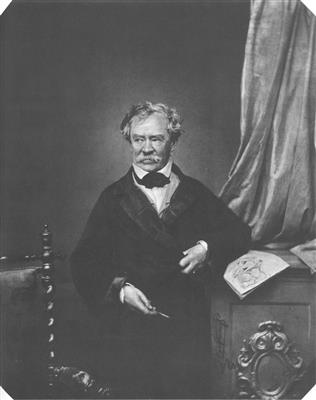
Biography
Born in Nördlingen, Bavaria, in 1786[1], Adam had trained as a confectioner before teaching himself to draw. The Russian campaign gave him material unlike anything a studio artist could produce: devastated villages, the crossings of the Neman and Dnieper rivers, the battlefields of Smolensk and Borodino, the slow catastrophe of the retreat. He depicted it without Napoleonic grandeur, noting the mud, the dead horses, and the bewildered civilians left behind.
In 1815[1] he was appointed court painter to King Maximilian I Joseph of Bavaria, a position that provided stability while he developed his reputation as the foremost German[1] equine painter of his generation. King Ludwig I and Maximilian von Leuchtenberg became subsequent patrons, and his work on cavalry and battle scenes sustained considerable demand through the mid-century.
Three of his sons, Benno, Eugen, and Franz, became painters in turn, and his grandson Emil Adam continued the family specialisation in equestrian subjects well into the Edwardian era. Albrecht Adam died in Munich in August 1862[1].
Timeline
- 1786Born in Nördlingen, Bavaria
- 1812Joined Napoleon's Grande Armée as official artist
- 1812Sketched the advance into Russia and the catastrophic retreat
- 1815Appointed court painter to King Maximilian I Joseph of Bavaria
- 1828Published 'Voyage pittoresque et militaire' (1828-1833)
- 1833Published 'Voyage pittoresque et militaire' (1828-1833) completed
- 1862Died in Munich
Notable Works
Tap to view larger.
Next stop
Browse the movements →
Every movement in the collection, from the Renaissance to Pop art.
Related Artists


Frequently Asked Questions
What is Albrecht Adam known for?
Albrecht Adam is known for his depictions of military scenes, particularly his comprehensive visual record of Napoleon's campaign in Russia. His series of lithographs, Voyage pittoresque et militaire, captured the realities of war, including the hardships faced by soldiers and civilians. He also gained recognition as the foremost German[1] equine painter of his generation.What is Albrecht Adam's most famous work?
It is difficult to name one single work as Albrecht Adam's most famous. Adam was a prolific painter, especially known for his paintings of battle scenes. He accompanied the French army on several campaigns, including the 1812[1] Russian campaign, and the events of these military engagements informed much of his artistic output. His paintings of battles during the Napoleonic Wars, such as the "Battle of Moscow", earned him considerable recognition. He is also known for his depictions of horses and other animals, and for his portraits of military figures. Adam's detailed and realistic style, combined with his ability to capture the energy and chaos of battle, made him a popular and respected artist in his time. Adam's body of work provides a valuable visual record of military history.What should I know about Albrecht Adam's prints?
Albrecht Adam (1786[1]-1862[1]) was a German[1] artist, mainly known for his military paintings and lithographs. He had a career as a painter of battle scenes, and he accompanied various military campaigns, including Napoleon's invasion of Russia in 1812[1]. Adam's prints are mainly lithographs, a printmaking technique that became popular in the 19th century. Lithography allowed for more detailed and tonal images compared to earlier printmaking methods. He is known for his detailed and accurate depictions of military subjects, including soldiers, horses, and battle formations. His prints often document specific battles or campaigns, providing a visual record of military history. Many of Adam's prints were created as part of larger series or albums, intended for a wide audience. They were often commissioned by military figures or institutions to commemorate events or promote military achievements. His works provide insight into military history, as well as the technical aspects of 19th-century printmaking.What style or movement did Albrecht Adam belong to?
Albrecht Adam (1786[1]-1862[1]) was a German[1] painter, best known for his battle scenes. He is associated with the Biedermeier movement, which dominated German art from around 1815[1] to 1848. Biedermeier art often featured realistic depictions and a focus on middle-class life. However, some scholars suggest that Adam's work also shows elements of Romanticism, particularly in his dramatic compositions and emphasis on the emotional impact of warfare. Others note that Adam's paintings share qualities with Realism, due to his attention to detail and accurate portrayal of military subjects. Given the overlap in dates, it is not unusual for an artist's work to partake of more than one tendency. Adam's art is a blend of these different styles, making him a complex figure in 19th-century European painting.What techniques or materials did Albrecht Adam use?
Albrecht Adam was a painter, but the term covers a range of techniques. Some artists working on glass used light to their advantage. They would paint details on glass, and the effect would be achieved through melting, becoming a filter of light. The hues of glass painting do not materialise as they do with reflected light through spectral values of body colours. Instead, hues appear by the selective absorption or diffusion of specific wavelengths of light. From about 1430, glass painters adopted stylistic methods from oil paintings and graphic arts. In the fifteenth century, the stained-glass window became a picture. The glass became the pictorial support, comparable to wood or canvas in painting, and thus lost the meaning it had in the Middle Ages as a radiant two-dimensional extension. In their use of colours, glass artists abandoned the rules that had governed the medieval window; they now used colour naturalistically. Pictorial backgrounds are opened "to the outside." Light, usually falling from the upper left, originates from an imaginary light source. Further, corporeal modelling and shadows are introduced.Where can I see Albrecht Adam's work?
Albrecht Adam's works can be viewed in numerous museums across Europe. In Germany, several institutions hold his pieces, including the Brucke Museum, Nationalgalerie, and Kunsthalle in Berlin; the Kunsthalle in Bremen; the Ludwig Museum and Wallraf-Richartz Museum in Cologne; the Folkwang Museum in Essen; and the Stadtische Kunsthalle in Mannheim. Other German[1] locations include the Bayerische Staatsgemaldesammlungen in Munich; the Stiftung Ada und Emil Nolde in Seebüll; and the Von der Heydt Museum in Wuppertal. Outside of Germany, Adam's art can be found in the Staatliche Museen in Berlin; the Herzog Anton Ulrich-Museum in Braunschweig; the Gemaldegalerie Alte Meister in Dresden; the National Gallery of Scotland in Edinburgh; the Galleria degli Uffizi in Florence; and the Stadel Museum in Frankfurt am Main. Further afield are the National Museums Liverpool, the British Library, the British Museum, the National Gallery, the National Portrait Gallery, Tate, UCL Art Collections, and the Victoria and Albert Museum, all in London. His works are also held at the Museo Thyssen-Bornemisza in Madrid; the Musée du Louvre in Paris; the Royal Cabinet of Paintings, Mauritshuis in The Hague; the Kunsthistorisches Museum in Vienna; and the National Gallery of Art in Washington.Where was Albrecht Adam from?
Albrecht Adam was from Germany. More specifically, it is believed he was born in Regensburg, around 1480. His father, Ulrich Altdorfer, was an engraver who left Regensburg around 1491. In 1505, Albrecht was recorded as being from Amberg, a location near Regensburg. However, this was only temporary, as there is no record of him residing in Amberg. Records indicate that he remained in Regensburg. By 1513, Albrecht was married and bought a house in Regensburg. He appeared to have been successful in the area, as he bought another house in 1517, later selling it in 1522. He also owned a vineyard from 1530. In 1519, he became a member of the junior council of Regensburg. In 1526, he was a member of the senior council and was made city architect. He died in 1538, leaving behind a ten-page will.Who did Albrecht Adam influence?
Albrecht Dürer's widespread influence touched numerous artists across Europe from the 16th century onward. Limewood sculptors like Tilman Riemenschneider borrowed from Dürer's prints. During the 'Dürer Renaissance' (approximately 1570 to 1630), artists such as Hans Hoffmann and Jan Brueghel created works directly inspired by him; Brueghel's Large Calvary of 1604 is a replica of a Dürer drawing. Even Rudolph II amassed a large collection of Dürer's works. In the 17th century, Caravaggio drew inspiration from Dürer's woodcuts, specifically the Beheading of St John the Baptist of 1510. Diego Velázquez, too, appears to have paid homage to Dürer, with the pose of a cat in Las Hilanderas resembling one in Dürer’s Adam and Eve engraving. Rembrandt owned Dürer's book on proportion and adapted figures from Dürer's Large Passion into his own works. In the 20th century, Otto Dix and Lucian Freud found inspiration in Dürer's art. Even Norman Rockwell included Dürer in his Triple Self-Portrait of 1960.Who was Albrecht Adam?
Albrecht Adam (1786[1]-1862[1]) was a German[1] painter, who specialised as a "Fachler" (subject specialist) in battle scenes. Munich underwent significant change in Adam's lifetime; it transformed from a centre of Counter-Reformation Catholicism to the administrative capital of a secular state. Its Gothic and Baroque centre became surrounded by neoclassical buildings housing royal offices and cultural landmarks. Maximilian II (reigned 1848[1]-64) granted parliament greater powers and encouraged scientific advances; he also sponsored the applied arts and "modern" architecture. The Kunstgewerbeverein was founded in 1851, and Munich saw its first major iron-and-glass edifice three years later. Unlike Ludwig I, who favored Greek and Italian Renaissance styles, Maximilian II patronised imitations of Gothic and Northern Renaissance styles. Realism replaced classicism at the Munich Academy of Art.How did Albrecht Adam die?
Albrecht Adam died in 1862[1] at the age of 76.
Sources
Editorial draws on the following primary and tertiary references for Albrecht Adam.
- [1] wikipedia Wikipedia: Albrecht Adam Used for: biography, birth dates, death dates, identifiers, movement attribution, nationality.
- [2] book Masterpieces of western art : a history of art in 900 individual studies from the Gothic to the present day Used for: biography.
- [3] book Cuttler, Charles D, Northern painting from Pucelle to Bruegel: fourteenth, fifteenth, and sixteenth centuries Used for: biography.
- [4] book Charles D. Cuttler, Northern Painting From Pucelle to Bruegel Fourteenth, Fifteenth, and Sixteenth Centuries Used for: biography.
Editorial overseen by Solis Prints. Sources verified 2026-09-30. Click a source for details, or hover over [N] in the page above to preview.
Editorial standardsMethodologyCorrectionsAI disclosureAbout the editorial team