



Andreas Achenbach
- Romanticism
- Düsseldorf school of painting
Andreas Achenbach sold a painting at a local exhibition when he was sixteen. The following year, Prince Frederick of the Rhine Province bought one. He went on to outlive virtually every painter of his generation, dying in Düsseldorf in 1910[3] at ninety-four, by which point the dark, storm-charged seascapes he had been producing since the 1830s had become foundational to German[3] Romantic landscape painting.
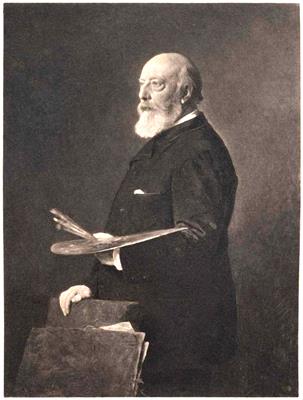
Biography
Achenbach entered the Düsseldorf Academy in 1827[3] at the age of twelve, eventually studying landscape with Johann Wilhelm Schirmer and absorbing the school's deep investment in seventeenth-century Dutch painting. He travelled extensively: the Netherlands, Bavaria, Tyrol, Scandinavia, and Italy all fed his palette, which settled on the toned greens, browns, and silvery greys he had inherited from Jacob van Ruisdael. Like Ruisdael, he favoured Westphalian mills, churning North Sea coastlines, and the kind of dramatic contrast between a lit sky and a dark forest interior that makes weather the subject rather than the setting.
His brother Oswald was also a Düsseldorf landscapist, and the two became such dominant figures in their respective sub-genres that contemporaries nicknamed them the Alpha and Omega of German[3] landscape painting. Andreas took the sea; Oswald took Italy.
Major works from these decades include Storm on the Sea at the Norwegian Coast (1837[3], Städel Museum, Frankfurt), Clearing Up: Coast of Sicily (1847, Walters Art Museum, Baltimore), and Watermill in Westphalia (1863, Kunsthalle Bremen[2]). The honours accumulated steadily: Order of Leopold, Order of Saint Stanislaus, Order of St. Olav, and honorary membership of the Pennsylvania Academy of Fine Arts (1853). He became an honorary citizen of Düsseldorf in 1885, a quarter-century before his death.
Timeline
- 1815Born in Germany.
- 1827Entered the Düsseldorf Academy at 12.
- 1831Sold a painting at a local exhibition at 16.
- 1832Prince Frederick of the Rhine Province bought one of his paintings at 17.
- 1837Painted "Storm on the Sea at the Norwegian Coast".
- 1847Painted "Clearing Up: Coast of Sicily".
- 1853Became an honorary member of the Pennsylvania Academy of Fine Arts.
- 1863Painted "Watermill in Westphalia".
- 1885Became an honorary citizen of Düsseldorf.
- 1910Died in Düsseldorf at 94.
Notable Works
Tap to view larger.
Where to See Andreas Achenbach
2 museums worldwide.
-
2 works
Galleria d'arte moderna di Milano
Milan, Italy
Tue–Sun 10:00–17:30, closed Mondays · €8 adults
-
 1 works
Kunsthalle Bremen
Bremen, Germany
Tue 10:00–21:00, Wed–Sun 10:00–17:00/18:00 (seasonal), closed Mondays · €12–€15 adults

Next stop
Romanticism →
Explore the artists and ideas of Romanticism.
Andreas Achenbach prints
Hand-finished archival prints from Andreas Achenbach's body of work.

Related Artists




Take Andreas Achenbach home.
See all Andreas Achenbach prints →Frequently Asked Questions
What is Andreas Achenbach known for?
Andreas Achenbach is known for his dark, storm-charged seascapes, which became foundational to German[3] Romantic painting. He favoured Westphalian mills, churning North Sea coastlines, and dramatic contrasts between a lit sky and a dark forest interior. His brother Oswald was also a Düsseldorf landscapist, and the two became such dominant figures in their respective sub-genres that contemporaries nicknamed them the Alpha and Omega of German painting.Who was Andreas Achenbach?
Andreas Achenbach was a German[3] painter who studied at the Düsseldorf Academy. He studied with Johann Wilhelm Schirmer and absorbed the school's investment in seventeenth-century Dutch painting. He travelled extensively, with the Netherlands, Bavaria, Tyrol, Scandinavia, and Italy all feeding his palette.What was Andreas Achenbach's art style?
Andreas Achenbach's art style involved toned greens, browns, and silvery greys, which he inherited from Jacob van Ruisdael. His work built tension between the brightly lit sky or rushing stream and the dark depth of the forest. He made weather the subject, rather than the setting.How did Andreas Achenbach die?
Andreas Achenbach died in 1910[3] at the age of 95.
Sources
Editorial draws on the following primary and tertiary references for Andreas Achenbach.
- [1] museum Galleria d'arte moderna di Milano Used for: museum holdings.
- [2] museum Kunsthalle Bremen Used for: museum holdings.
- [3] wikipedia Wikipedia: Andreas Achenbach Used for: biography, birth dates, death dates, identifiers, movement attribution, nationality.
- [4] book Husslein-Arco, Agnes, editor; Koja, Stephan, editor; Law, Rebecca (Translator), translator; McInnes, Robert (Translator), translator; Somers, Nick, translator; Monet, Claude, 1840-1926. Paintings. Selections; Österreichische Galerie Belvedere, h Used for: biography.
- [5] book Rosales Rodríguez, Agnieszka,Michałowicz, Klaudyna, In the Footsteps of the Old Masters Used for: biography, stylistic analysis.
- [6] book Masterpieces of western art : a history of art in 900 individual studies from the Gothic to the present day Used for: biography.
- [7] book Neoclassicism and romanticism : architecture, sculpture, painting, drawings, 1750-1848 Used for: biography, stylistic analysis.
Editorial overseen by Solis Prints. Sources verified 2026-09-27. Click a source for details, or hover over [N] in the page above to preview.
Editorial standardsMethodologyCorrectionsAI disclosureAbout the editorial team