



Ferdinand Georg Waldmüller
Ferdinand Georg Waldmüller spent a significant portion of his career in open conflict with the institution that employed him. A professor at the Vienna Academy of Fine Arts for decades, he was also its most vocal internal critic, arguing that academic conventions were strangling a generation of painters and that direct observation of nature was the only honest foundation for painting. The Academy did not thank him for it.
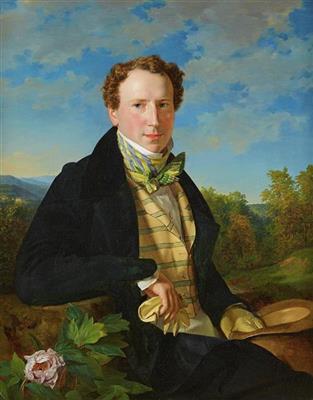
Biography
Born in Vienna in 1793[3], Waldmüller studied at the Academy before supporting himself through portrait commissions and work as a drawing teacher in the household of Count Gyulay in Croatia. His career unfolded against the political backdrop of Biedermeier Vienna, the period bounded by the Congress of Vienna in 1815[3] and the revolutionary upheavals of 1848 — an era of relative domesticity and middle-class aspiration that Waldmüller became its most consistent visual chronicler.
His technical signature was an insistence on crisp, direct sunlight rather than the hazy academic tonality of his contemporaries. Portraits from the 1820s and 1830s show a preference for golden side-lighting and precise surface texture; his genre scenes carry a similar precision. "After Confirmation" (1859[3]), with its barefooted peasant girls, and "On Corpus Christi Morning" (1857), which places working-class figures against well-dressed churchgoers, are studies in social observation as much as painting.
He also painted Beethoven, whom he apparently admired as a fellow believer in direct experience over received convention. The Belvedere in Vienna holds the most significant collection of his work and dedicated a major retrospective to him: "Better Times? Waldmüller and Biedermeier in Vienna."
Timeline
- 1793Born in Vienna.
- 1815The Congress of Vienna marked the beginning of the Biedermeier period, during which Waldmüller's career unfolded.
- 1820Waldmüller's portraits from the 1820s show a preference for golden side-lighting and precise surface texture.
- 1830Waldmüller's portraits from the 1830s show a preference for golden side-lighting and precise surface texture.
- 1848The revolutionary upheavals of 1848 marked the end of the Biedermeier period.
- 1857Painted "On Corpus Christi Morning".
- 1859Painted "After Confirmation".
- 1865Died in Vienna.
Notable Works
Tap to view larger.
Where to See Ferdinand Georg Waldmüller
2 museums worldwide.
-

-
 1 works
Kunsthalle Bremen
Bremen, Germany
Tue 10:00–21:00, Wed–Sun 10:00–17:00/18:00 (seasonal), closed Mondays · €12–€15 adults
Next stop
Browse the movements →
Every movement in the collection, from the Renaissance to Pop art.
Ferdinand Georg Waldmüller prints
Hand-finished archival prints from Ferdinand Georg Waldmüller's body of work.
 Depleted Power - Ferdinand Georg Waldmüller
From £28.00
Depleted Power - Ferdinand Georg Waldmüller
From £28.00
 Lower-Austrian Peasant Wedding - Ferdinand Georg Waldmüller
From £37.00
Lower-Austrian Peasant Wedding - Ferdinand Georg Waldmüller
From £37.00
 The Höllengebirge at Ischl - Ferdinand Georg Waldmüller
From £37.00
The Höllengebirge at Ischl - Ferdinand Georg Waldmüller
From £37.00
 Der Wolfgangsee - Ferdinand Georg Waldmüller
From £28.00
Der Wolfgangsee - Ferdinand Georg Waldmüller
From £28.00
 Still life with roses, strawberries, and bread - Ferdinand Georg Waldmüller
From £28.00
Still life with roses, strawberries, and bread - Ferdinand Georg Waldmüller
From £28.00
 Four shop signs (Hygieia, Hippocrates, Galen and Fauna) for the pharmacy, The Golden Lion in Josefstadt - Ferdinand Georg Waldmüller
From £28.00
Four shop signs (Hygieia, Hippocrates, Galen and Fauna) for the pharmacy, The Golden Lion in Josefstadt - Ferdinand Georg Waldmüller
From £28.00
Related Artists



Take Ferdinand Georg Waldmüller home.
See all Ferdinand Georg Waldmüller prints →Frequently Asked Questions
What is Ferdinand Georg Waldmüller's most famous work?
Ferdinand Georg Waldmüller (1793[3]-1865[3]) was an Austrian painter and instructor at the Academy of Fine Arts in Vienna. He is associated with the Biedermeier style, which valued clear design and appealed to middle-class tastes. It is difficult to name one single "most famous" work. Waldmüller painted portraits, but he is better known for his genre scenes and his attention to light and detail. He often depicted rural life, sometimes showing the darker side of peasant existence, rather than idealised celebrations. His paintings include *Children at the Window* (1853[3]), which depicts five children of different ages in a window setting; *After Confirmation* (1859), which portrays barefoot girls in peasant clothing; and *On Corpus Christi Morning* (1857), which contrasts social classes. *The Last Calf* (1857) shows a poor family selling their last calf. Waldmüller's *Self-Portrait as a Young Man* (1828) presents the artist as a Romantic figure. He also painted pure outdoor scenes, such as *View of the Dachstein from the “Sophien-Doppelblick” Near Ischl* (1835).What should I know about Ferdinand Georg Waldmüller's prints?
Printmaking was not Ferdinand Georg Waldmüller's primary medium; he is better known as a painter. However, prints after his work circulated during his lifetime and afterward, contributing to his wider popularity. The production of prints has a long history in Europe. As paper became readily available around the end of the fourteenth century, woodcuts were used for book illustrations, religious icons, and even playing cards. By the nineteenth century, prints were increasingly viewed as a major artistic medium. Artists began to sign their prints, differentiating original graphics from commercial reproductions. They also controlled quality by limiting edition sizes. Prints allowed artists to reach a larger audience because they could be produced in greater quantities and at a lower cost than paintings or sculptures. Dealers recognised the value of prints as a popular art form and encouraged painters to make them.What style or movement did Ferdinand Georg Waldmüller belong to?
Ferdinand Georg Waldmüller (1793[3]-1865[3]) is associated with the Biedermeier style, which originated around 1815[3] at the Congress of Vienna. The style lasted until the 1848 revolution and is identified by a clear aesthetic that appealed to the middle class. Waldmüller is considered one of the leaders of Biedermeier. The Belvedere Museum in Vienna has a comprehensive collection of Biedermeier painting. Waldmüller began his career around 1810 and had some affiliation with the Romantic movement; he painted a portrait of Ludwig van Beethoven and was an enthusiast of the composer's music. However, Waldmüller came into conflict with Viennese establishment painters because he believed in plein air work and opposed academic conventions. He favoured realism and precise depictions of surfaces, using crisp, golden side-lighting to bring out contrast. His *Self-Portrait as a Young Man* (1828) is considered an image of a Romantic dandy.When did Ferdinand Georg Waldmüller live and work?
Ferdinand Georg Waldmüller was an Austrian painter who lived from 1793[3] to 1865[3]. Born in Vienna, he studied at the Academy of Fine Arts. He then worked as an art teacher for Count Gyulay in Croatia, supplementing his income by painting portraits. Waldmüller began working in painting and developed a distinctive, luminous style. This allowed him to enter the Academy of Fine Arts in Vienna, where he taught throughout his career. He is considered a leading artist of the Biedermeier style, which emerged after the Congress of Vienna in 1815[3] and lasted until the 1848 revolution. This style is characterised by clear design that appealed to the middle classes. Waldmüller's work often focused on rural life. Some of his paintings, such as *The Last Calf* (1857), depict the hardships faced by poor farmers. He was concerned with realism and the accurate depiction of surfaces. Waldmüller favoured crisp, golden side-lighting to create contrast. He also painted portraits, including one of Ludwig van Beethoven. Waldmüller's dedication to plein air work and his opposition to academic conventions sometimes put him at odds with Vienna's established painters.Where was Ferdinand Georg Waldmüller from?
Ferdinand Georg Waldmüller was Austrian. He was born in Vienna in 1793[3]. Waldmüller trained at the Academy of Fine Arts in Vienna. Later, he worked as an art teacher for Count Gyulay in Croatia. He supplemented his income by painting portraits. During this period, he began to focus on landscape painting, developing a distinctive, luminous style. His artistic skill allowed him to return to the Academy of Fine Arts in Vienna, where he then taught painting throughout his career. Waldmüller's work often depicted rural life and genre scenes. He is associated with the Biedermeier style, which catered to middle-class tastes with clear and crisp designs. However, some observers note that he sometimes portrayed the darker aspects of rural poverty, rather than idealised comfort. He died in 1865[3].Who did Ferdinand Georg Waldmüller influence?
Ferdinand Georg Waldmüller, an Austrian painter working from around 1810[3], is associated with the Biedermeier style, which valued clear design and appealed to the middle classes. Waldmüller’s interest in accurately depicting sunlight and textures, and his habit of painting outdoors, put him at odds with Vienna's established artists. His style, though detailed and realistic, also captured a romantic mood. He painted portraits, and genre scenes depicting both bourgeois and rural subjects. Later in his career, Waldmüller's paintings, such as *The Last Calf* (1857), showed the hardships of rural life. He focused on the effects of light, even using it to define facial expressions. His emphasis on light as a means of modelling form prefigured the techniques of the Impressionists. The impact of Impressionism was felt in Austrian painting, particularly among younger artists at the turn of the century. Figures such as Alfred Zoff, Herbert Boeckl, and Anton Mahringer combined Impressionist and Expressionist elements in their work.Who influenced Ferdinand Georg Waldmüller?
Ferdinand Georg Waldmüller, an Austrian painter born in Vienna in 1793[3], attended the Academy of Fine Arts. He later worked as an art teacher for Count Gyulay in Croatia, supplementing his income with portraiture. Waldmüller's early career saw him develop a distinctive, luminous style in his paintings. This approach gained him entry to the Academy of Fine Arts in Vienna, where he subsequently taught. He came into conflict with the Viennese establishment due to his belief in plein air work and his opposition to academic conventions. Waldmüller had some affiliation with the Romantic movement. He was an enthusiast for the music of Ludwig van Beethoven and painted the composer’s portrait. Waldmüller favoured realism and precise depictions of surfaces and textures. His concentration on the effect of sunlight in his work would later serve the Impressionists. Waldmüller is considered a leading artist of the Biedermeier style, which began around 1815[3]. This style manifested itself in clear, crisp designs that catered to the middle class. Waldmüller died in 1865[3].Why are Ferdinand Georg Waldmüller's works important today?
Ferdinand Georg Waldmüller (1793[3]-1865[3]) is significant as a leading painter of the Biedermeier style. This style emerged after the Congress of Vienna in 1815[3] and continued until the 1848 revolution. It is characterised by clear design and appealed to middle-class tastes. Waldmüller's importance also stems from his dedication to realism. He meticulously depicted surfaces and textures, often using a crisp, golden side-lighting to enhance contrast. He believed in working en plein air, which set him apart from more conventional Viennese artists. His paintings often portrayed rural life. Some works, such as *After Confirmation* (1859), depict the rural poor, while others, such as *On Corpus Christi Morning* (1857), contrast social classes. *The Last Calf* shows the darker aspects of rural life, portraying the impoverishment of a small farming family. Waldmüller's focus on sunlight also distinguishes his work; he used light to define form and expression.How did Ferdinand Georg Waldmüller die?
Ferdinand Georg Waldmüller died in 1865[3].What is Ferdinand Georg Waldmüller known for?
Waldmüller is known as a consistent visual chronicler of Biedermeier Vienna. His genre scenes, such as "After Confirmation" and "On Corpus Christi Morning", are studies in social observation. He also painted a portrait of Beethoven.What was Ferdinand Georg Waldmüller's art style?
Waldmüller's technical signature was an insistence on crisp, direct sunlight rather than the hazy academic tonality of his contemporaries. His portraits from the 1820s and 1830s show a preference for golden side-lighting and precise surface texture; his genre scenes carry a similar precision.When did Ferdinand Georg Waldmüller die?
Ferdinand Georg Waldmüller died in 1865[3] at the age of 72.
Sources
Editorial draws on the following primary and tertiary references for Ferdinand Georg Waldmüller.
- [1] museum Liechtenstein Museum Used for: museum holdings.
- [2] museum Kunsthalle Bremen Used for: museum holdings.
- [3] wikipedia Wikipedia: Ferdinand Georg Waldmüller Used for: biography, birth dates, death dates, identifiers, movement attribution, nationality.
- [4] book 20210601artandantiques Used for: biography.
- [5] book Allison Lee Palmer, Historical Dictionary of Neoclassical Art and Architecture Used for: biography.
- [6] book Masterpieces of western art : a history of art in 900 individual studies from the Gothic to the present day Used for: biography.
Editorial overseen by Solis Prints. Sources verified 2026-09-30. Click a source for details, or hover over [N] in the page above to preview.
Editorial standardsMethodologyCorrectionsAI disclosureAbout the editorial team