



Adam Elsheimer
Adam Elsheimer arrived in Rome in 1600[3], aged twenty-one, having spent two years in Venice as assistant to Hans Rottenhammer. The son of a Frankfurt tailor, he had trained under Philipp Uffenbach and was still largely unknown south of the Alps. By the time he died ten years later, aged thirty-one, in poverty and reportedly broken by imprisonment, his small copper panels had been seen by Rubens, admired by Claude Lorrain, and drawn from by the young Rembrandt.
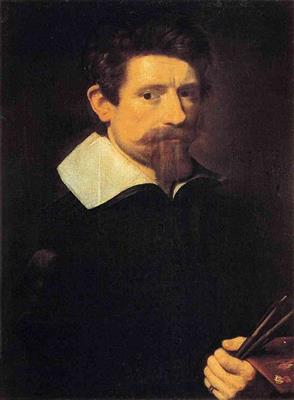
Biography
His entire surviving output amounts to roughly two dozen pictures, all on copper. What distinguishes them is his handling of light: where Caravaggio kept the source hidden, Elsheimer showed it directly (fire, torch, moon, heavenly rays), building each composition around the simultaneous play of different lights on the same scene. In The Flight into Egypt (1609[3], Alte Pinakothek, Munich), three separate sources illuminate the night. The full moon appears inverted in the sky, as it would through a magnifying telescope, while its reflection in the water below shows it correctly oriented. Elsheimer moved in the circle of the Accademia dei Lincei, the institution that also sponsored Galileo, and the summer of 1609 is when Galileo first turned a telescope on the moon.
The Stoning of Saint Stephen (c.1603[3]/4, National Gallery of Scotland) sat unrecognised in a Scottish private collection until 1965. By then, scholars had established that Rembrandt's own Saint Stephen (1625, Musée des Beaux-Arts de Lyon) drew directly from it, placing Elsheimer in Rembrandt's visual formation despite his relative obscurity in the broader canon.
He died in poverty. Hendrick Goudt, the Dutch printmaker who lodged in his house and acted as both pupil and patron, had him thrown into debtor's prison when Elsheimer failed to deliver commissioned work quickly enough. An inventory taken eight days after his death confirmed the destitution. Goudt subsequently acquired The Flight into Egypt.
Timeline
- 1578Born in Frankfurt, Germany.
- 1600Arrived in Rome, Italy.
- 1600Assistant to Hans Rottenhammer in Venice for two years.
- 1603Painted 'The Stoning of Saint Stephen' (approximate).
- 1609Painted 'The Flight into Egypt'.
- 1609Associated with the Accademia dei Lincei.
- 1610Imprisoned for debt.
- 1610Died in Rome, Italy, in poverty.
Notable Works
Tap to view larger.
Where to See Adam Elsheimer
2 museums worldwide.
-
 4 works
National Gallery of Art
Washington D.C., United States
Mon–Sat 10:00–17:00, Sun 11:00–18:00 · Free
-
1 works
Musée des Beaux-Arts de Bordeaux
Bordeaux, France
Wed–Mon 11:00–18:00, closed Tuesdays · 6€–8€ adults (varies by exhibition status), free for under 18s and first Sundays of the month (except July/August)

Next stop
Browse the movements →
Every movement in the collection, from the Renaissance to Pop art.
Related Artists




Frequently Asked Questions
What is Adam Elsheimer known for?
Adam Elsheimer is known for his handling of light, building each composition around the simultaneous play of different lights on the same scene. He showed the light source directly, such as fire, torch, moon, or heavenly rays.What is Adam Elsheimer's most famous work?
It is difficult to name one single work as Adam Elsheimer's 'most famous'. He died relatively young, and his stylistic influence on later painters is perhaps better known than any individual painting. Elsheimer's influence is particularly notable on Dutch and Italian Baroque painters. Many of his paintings feature religious or mythological subjects. Titles associated with Elsheimer include: *St Christopher*, *St George and the Dragon*, *St Margaret*, *St Nicholas Calming the Storm*, *Samson and Delilah*, *Samson and the Lion*, *Two Lansquenets and a Couple*, *Venus and Cupid*, *View of Sarmingstein*, *View of Schloss Wörth*, *Wild Family*, *Wild Man*, *Willow Landscape*, and *Witches’ Sabbath*. He also produced prints, including *Annunciation*, *Bathing Woman*, *Beheading of John the Baptist*, *Foliate Ornament*, *Holy Family at the Fountain*, *Jael and Sisera*, *Lucretia*, *Madonna with Blessing Christ Child*, *Pyramus and Thisbe*, *Regensburg Synagogue*, *Resurrection of Christ*, *St Christopher*, *St George*, *Schöne Maria of Regensburg*, and *Triumphal Procession*.What should I know about Adam Elsheimer's prints?
Adam Elsheimer (1578[3]-1610[3]) was a German[3] painter and engraver. He was born in Frankfurt, the son of a tailor, and was a pupil of Philipp Uffenbach, a local painter and printmaker. He travelled to Italy around 1598[3], and was active in Rome from 1600 until his death. Elsheimer's paintings are typically small scale and rendered on copper plates. Examples include *The Glorification of the Cross*, c. 1605, and *The Flight to Egypt*, 1609. Although Elsheimer was not widely known during his lifetime, his work had a considerable influence, particularly in Northern Europe. Hendrick Goudt, a Dutch artist who lived with Elsheimer, made seven engravings of Elsheimer's paintings between 1608 and 1613. These engravings helped to disseminate Elsheimer's work across Europe. Artists such as Claude, Rembrandt (who owned Goudt's engravings), and Peter Paul Rubens were all influenced by him. Elsheimer's interest in chiaroscuro effects came from studying the works of Caravaggio.What style or movement did Adam Elsheimer belong to?
Adam Elsheimer (1578[3]-1610[3]) is associated with both the Baroque and Caravaggism styles. Born in Frankfurt, he became a pupil of Philipp Uffenbach. Around 1598[3], Elsheimer relocated to Italy, where he absorbed influences from Venetian artists. He lived in Rome from 1600 until his death. There, in 1606, he joined the Accademia di San Luca. Elsheimer's paintings are known for their small scale and use of copper plates. His interest in chiaroscuro developed from studying Caravaggio's work. However, unlike Caravaggio, who often left the light source unidentifiable, Elsheimer typically depicted it directly, whether as the sun, moon, fire, or heavenly rays. His paintings also show attention to detail, use of colour, and emphasis on realism. Elsheimer's style influenced artists like Rembrandt, Claude Lorrain, and Peter Paul Rubens. Hendrick Goudt made engravings of Elsheimer's paintings, which helped to spread his style across Europe.What techniques or materials did Adam Elsheimer use?
Adam Elsheimer, born in Frankfurt in 1578[3], was a German[3] painter and engraver. He trained with Philipp Uffenbach, a local painter and printmaker. Around 1598[3], Elsheimer travelled to Italy, and from 1600 he lived in Rome until his death in 1610[3]. He was known as "Adamo Tedesco" in early sources. Although not widely known in his own time, his work had a widespread influence, especially in Northern Europe. Elsheimer specialised in small-scale paintings on copper plates. Examples include *The Flight into Egypt* (1609) and *The Glorification of the Cross* (circa 1605). His paintings often display great attention to detail. His work combines the Venetian use of colour with an understanding of light and an emphasis on realism. Elsheimer had a particular interest in nocturnal scenes and the effects of *chiaroscuro*, possibly influenced by Caravaggio and the Bassani. Light sources, such as the sun, moon, or fire, are almost invariably shown in his paintings.What was Adam Elsheimer known for?
Adam Elsheimer (1578[3]-1610[3]) was a German[3] painter and engraver. The son of a tailor from Frankfurt, he became a pupil of Philipp Uffenbach, a local painter and printmaker. Around 1598[3], Elsheimer travelled to Italy, where Venetian artists influenced him. From 1600 until his death, he lived in Rome. There, in 1606, he joined the Accademia di San Luca. He converted to Roman Catholicism and married a woman of Scottish descent. Elsheimer is known for small-scale paintings on copper plates. He combined the Venetian use of colour with his own understanding of light and an emphasis on realism. He had a preference for night scenes, such as *The Flight into Egypt* (1609). His interest in contrasting light and shade came from studying the works of Caravaggio. Unlike Caravaggio, Elsheimer almost invariably depicted the light source, whether sun, moon, or fire. Although not famous in his own time, his work became widely known through engravings by Hendrick Goudt. Artists such as Claude, Rembrandt, and Rubens admired him.When did Adam Elsheimer live and work?
Adam Elsheimer was born in Frankfurt am Main in 1578[3]. He died in Rome in 1610[3], at only 32 years of age. Elsheimer spent his early career in Germany. From 1596[3] to 1598, he apprenticed with Philipp Uffenbach. He then moved to Munich, where he was likely working by 1599. By 1600, Elsheimer had relocated to Italy. He initially lived in Venice. By 1602, he had moved again, this time to Rome. Although he returned to Germany briefly in 1606, Rome became his home. He remained there for the rest of his life. Elsheimer's short life saw him move between important artistic centres. His presence in both Venice and Rome allowed him to synthesise north and south European artistic traditions. His paintings influenced artists such as Peter Paul Rubens and Rembrandt van Rijn.Where can I see Adam Elsheimer's work?
Adam Elsheimer's paintings can be viewed in several European museums. In Germany, his work is held at the Städelsches Kunstinstitut in Frankfurt am Main and the Staatliche Museen in Berlin. Other German[3] museums with his paintings include the Herzog Anton Ulrich-Museum in Braunschweig, the Gemäldegalerie Alte Meister in Dresden, the Niedersächsisches Landesmuseum in Hanover, and the Staatliche Graphische Sammlung in Munich. Elsewhere in Europe, Elsheimer's pieces can be found at the National Gallery of Scotland in Edinburgh, the Galleria degli Uffizi in Florence, the Musée du Louvre in Paris, the Royal Cabinet of Paintings Mauritshuis in The Hague, and the Kunsthistorisches Museum in Vienna. Works by Elsheimer are also held in the collection of the National Gallery in London. In the United States, The Metropolitan Museum of Art in New York and the National Gallery of Art in Washington possess examples of his painting.Where was Adam Elsheimer from?
Adam Elsheimer was German[3]. He was born in 1578[3] in Frankfurt, the son of a tailor. He trained as a painter and printmaker with Philipp Uffenbach, who was also local to Frankfurt. By 1598[3], Elsheimer travelled south via Bavaria to Italy. He spent time in Venice, where he collaborated with Hans Rottenhammer. By 1600, he relocated to Rome, where he lived until his death in 1610[3]. In 1606, he joined the Accademia di San Luca. Known as 'Adamo Tedesco' (Adam the German), Elsheimer moved in a circle of intellectuals, including Johannes Faber (the pope's physician) and Peter Paul Rubens. He converted to Roman Catholicism and married a woman of Scottish descent. Although not famous during his lifetime, Elsheimer's paintings became widely known through engravings made by Hendrick Goudt. His influence extended to artists such as Claude Lorrain and Rembrandt.Who did Adam Elsheimer influence?
Adam Elsheimer, born in Frankfurt in 1578[3], spent his career in Italy, dying in Rome in 1610[3]. Although not widely known in his own time, his paintings had a considerable effect on other artists, particularly in Northern Europe. His paintings, generally small-scale works on copper, became known through engravings made by Hendrick Goudt. Goudt, a Dutch artist, lived with Elsheimer and acted as both pupil and patron. Goudt's engravings, made from 1608[3] to 1613, circulated Elsheimer's compositions. Elsheimer's influence is apparent in the work of Claude Lorrain, Rembrandt, and Peter Paul Rubens, who was also a close friend. Rembrandt owned Goudt's engravings. Figures taken from Elsheimer's painting, The Stoning of Saint Stephen (circa 1603-4), appear in works by David Teniers the Elder, Jacob Pynas, Frans Francken II, and the young Rembrandt. Rubens made a drawing, later engraved by Pieter Soutman, that also incorporates figures from The Stoning of Saint Stephen.Who influenced Adam Elsheimer?
Identifying artistic influences involves recognising how artists adapt and improve upon existing works. Art theory, mirroring literary theory, describes this process as having three stages. The first, translatio, is a close copy serving as a technical study. The second, imitatio, is a variant demonstrating understanding of both structure and style. The final stage, aemulatio, is a version surpassing the original model. Franciscus Junius advised artists to seek guidance from the best masters. He noted that any recognisable influence must be an improvement, paying homage to the model while displaying the artist's superiority. This approach involves recognising an artist's sources, giving us a sense of their artistic development. For example, pupils in the Rembrandt workshop made faithful copies and variants of his paintings, incorporating his style into their own compositions and sometimes embellishing his inventions.Who was Adam Elsheimer?
Adam Elsheimer (1578[3]-1610[3]) was a German[3] painter and engraver who spent his career in Italy. Born in Frankfurt, the son of a tailor, he trained locally with Philipp Uffenbach. Around 1598[3], Elsheimer relocated, travelling through Bavaria to Venice, where he collaborated with Hans Rottenhammer. By 1600, he was living in Rome; in 1606, he joined the Accademia di San Luca. In Rome, Elsheimer moved in intellectual circles that included Peter Paul Rubens, and he converted to Roman Catholicism. He married a woman of Scottish descent. The artist Hendrick Goudt, who lived in Elsheimer's house, acted as his pupil and patron. Goudt made engravings of Elsheimer's paintings, which helped to spread the German artist's work across Europe. Elsheimer died in poverty, possibly after being put in debtors' prison by Goudt. Elsheimer is known for small-scale paintings on copper plates, especially nocturnal scenes. His interest in effects of light and shade came partly from studying Caravaggio, but Elsheimer's use of light differs; Caravaggio's light is like a spotlight, while Elsheimer's light models the forms. His paintings influenced artists such as Claude Lorrain and Rembrandt.
Sources
Editorial draws on the following primary and tertiary references for Adam Elsheimer.
- [1] museum Prints in the National Gallery of Art Used for: museum holdings.
- [2] museum Musée des Beaux-Arts de Bordeaux Used for: museum holdings.
- [3] wikipedia Wikipedia: Adam Elsheimer Used for: biography, birth dates, death dates, identifiers, movement attribution, nationality.
- [4] book Beard, Lee, 1973- author, Butler, Adam, author; Van Cleave, Claire, author; Fortenberry, Diane, author; Stirling, Susan, author, Beard, Lee, 1973- author, Butler, Adam, author; Van Cleave, Claire, author; Fortenberry, Diane, author; Stirling, Susan, author - The Art Book_ New Edition, Mini Format Used for: biography.
- [5] book Lilian H. Zirpolo, Historical Dictionary of Baroque Art and Architecture Used for: biography.
- [6] book Masterpieces of western art : a history of art in 900 individual studies from the Gothic to the present day Used for: biography.
Editorial overseen by Solis Prints. Sources verified 2026-09-22. Click a source for details, or hover over [N] in the page above to preview.
Editorial standardsMethodologyCorrectionsAI disclosureAbout the editorial team