

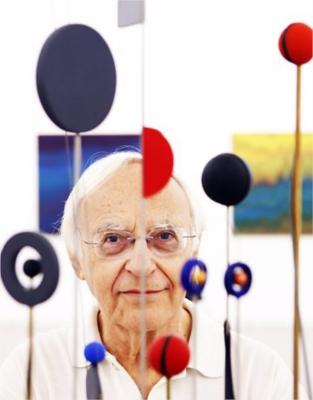
Abraham Palatnik
The device he brought to the first São Paulo Biennial in 1951[1] contained 600 metres of cable, 101 light bulbs of different voltages, and rotating cylinders that projected controlled colour through prisms onto a translucent screen. It was, in any meaningful sense, a painting that moved. Abraham Palatnik called it a cinechromatic apparatus; the critic Mario Pedrosa, who became his closest intellectual ally, coined the term "cinechromatic art" to describe it.
Biography
Palatnik was born on 2 February 1928[1] in Natal, Brazil, to Ukrainian-Jewish immigrant parents. The family moved to Mandatory Palestine when he was four, and he spent his formative years in Tel Aviv, studying mechanics and physics at the Montefiori Technical School between 1942[1] and 1945. That technical grounding would prove decisive. When he returned to Brazil in 1948, he arrived not as a conventional painter but as an engineer of light.
In 1953[1] he founded the Frente group in Rio de Janeiro, gathering a generation of Brazilian[1] concretists and neo-concretists around a shared interest in perceptual and kinetic experience. The international art world caught up slowly: he exhibited cinechromatic devices at the Venice Biennale in 1964 and showed at the Denise René Gallery in Paris the same year. MoMA eventually acquired two works. In 2013, his Sequencia Visual S-51 sold at Christie's New York for $785,000.
Palatnik died on 9 May 2020[1] in Rio de Janeiro, aged 92, from COVID-19. He had spent seven decades making work that most of his contemporaries did not yet have a name for.
Timeline
- 1928Born in Natal, Brazil, to Ukrainian-Jewish immigrant parents
- 1932Family moved to Mandatory Palestine
- 1942Studied mechanics and physics at Montefiori Technical School
- 1945Finished studies at Montefiori Technical School
- 1948Returned to Brazil
- 1951Showed cinechromatic apparatus at the São Paulo Biennial
- 1953Founded the Frente group in Rio de Janeiro
- 1964Exhibited at the Venice Biennale and Denise René Gallery in Paris
- 2013Sequencia Visual S-51 sold for $785,000 at Christie's New York
- 2020Died in Rio de Janeiro from COVID-19
Notable Works
Tap to view larger.
Next stop
Browse the movements →
Every movement in the collection, from the Renaissance to Pop art.
Related Artists




Frequently Asked Questions
What is Abraham Palatnik known for?
Abraham Palatnik is known for his 'cinechromatic' art, which involved creating moving paintings using light and mechanical devices. He constructed apparatuses with light bulbs, rotating cylinders, and prisms to project coloured light onto a screen. He is also known for founding the Frente group in Rio de Janeiro in 1953[1].Who was Abraham Palatnik?
Abraham Palatnik was a Brazilian[1] artist known for his innovative 'cinechromatic' art. Born in 1928[1], he created devices that combined light bulbs, rotating cylinders, and prisms to project controlled colour onto a screen, creating moving paintings. His work bridged the gap between art and engineering.What was Abraham Palatnik's art style?
Abraham Palatnik's art style combined elements of perceptual and kinetic experience. His 'cinechromatic' devices integrated mechanics and light to create moving abstract compositions. He is associated with the concretist and neo-concretist movements in Brazil.When was Abraham Palatnik born?
Abraham Palatnik was born in 1928[1].
Sources
Editorial draws on the following primary and tertiary references for Abraham Palatnik.
- [1] wikipedia Wikipedia: Abraham Palatnik Used for: biography, birth dates, death dates, identifiers, movement attribution, nationality.
- [2] book Beard, Lee, 1973- author, Butler, Adam, author; Van Cleave, Claire, author; Fortenberry, Diane, author; Stirling, Susan, author, Beard, Lee, 1973- author, Butler, Adam, author; Van Cleave, Claire, author; Fortenberry, Diane, author; Stirling, Susan, author - The Art Book_ New Edition, Mini Format Used for: biography.
- [3] book guggenheim-guggenheimintern1964allo Used for: biography.
- [4] book guggenheim-refigur00kren Used for: biography.
Editorial overseen by Solis Prints. Sources verified 2026-08-26. Click a source for details, or hover over [N] in the page above to preview.
Editorial standardsMethodologyCorrectionsAI disclosureAbout the editorial team