



Almir Mavignier
For five years, Almir Mavignier co-ran an art workshop inside a psychiatric hospital on the outskirts of Rio de Janeiro, working alongside the psychiatrist Nise da Silveira at the Engenho de Dentro facility from 1946[1] to 1951. The programme, which encouraged patients to paint and model without formal instruction, became one of the founding chapters of art therapy in Brazil. For Mavignier, it was also an education: working with patients whose art existed entirely outside convention pushed him decisively towards abstraction.
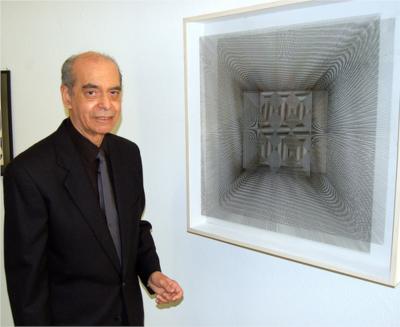
Biography
Born in Rio in 1925[1], Mavignier left Brazil in the early 1950s to study in Europe. He attended the Hochschule fur Gestaltung in Ulm, the influential postwar design school founded by Max Bill, studying under Bill and Josef Albers. The geometric discipline of Ulm shaped everything that followed. By the late 1950s he was affiliated with the Zero group, the experimental collective based in Dusseldorf, and in 1961[1] he helped organise the first New Tendencies exhibition in Zagreb.
His paintings, which he called "permutations", applied mathematically calculated arrangements of colour and geometric form to produce optical pulsation and spatial depth with no figurative content whatsoever. The work was selected for the Venice Biennale in 1964[1] and appeared in "The Responsive Eye" at the Museum of Modern Art, New York, in 1965, one of the defining Op Art exhibitions of the decade.
Mavignier settled permanently in Hamburg, and in addition to painting produced over two hundred posters for cultural institutions. He died there in September 2018[1], aged ninety-three.
Timeline
- 1925Born in Rio de Janeiro.
- 1946Began co-running an art workshop at the Engenho de Dentro psychiatric hospital in Rio de Janeiro, with Nise da Silveira.
- 1950Moved to Europe to study.
- 1950Attended the Hochschule fur Gestaltung in Ulm, studying under Max Bill and Josef Albers.
- 1951Left the art workshop at the Engenho de Dentro psychiatric hospital.
- 1961Helped organise the first New Tendencies exhibition in Zagreb.
- 1964His work was selected for the Venice Biennale.
- 1965His work appeared in "The Responsive Eye" exhibition at the Museum of Modern Art, New York.
- 2018Died in Hamburg at 93.
Notable Works
Tap to view larger.
Next stop
Browse the movements →
Every movement in the collection, from the Renaissance to Pop art.
Related Artists



Frequently Asked Questions
What is Almir Mavignier known for?
Almir Mavignier is known for his mathematically calculated arrangements of colour and geometric form. These "permutations" produced optical pulsation and spatial depth, and were featured in the Venice Biennale in 1964[1] and the 1965 "The Responsive Eye" exhibition in New York.What is Almir Mavignier's most famous work?
It is difficult to identify Almir Mavignier's single "most famous" work, as his notability rests on his overall contribution to concrete art and his theoretical writings. He is well known for his involvement with the Ulm School of Design and his work exploring serial structures and mathematical principles in art. Mavignier's body of work includes paintings, serigraphs, and sculptures, often characterised by geometric forms and systematic arrangements. Rather than one specific piece, it is the consistent exploration of these themes throughout his career that defines his artistic contribution. He investigated the relationship between art, science, and technology, which is reflected in his pieces. He moved away from subjective expression, favouring objective, visually structured compositions.What should I know about Almir Mavignier's prints?
Almir Mavignier's prints, like those of many artists, exist in a complex market. Original prints are produced by hand, with the artist creating the artwork directly on a plate, woodblock, or screen. These include woodcuts, engravings, linocuts, mezzotints, etchings, lithographs, or serigraphs. Each print is considered an original because of this direct creation. They are often sold through specialist print galleries, frame shops, and fine art galleries. Offset reproductions, also known as posters, are created through photochemical means. Giclée prints are also gaining popularity, using colour-copier technology to create inkjet fine art prints. Canvas transfers, where the image is transferred onto canvas, offer the look of a painting. Limited editions are a choice made by the artist, not a technical requirement. Printmakers mark each print with an edition number, the title, and their signature, typically in pencil. While these conventions aren't legally binding, they are widely respected and add value if followed truthfully. The market distinguishes between original prints and reproductions, valuing those personally executed by the artist more highly.What techniques or materials did Almir Mavignier use?
Information regarding Almir Mavignier's specific techniques is scarce. However, some general observations about painting and photographic techniques can be made. Since the late 19th century, artists have combined photography and painting. M. L. Winter of Vienna, for example, established a business in 1877 producing enlarged photographs on linen. Faster bromide emulsions, introduced in the 1880s, simplified the enlargement process. Oils have been frequently employed for painting on photographic images. Other materials proposed include dry powdered pigments mixed with albumin, ammonium carbonate, glycerin, liquid ammonia, and water. Aniline dyes dissolved in alcohol, applied to the reverse of the image, were also used. Oils, watercolours, and pastels could be applied over a preparatory layer of gelatin (for oils) or shellac (for watercolours and pastels). A wax medium was also proposed.When did Almir Mavignier live and work?
Almir Mavignier was born in Rio de Janeiro, Brazil, in 1925[1]. He is associated with concrete art, a movement that rejects representational illusionism. Mavignier began his artistic training in the late 1940s, studying drawing and painting with Axl Leskoschek. In the early 1950s, he studied at the Ulm School of Design in Germany, an institution that had connections to the Bauhaus. There, he studied visual communication and worked with Max Bill. Mavignier's work often explores the relationship between colour, form, and perception, using geometric shapes and mathematical principles. He participated in the concrete art movement, contributing to its theories and exhibitions. He lived and worked in Germany and Brazil. Mavignier died in 2018[1].Where can I see Almir Mavignier's work?
While I do not have specific information about where Almir Mavignier's works are currently on display, numerous museums exhibit similar styles of art. These include institutions in Europe and North America. In the United States, you might check the Charles Hosmer Morse Museum of American Art (Winter Park, Florida), the Los Angeles County Museum of Art (Los Angeles), the Metropolitan Museum of Art (New York), the Minneapolis Institute of Arts (Minneapolis), the Museum of Modern Art (New York), the Virginia Museum of Fine Arts (Richmond), or the Wolfsonian at Florida International University (Miami Beach). In Canada, the Royal Ontario Museum (Toronto) may be of interest. In the United Kingdom, consider the Bakelite Museum (Williton), the Brighton Museum & Art Gallery (Brighton), the Geffrye Museum (London), the Manchester Art Gallery (Manchester), the National Museums of Scotland, Royal Museum (Edinburgh), or the Victoria & Albert Museum (London). Other European options are the Brangwyn Museum (Brugge, Belgium), the Clockarium Museum (Brussels), the Musée d’Art et d’Industrie (Roubaix, France), the Musée de l’Ecole de Nancy (Nancy, France), the Musée des Arts Décoratifs (Paris), the Musée des Beaux-Arts (Nancy, France), the Museo Art Nouveau y Art Deco (Salamanca, Spain), the Museu Calouste Gulbenkian (Lisbon), and the Museu d’Art Modern (Barcelona, Spain).Who influenced Almir Mavignier?
Almir Mavignier's artistic development involved several influences. Josef Albers, who taught at Black Mountain College and Yale University, gave an entire generation of American artists insight into the ideals of the Bauhaus. Albers's students included Motherwell, de Kooning, and Rauschenberg. Albers, who turned to abstract art in 1920, became primarily known for his severe square-pictures, analysing problems of depth and colour in two-dimensional art which he called “Homage to the Square” from 1950[1] onwards. He is considered a precursor of Op Art and Minimal Art. Roberto Matta, who worked with Le Corbusier in Paris from 1934 to 1935, met Picasso and observed the progress of his work on “Guernica”. Matta's first pictures in the Surrealist manner date from about 1937. Two years later he went to New York, joining the Surrealists and becoming greatly influential in the New York art scene, with his abstract works comprising all the elements of psychic automatism. His contribution to abstract Expressionism was significant, and he greatly influenced Gorky and Motherwell.Why are Almir Mavignier's works important today?
Almir Mavignier (1925[1]-2018[1]) was a Brazilian[1] artist associated with concrete art and Op art. His work remains relevant because it engages with fundamental questions about the nature of art, perception, and the role of the artist. Mavignier's practice can be viewed within the context of a broader discussion about artistic movements. Some argue that movements do not add anything new to art; instead, they rename or re-signify existing elements. The artist's signature, in this view, becomes a mere act of nomination. Furthermore, the art world has become increasingly globalised since the beginning of the 2000s. While there is a sense that no country can claim greater artistic importance, a hierarchy of countries persists. Despite multiculturalism, Western Europe and North America still dominate when it comes to the most recognised contemporary art. Mavignier's position as a Brazilian artist within this international context offers a valuable perspective on these dynamics.When was Almir Mavignier born?
Almir Mavignier was born in 1925[1].
Sources
Editorial draws on the following primary and tertiary references for Almir Mavignier.
- [1] wikipedia Wikipedia: Almir Mavignier Used for: biography, birth dates, death dates, identifiers, movement attribution, nationality.
- [2] book guggenheim-onehundredpainti00thom Used for: biography.
- [3] book guggenheim-twentycontempora00dotr Used for: biography.
- [4] book guggenheim-twopri00weis Used for: biography.
- [5] book Nathalia Brodskaya, The Fauves Used for: biography.
Editorial overseen by Solis Prints. Sources verified 2026-09-30. Click a source for details, or hover over [N] in the page above to preview.
Editorial standardsMethodologyCorrectionsAI disclosureAbout the editorial team