

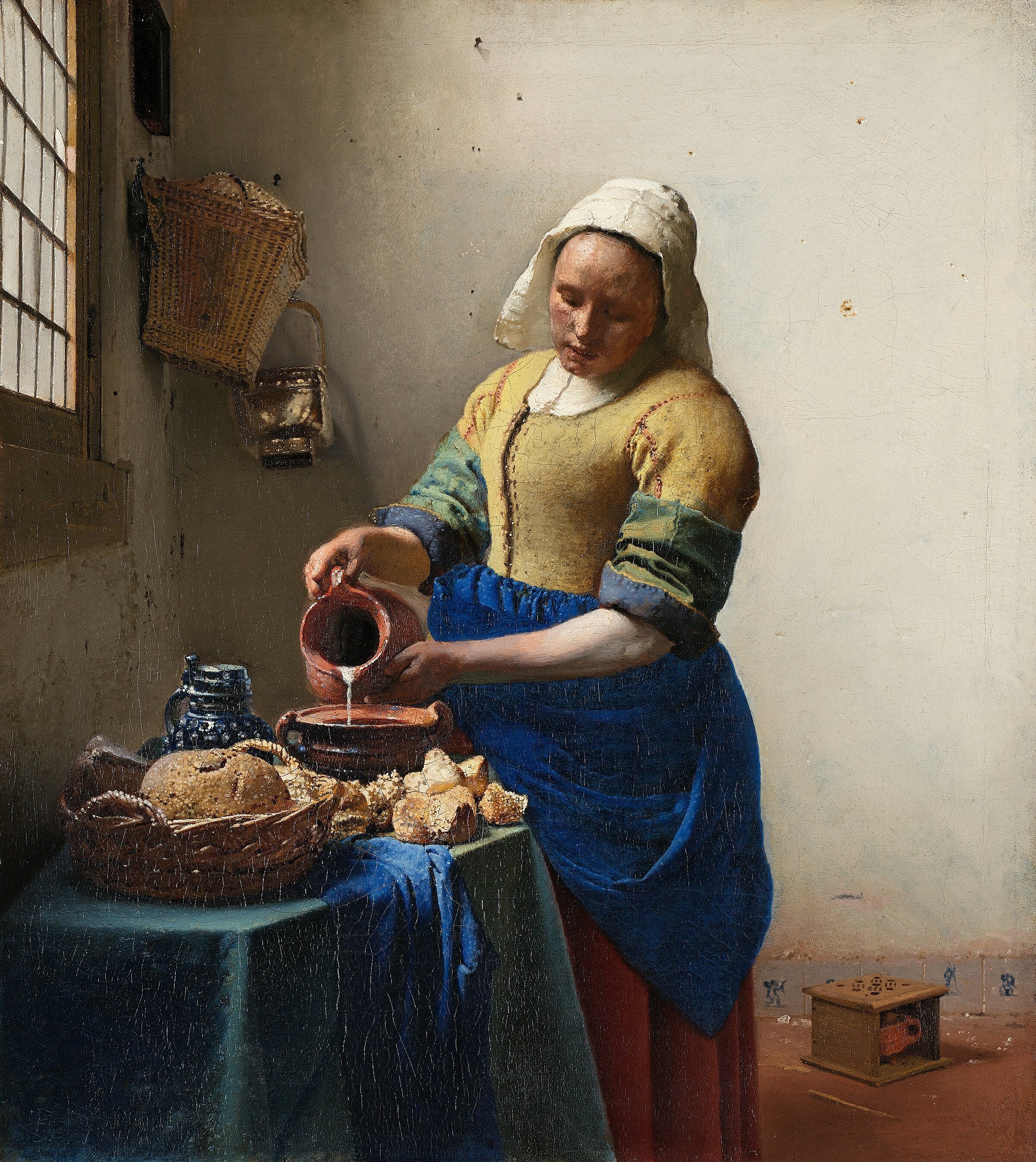
Johannes Vermeer (1632 to 1675) left behind thirty-four paintings. He worked slowly, fine-tuning each canvas before releasing it to his main patron, Pieter van Ruijven. He almost always painted the same room: his studio, with its chequered tile floor and panelled window. He would not let his wife and eleven children enter while he was working. Whether this was artistic discipline or a reasonable desire for quiet in a house with eleven children is a question he never answered.
The Milkmaid and the Meaning of Stillness
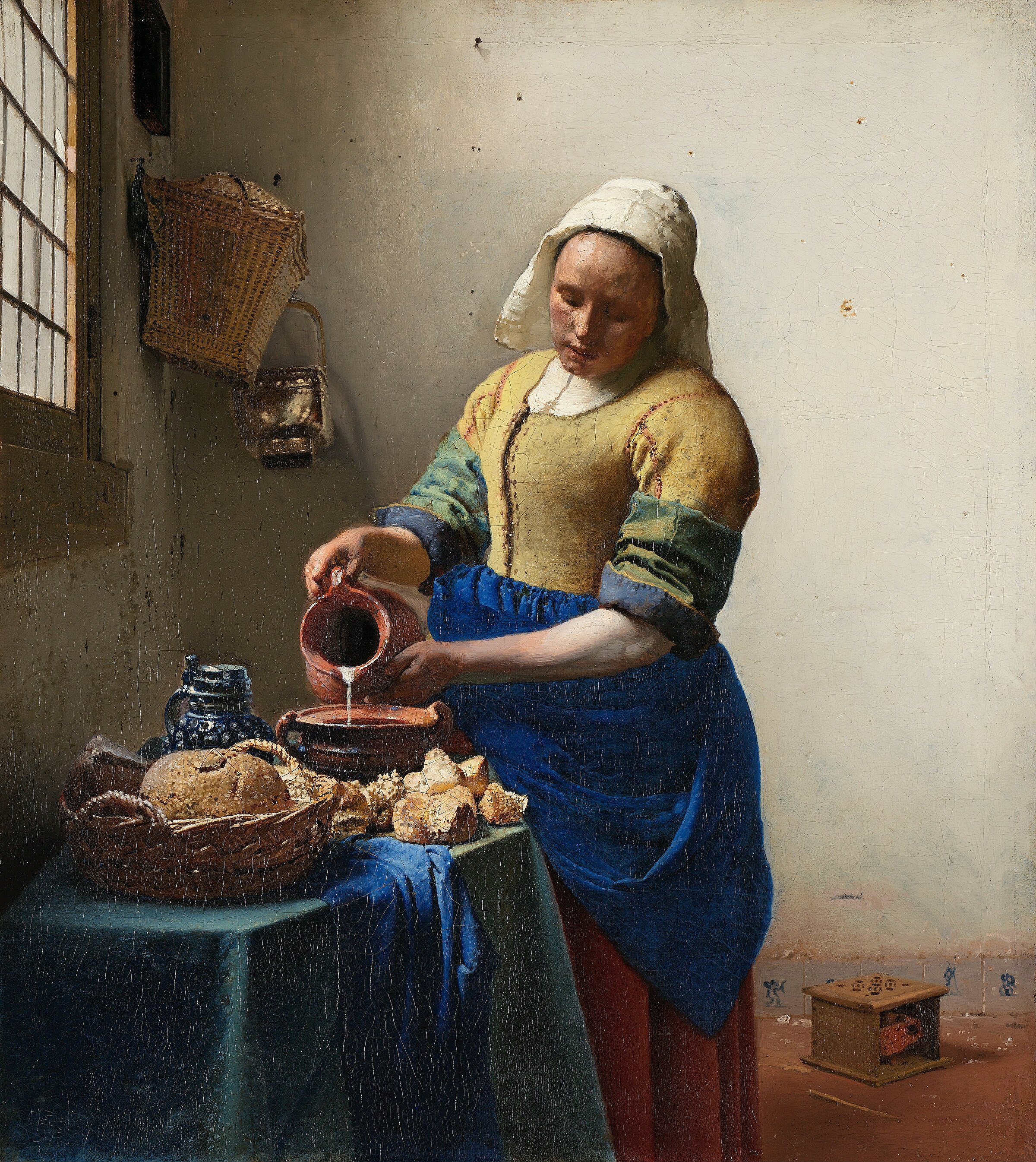
The Milkmaid shows a woman pouring milk from a jug into an earthenware bowl. That is all that happens. The painting is 45.5 by 41 centimetres, small enough to hold in two hands. Yet it is one of the most studied paintings in Western art, and the reason is light.
Light enters from the window on the left, catching the woman's forehead, the curve of the jug, the bread on the table, and the rough plaster of the wall. Vermeer painted light not as a uniform wash but as a physical substance with weight and texture. The bread crusts are speckled with tiny dots of impasto that catch real light from the room where the painting hangs, making them shimmer. This technique, sometimes called pointills of light, anticipates effects that would not be systematically explored for another two centuries.
Technical investigations have revealed that Vermeer originally included a map or painting on the wall behind the milkmaid, and a laundry basket where the foot stove now sits. He removed them. The starker composition focuses attention entirely on the figure and the light, eliminating anything that might compete. It is editing as much as painting.
The Girl, the Pearl, and Two Guilders
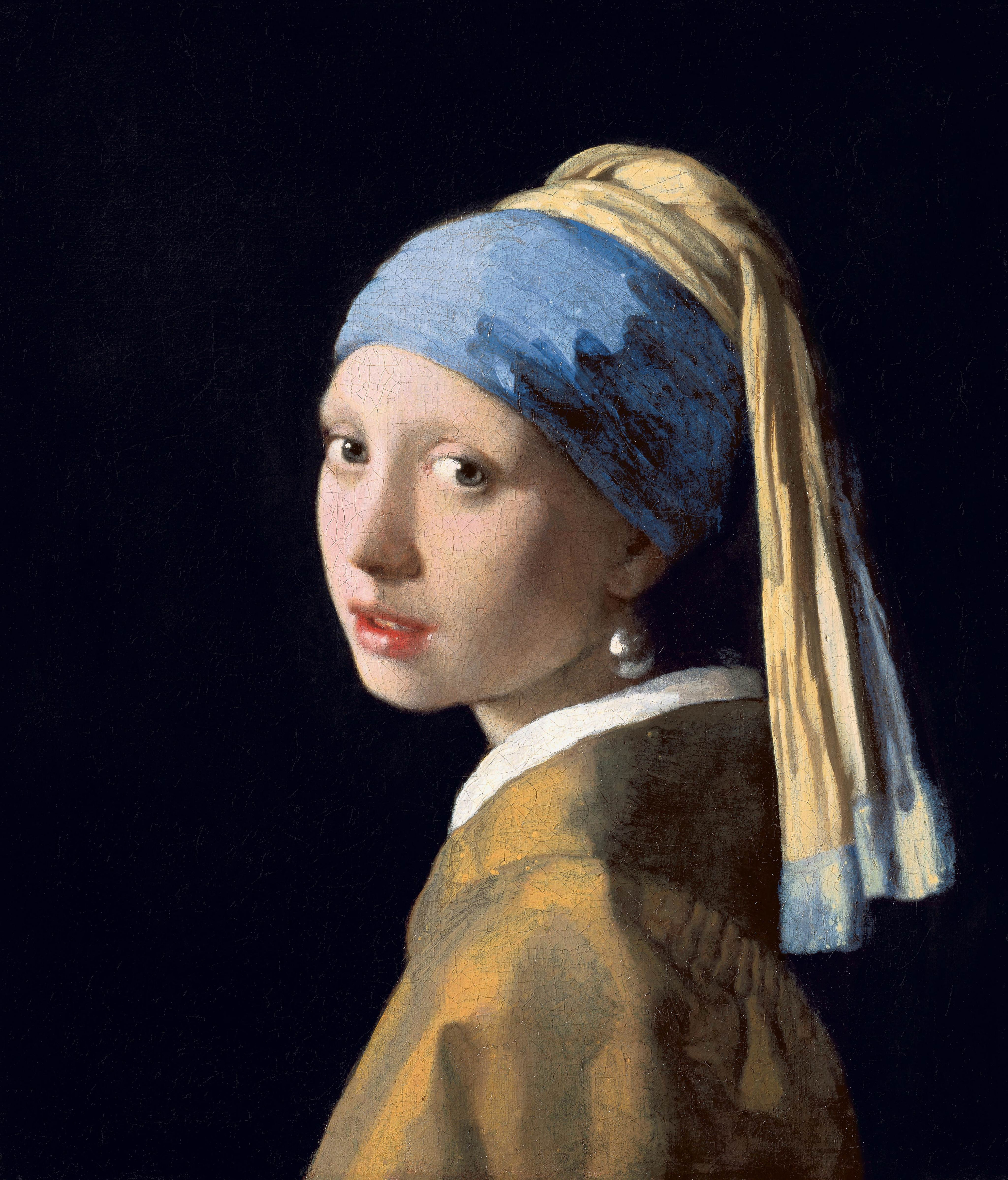
Girl with a Pearl Earring is sometimes called the Mona Lisa of the North, a comparison that flatters both paintings without quite fitting either. Where the Mona Lisa is composed and distant, Vermeer's girl has turned toward the viewer as if interrupted. Her lips are slightly parted. The pearl catches the light. The dark background removes her from any identifiable space, placing her entirely in the viewer's world.
The painting's history tells its own story about the fickleness of reputation. In 1881, Girl with a Pearl Earring sold for two guilders, roughly two dollars. Vermeer's fame had sunk so low that a painting now considered priceless was worth less than a meal. His rediscovery came gradually through the late nineteenth century, and he is now ranked among the greatest painters of any period.
One Room, Thirty-four Paintings
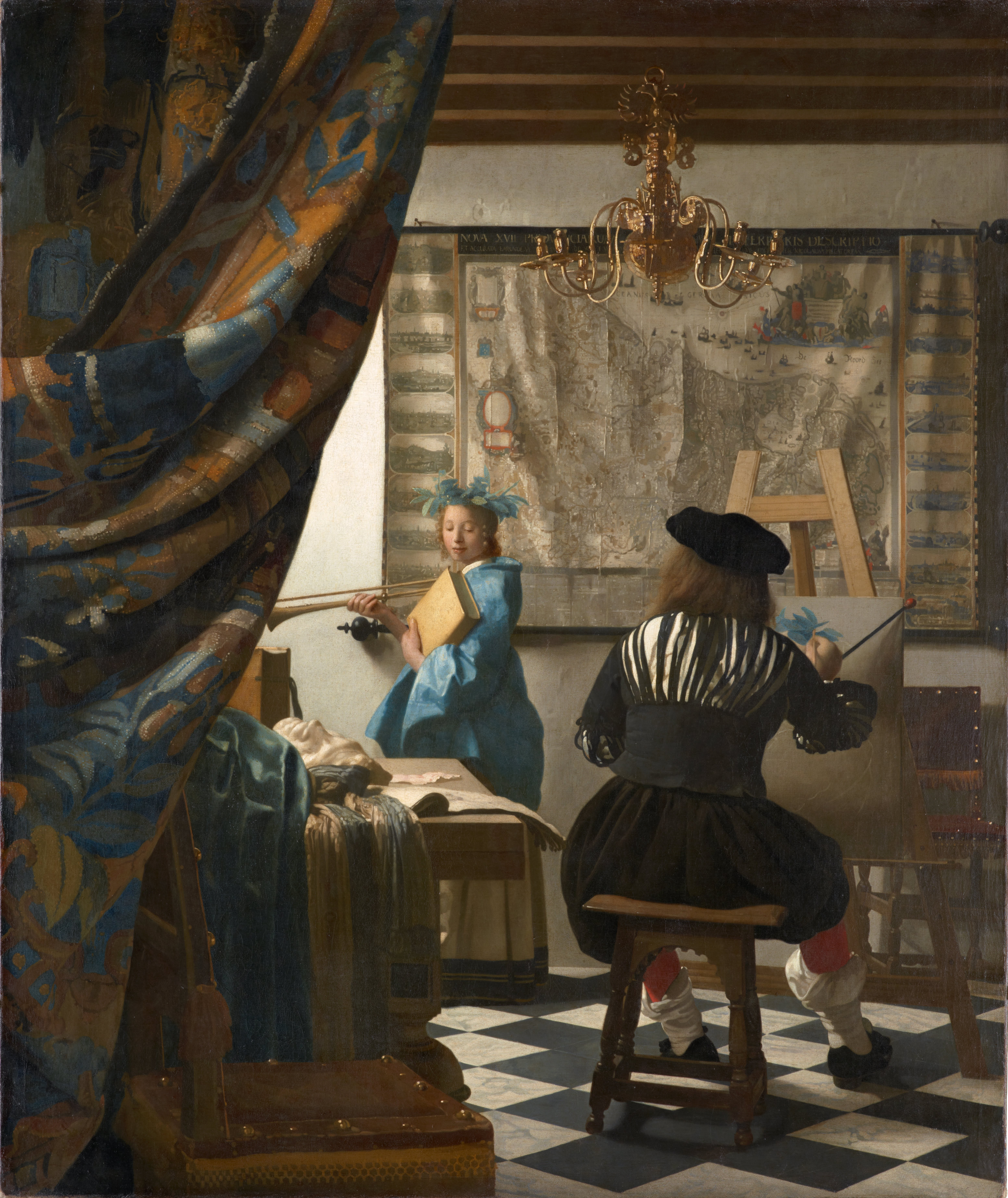
Vermeer's light is often described as warm and cool simultaneously: a mixture of yellow and blue filtering through the same window. He knew his studio's moods the way a musician knows an instrument, and he let those moods speak through his canvases. A woman reads a letter. A man turns a globe. A girl plays a guitar. Nothing dramatic occurs. The drama is in how the light falls, where the shadows gather, and what the silence between figures suggests.
The Art of Painting is Vermeer's most ambitious work and his most self-conscious. A painter (seen from behind, in a costume no working artist would wear) paints a model posing as the muse of History. A map of the Netherlands hangs on the wall. A chandelier catches the light. The painting is about painting itself: what it means to record a moment, to fix light on canvas, to turn the ordinary into something that outlasts the people in it.
Vermeer proved that you did not need mythological subjects, church commissions, or even much space to make great art. A room, a window, and enough patience to wait for the light to do something worth recording was enough.


