

If Hokusai was the old man mad about painting, Utagawa Hiroshige (1797 to 1858) was the quieter artist who noticed what Hokusai often rushed past: the mood of a place at a particular moment, when rain was falling or snow was settling or the light was doing something it would never do again.
Hiroshige began his career designing portraits of actors and beautiful women, the standard fare of the ukiyo-e market. He gave up his position as a fire warden in 1823 to concentrate on art. It was not until the early 1830s, when he was already in his mid-thirties, that he turned to landscapes. The shift was decisive. Within a few years he had become the leading landscape artist in Japan, and the Tokaido road that connected Edo (modern Tokyo) with Kyoto became his defining subject.
The Tokaido: Fifty-three Stations

The series known as the "Hoeido Tokaido," published from around 1832 to 1833, was Hiroshige's breakthrough. Fifty-five prints (the fifty-three way stations plus the start and end points) depicted the journey along Japan's most important highway. Each station was shown in a different season, a different weather condition, a different time of day. Travellers bent into wind, sheltered under trees, or trudged through snow. The road was the constant; everything else changed.
The "Shono" print above shows travellers caught in a sudden downpour, leaning forward against the wind as rain slashes diagonally across bamboo groves. The composition is almost entirely about movement: the angle of the rain, the tilt of the figures, the bend of the trees. Fuji does not appear. The weather is the subject.
The series was an immediate commercial success. The publisher, Takenouchi Magohachi, reprinted it so many times that the original woodblocks wore out and had to be replaced. For every design, the publisher needed to sell enough impressions to cover the costs of the designer, engraver, and printer. With the Tokaido, demand far exceeded that threshold. Hiroshige had found the subject that would define the rest of his career.
One Hundred Famous Views of Edo
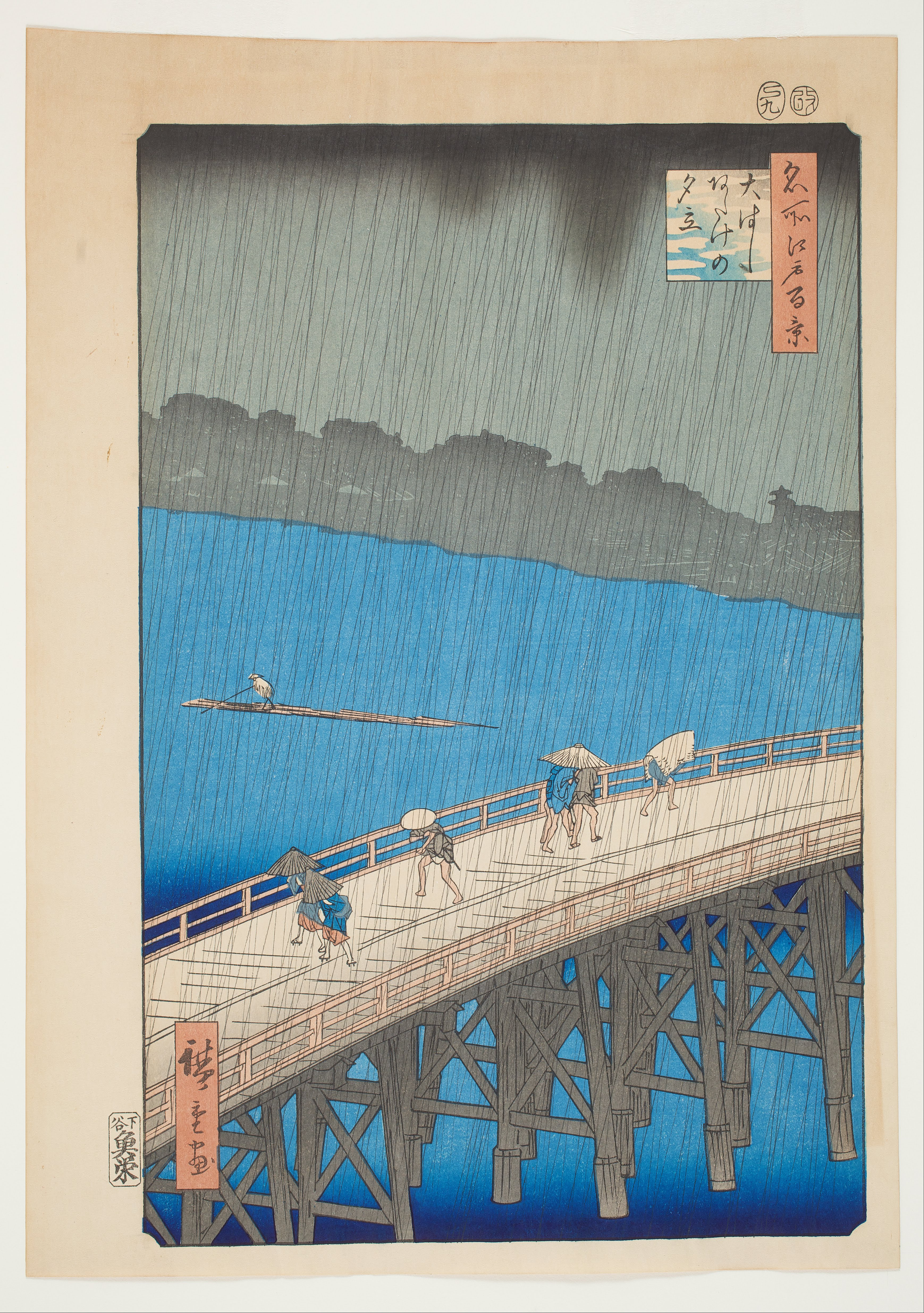
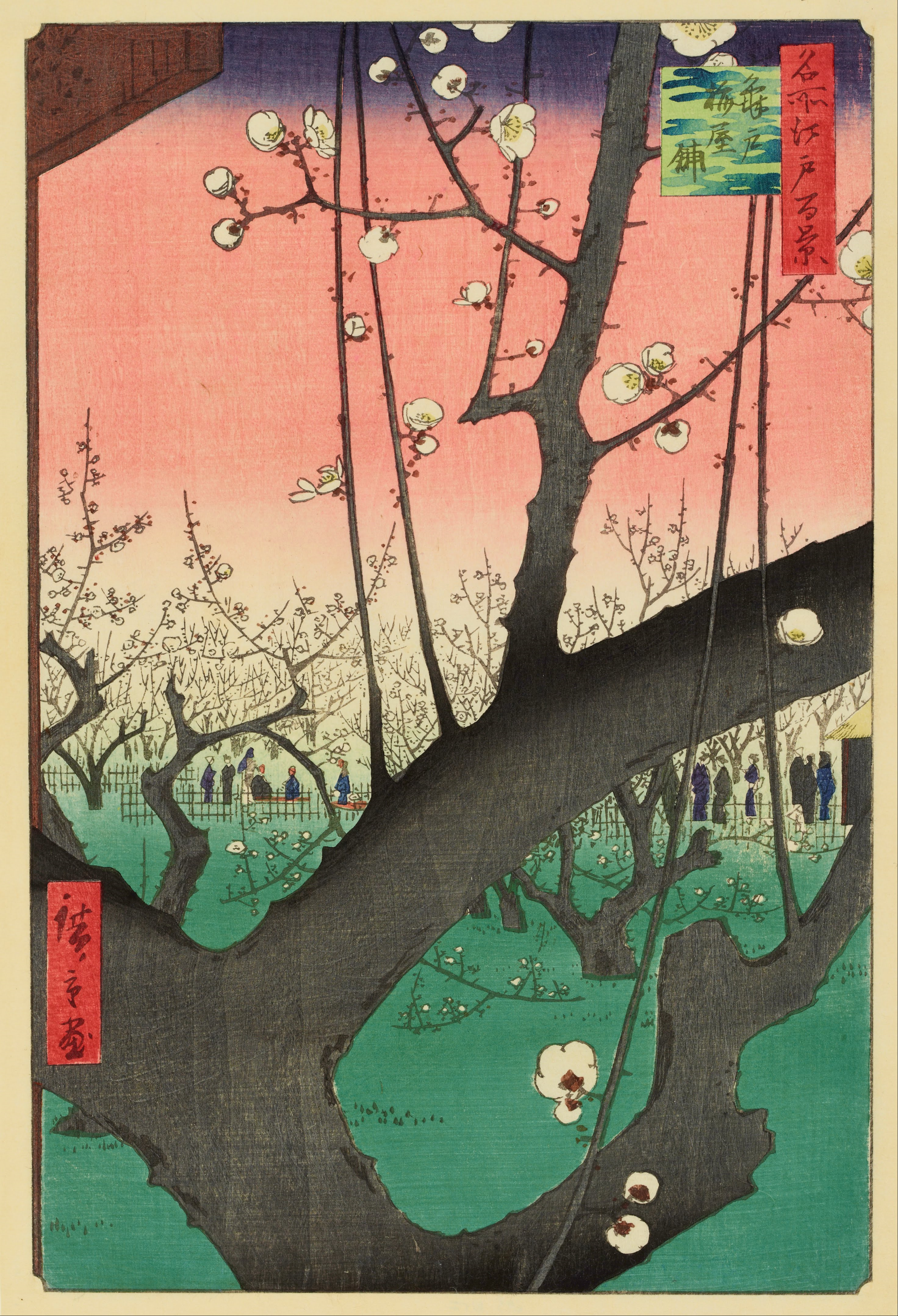
Hiroshige's last great series, "One Hundred Famous Views of Edo," was published between 1856 and 1858, the year he died. Where the Tokaido was a journey, this was a portrait of a single city seen from a hundred angles. The prints used bold compositional devices: extreme close-ups of foreground objects (a plum branch, a cat on a windowsill, a bridge railing) framing a distant view. The effect was cinematic before cinema existed.
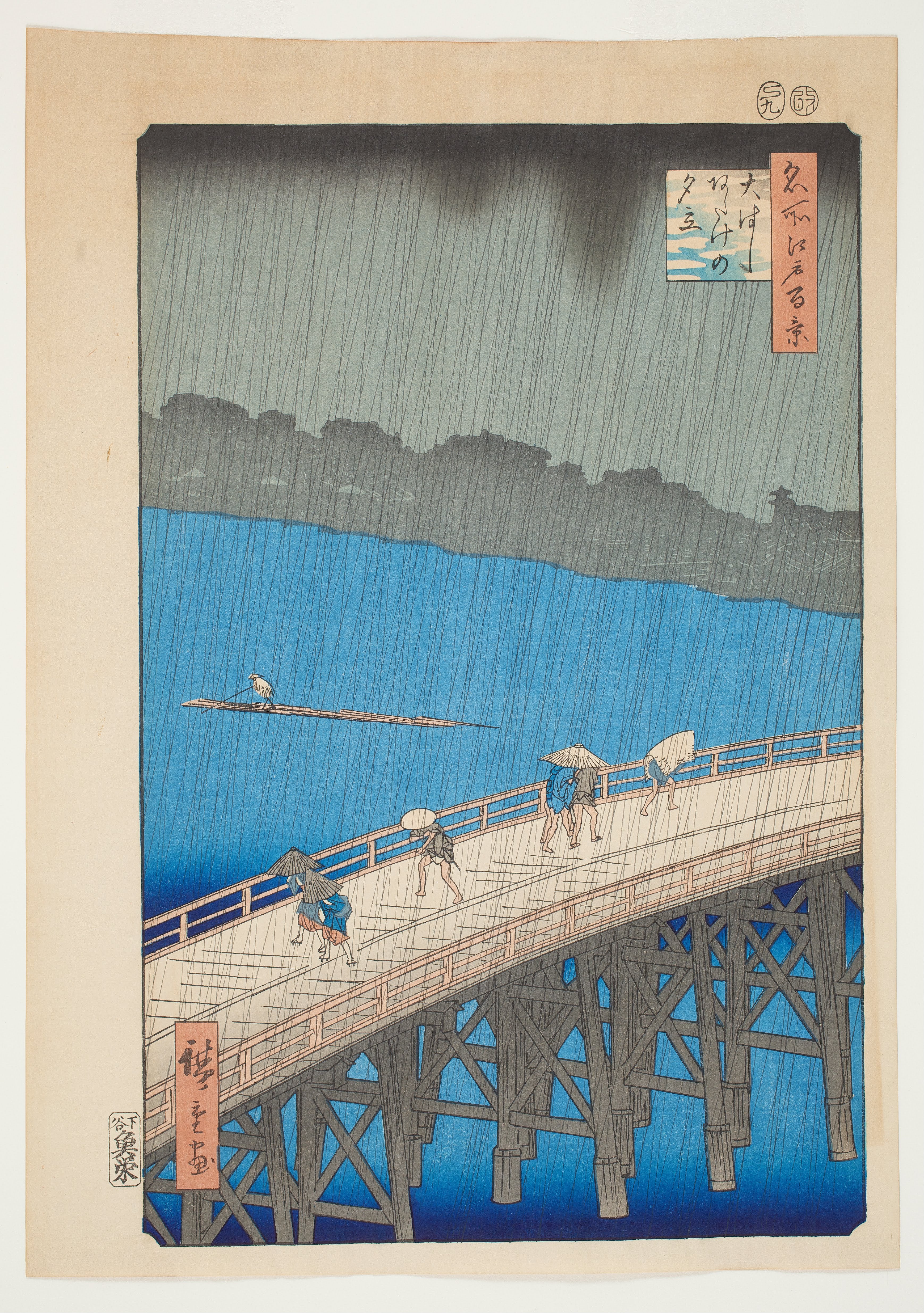
"Sudden Shower over Shin-Ohashi Bridge" is perhaps the most celebrated print in the series. Pedestrians hurry across the bridge as vertical lines of rain fall from a dark sky onto the grey river below. The bridge divides the composition in half; the rain unifies it. When Vincent van Gogh saw a reproduction of this print in Paris in the 1880s, he copied it in oils, adding a border of Japanese characters. It was one of the images that convinced European artists that Japanese composition had something to teach them.
Why Hiroshige Still Matters
Hiroshige produced more than five hundred fan prints, illustrated over 130 books, and created hundreds of paintings alongside his print work. His flower and bird compositions are considered among the finest in the ukiyo-e tradition. But it is the landscapes that secured his place: the ability to make you feel the temperature of a scene, to sense whether the air is damp or dry, to know what time of day it is without being told.
He died of cholera during an epidemic in 1858, leaving behind a body of work that would travel further than any of his subjects ever did. When Japanese prints arrived in Europe in the 1850s and 1860s, it was Hiroshige's rain, snow, and twilight that taught Monet and Whistler that atmosphere was a subject worth painting.


