

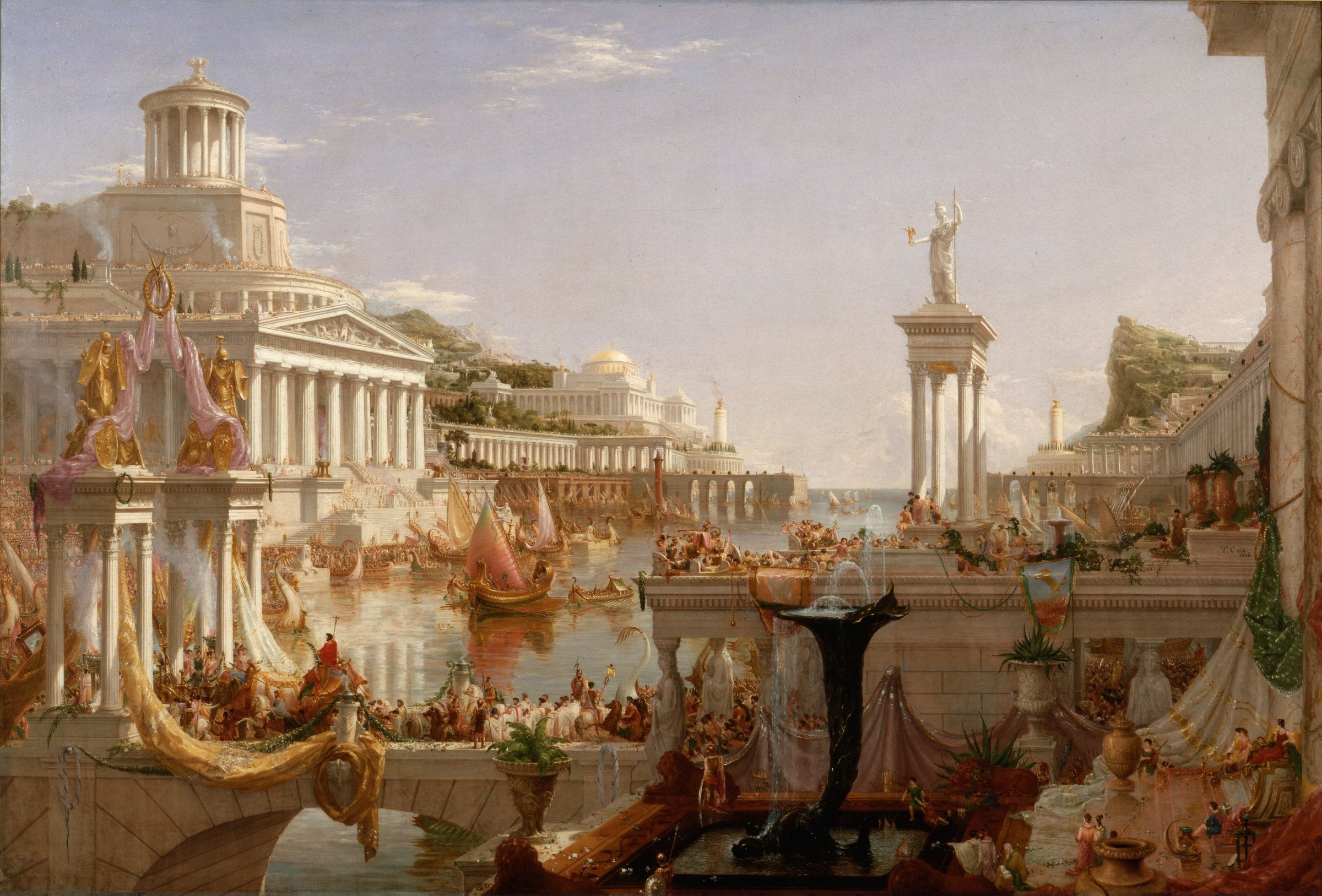
In 1836, in his studio in the Catskill Mountains, Thomas Cole finished The Course of Empire: five large canvases hung as a single cycle, all showing the same imaginary harbour landscape at five different stages. In the first panel, the land is wilderness with a single hunter. In the fifth, it is overgrown ruins with no human figures at all. Between them: a primitive village, a marble city, the city's destruction by invaders.
The cycle was commissioned by Luman Reed, a New York merchant. It hung in Reed's parlour for less than a year before he died. It is now in the New-York Historical Society. It was the most explicit statement Cole ever made of the moral ideas that would drive what came to be called the Hudson River School: the idea that American landscape, far from being a Romantic refuge, was a place where the moral history of civilisations would play out again.
From Lancashire to the Catskills
Thomas Cole was born in Bolton, Lancashire, in 1801. His family emigrated to Ohio in 1818. He worked as an engraver, then a sign-painter, then an itinerant portrait painter through Pennsylvania. He moved to New York City in 1825 and within months had a studio reputation.
The breakthrough came in autumn 1825, when three of his Catskill landscapes were bought by John Trumbull, William Dunlap, and Asher Durand from the window of a New York frame shop. Trumbull, then the leading American history painter, took the lead in promoting Cole. Within a year, Cole had a list of patrons and a permanent base in the village of Catskill on the Hudson River.
What the Hudson River School Was
The Hudson River School was never a school in the institutional sense. It was a group of landscape painters working in upstate New York and New England between roughly 1825 and 1875. The members included Asher Durand, Frederic Edwin Church, Albert Bierstadt, Sanford Gifford, and dozens of others. Cole was the founding figure.
The painters' subject was the American landscape, particularly the Hudson River valley, the Catskills, the Adirondacks, the White Mountains, and the Niagara Falls region. The landscapes are characterised by detailed naturalism, dramatic lighting, and (in the major Cole and Church canvases) explicit moral or theological subtext.
The Course of Empire
The Course of Empire is built around a single landscape feature: a tall mountain peak that appears in all five canvases. The peak is recognisable as a stylised version of the Storm King Mountain in the Hudson Highlands, near Cole's home. By keeping the geography constant, Cole forces the viewer to see history as something that happens to a place rather than to people.
The first panel, The Savage State, shows the landscape at dawn with a hunter in the foreground and a few small figures around a campfire. The forms are wild: jagged peaks, broken trees, a stormy sky. The second, The Pastoral State, shows a brighter morning with shepherds, a small marble temple, and figures dancing around a tree. The third, The Consummation of Empire, is the largest and brightest of the five: a marble city covers the harbour, monumental buildings line the shore, processions move through the streets.
Destruction and Desolation
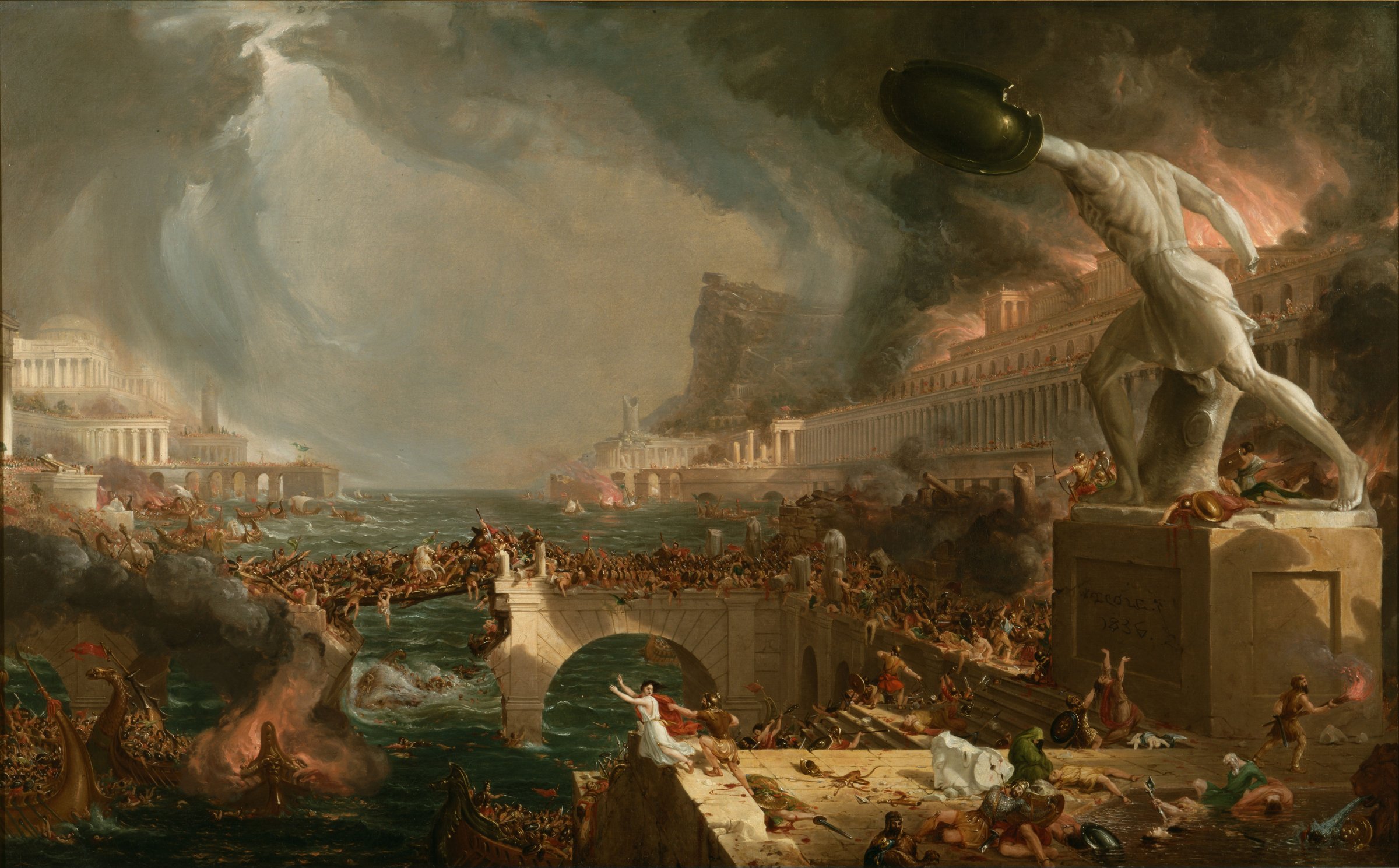
The fourth panel, Destruction, shows the same harbour at sunset. An army of invaders is sacking the city. Buildings are on fire. Statues are being toppled. A bridge is collapsing under the weight of fleeing citizens. The composition is built around a series of diagonals that lead the eye into the central destruction.
The fifth, Desolation, is the quietest. Centuries have passed. The marble buildings are now overgrown with vines. A solitary heron stands on a broken column. The mountain in the distance is unchanged. The painting is empty of human life. The cycle has run its course.
What Cole Was Arguing
The argument was that civilisations rise and fall and that America was not exempt. The Course of Empire was painted in the year of the Texas Revolution and during the political crises that would lead, twenty-five years later, to the Civil War. Cole watched American politics with growing pessimism and saw in the country's expansionist energies the same patterns he had read about in Edward Gibbon's Decline and Fall of the Roman Empire.
Cole was a religious conservative and a Whig. His politics underlay the moralism of his landscapes. The cycle was not just an academic exercise about ancient civilisations: it was a warning about America, painted at a moment when the country was rapidly industrialising and confidently expanding westward.
What Came After
Cole continued to make explicitly allegorical landscapes for the rest of his career: The Voyage of Life (a four-canvas cycle showing a person's life as a river journey), The Cross and the World (an unfinished series). The allegorical mode was not adopted by his followers. Asher Durand, who took over Cole's studio after his early death in 1848, kept the detailed naturalism but dropped the moralism. Frederic Church, Cole's only formal pupil, raised the technical level of the landscapes far beyond Cole's but turned the moral argument into a kind of theological awe at the natural sublime.
By the 1870s, the Hudson River School style had been overtaken by Impressionism and the Tonalism of George Inness. Cole's reputation declined. He was rediscovered in the 1940s by curators interested in American identity and has remained a foundational figure in any account of American art since.
What the Cycle Still Says
The Course of Empire is sometimes read as a museum piece: a quaint mid-nineteenth-century moralism about civilisations long dead. The pictures themselves resist that reading. The mountain in all five canvases is recognisably American. The Consummation could be New York Harbour. The Destruction looks like the burning of a port that does not yet exist.
Cole knew what he was doing. He painted American landscape as a warning because he was an American who thought warnings were owed. He died at forty-seven, in 1848, during a typhus epidemic in his Catskill village. He had finished the cycle twelve years earlier. It hung in a parlour, then in a museum, and is now considered the founding statement of American landscape painting.


