

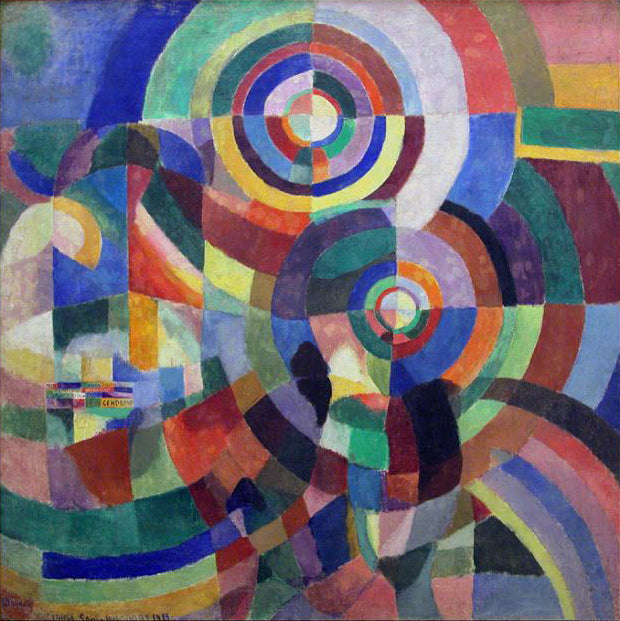
Sonia Delaunay was born Sara Stern in Ukraine in 1885 and adopted into a wealthy Saint Petersburg family at five. She studied painting in Karlsruhe and then Paris, married the French painter Robert Delaunay in 1910, and developed alongside him the theory of Simultaneism: a style of painting in which colour relationships, rather than line, structure the picture.
The 1917 Russian Revolution wiped out her family income. From that point until Robert's death in 1941, Sonia supported the household by designing textiles, costumes, and clothes. The decorative work funded the painting. The painting funded her later reputation. The textile archive funded her museum retrospectives. Both halves of her career have been undervalued because they have been treated separately.
From Saint Petersburg to Paris
Sonia Stern grew up in the household of her uncle Henri Terk, a wealthy lawyer with a major art collection. She enrolled at the Karlsruhe Academy of Art in 1903 and moved to Paris in 1905. She married the German art dealer Wilhelm Uhde in 1908 in a marriage of convenience that gave her independence from her uncle. She divorced Uhde in 1910 and married Robert Delaunay, then twenty-five and already a member of the Cubist circle.
The Delaunays' joint development of Simultaneism was concentrated in 1912 and 1913. They worked in adjacent studios, exchanged books on optics and colour theory, and produced parallel series of paintings. Robert's Eiffel Towers and Disks of the Sun, and Sonia's Bal Bullier (a painting of the famous Paris dance hall, 4.4 metres long and full of dancing colour-pairs), come from this period.
The Marriage of Painting and Textile
The first major textile work was the Couverture, a quilt Sonia made for her infant son Charles in 1911. The blanket is patched together from coloured fabric squares in irregular shapes; the composition is purely abstract. Sonia later said that looking at the quilt made her see how to paint Cubist canvases without subject matter.
From 1913 onward she designed book covers (Blaise Cendrars's Prose of the Trans-Siberian, an accordion-fold poem two metres long, the type and decoration done by Sonia in colour-collages), theatre costumes (Cleopatra for the Ballets Russes), and one-off dresses. The textiles were not separate from the paintings: the same colour-relationships powered both.
Madrid, Lisbon, the Crash
The First World War caught the Delaunays in Spain. They stayed for the duration, mostly in Madrid and Lisbon, where Sonia opened her first fashion business. She designed costumes for Diaghilev's Ballets Russes and made a small living from interior decoration commissions. The Russian Revolution ended the income that had supported the family from Saint Petersburg.
The Delaunays returned to Paris in 1921 with no capital. Sonia opened a fashion atelier in 1925 and designed for the Salon d'Automne, the Exposition Internationale des Arts Décoratifs (the 1925 Paris exhibition that gave Art Deco its name), and clients including the actresses Gloria Swanson and Nancy Cunard. She produced 150 fabric designs a year for the next fifteen years, working with manufacturers in Lyon and Paris.
What the Textiles Look Like
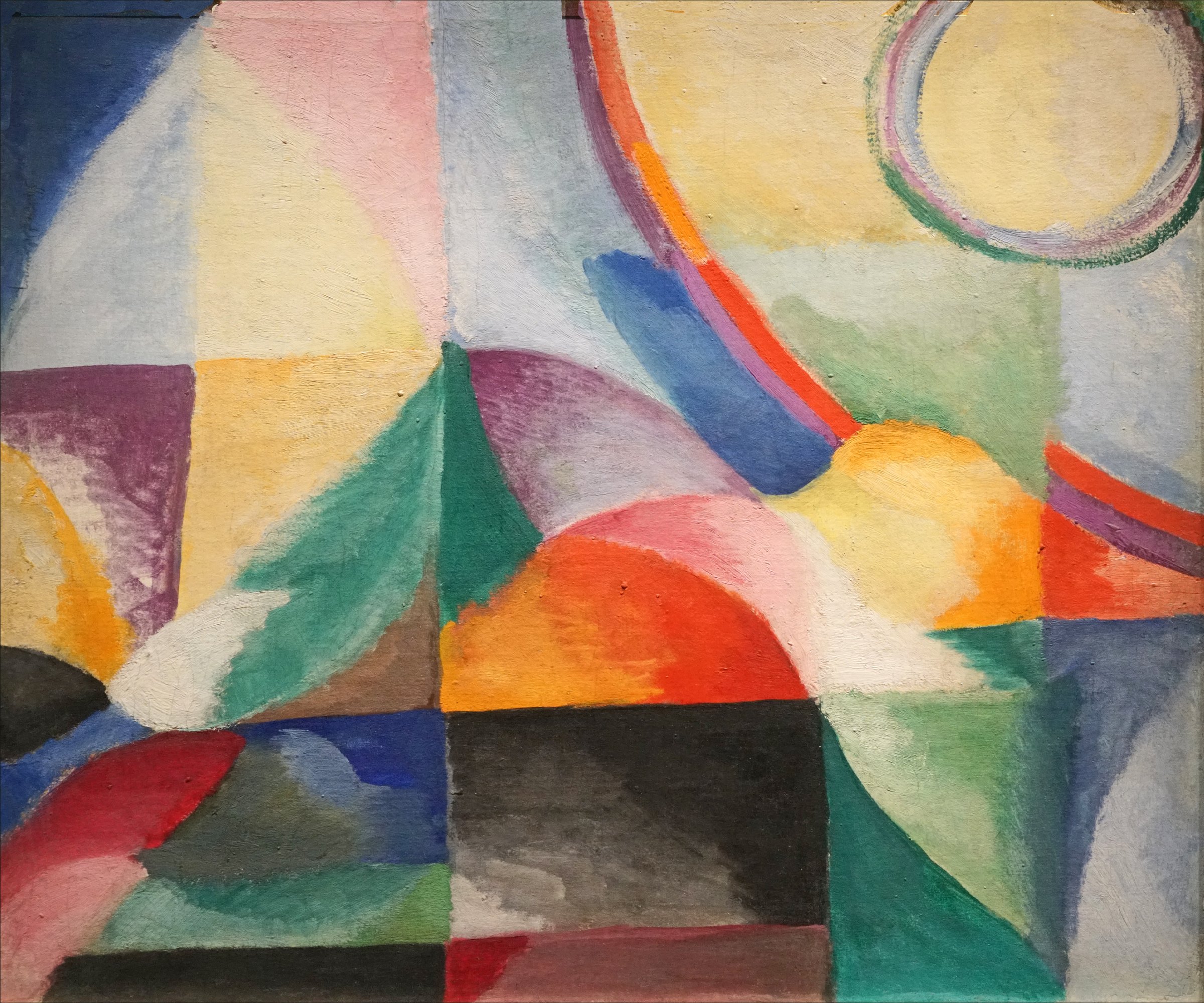
The Delaunay textile language is recognisable: bold geometric blocks of colour (often arranged in concentric circles or radiating triangles), strong colour contrasts (orange against blue, yellow against violet), and an absence of representational motifs. The dresses were designed as moving paintings: the seams and the body's movement would interact with the colour-blocks to produce continuous chromatic effects.
She also designed simultaneous suits for men, ties for Tristan Tzara, beach umbrellas, swimsuits, and shoes. The 1925 robe simultanée is a knee-length dress in coloured wool, the hem cut into geometric tabs that fall against the legs as the wearer walks. It is preserved at the Musée des Arts Décoratifs in Paris.
After Robert
Robert Delaunay died of cancer in 1941, in Mougins in the south of France. The couple had been there since 1940, having fled Paris before the German occupation. Sonia returned to Paris after the liberation and took up painting full-time. She closed the fashion atelier definitively in 1952.
Her later painting career was active. She designed the cover and posters for the 1964 Cassandra exhibition at the Louvre, the first major retrospective ever given to a living woman artist by that museum. She continued painting and printmaking until her death in 1979 at ninety-four.
What Was Recovered
Sonia Delaunay's textile work was largely undervalued during her lifetime. The 2014 retrospective at the Musée d'Art Moderne de la Ville de Paris was the first major exhibition to treat her painting and her textiles as a single output. The 2015 exhibition at Tate Modern (Sonia Delaunay: The EY Exhibition) made the same argument to a wider audience.
The reframing matters because the standard art-history narrative had Sonia as Robert's wife and helper, the textile production as a sideline. The reframing has Sonia as the more inventive of the two, the textiles as primary works rather than commercial off-shoots, and the painting as a continuation of the same colour project that produced the dresses.
The painter who sold dresses to fund the canvases was working a different system from the standard avant-garde model. She did not have a wealthy patron. She did not have a teaching salary. She made the work, made the clothes, and used the clothes to keep making the work. The system worked for fifty-four years.


