

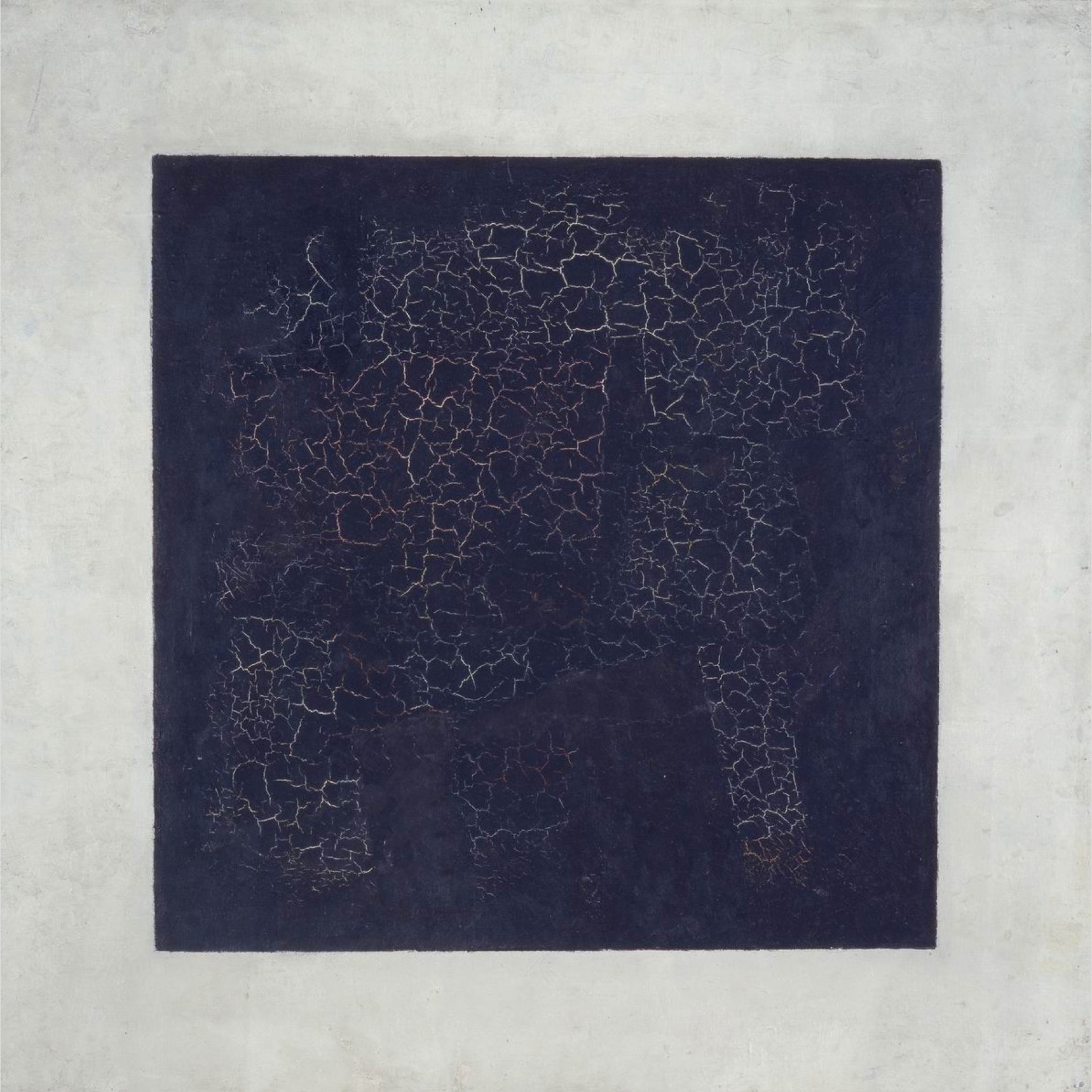
On 19 December 1915, in Petrograd (the wartime renaming of Saint Petersburg), the exhibition called The Last Futurist Exhibition of Paintings 0,10 opened to the public. Forty-nine paintings by Kazimir Malevich filled one wall of the small gallery. The most prominent of them was a square canvas, about eighty centimetres on each side, painted entirely black with a thin white border. It hung high in the corner of the room, where the wall met the ceiling.
The position was deliberate. In Russian Orthodox homes, the krasny ugol (red corner, or beautiful corner) is the place where icons are displayed: the corner diagonally opposite the entry door, lit by candles, at eye-level when standing. By hanging Black Square in the krasny ugol, Malevich was making a claim. The painting was not just a picture. It was a successor to the icon.
What Malevich Had Done Before
Malevich was thirty-six in 1915. He had been a Cubo-Futurist for several years, painting figures broken into geometric facets in the manner of Picasso and the Italian Futurists. By 1913 he had moved to alogism, an Eastern European pictorial mode that combined unrelated objects in puzzling juxtapositions, often with text.
In summer 1915, Malevich began the series he later called Suprematism. The paintings were geometric: rectangles, lines, circles, trapezoids in solid colours, suspended on white grounds. The colour palette was limited: black, red, yellow, blue, green. There were no representational subjects, no titles describing scenes, no narrative framework. The paintings were what they were.
The 0,10 Exhibition
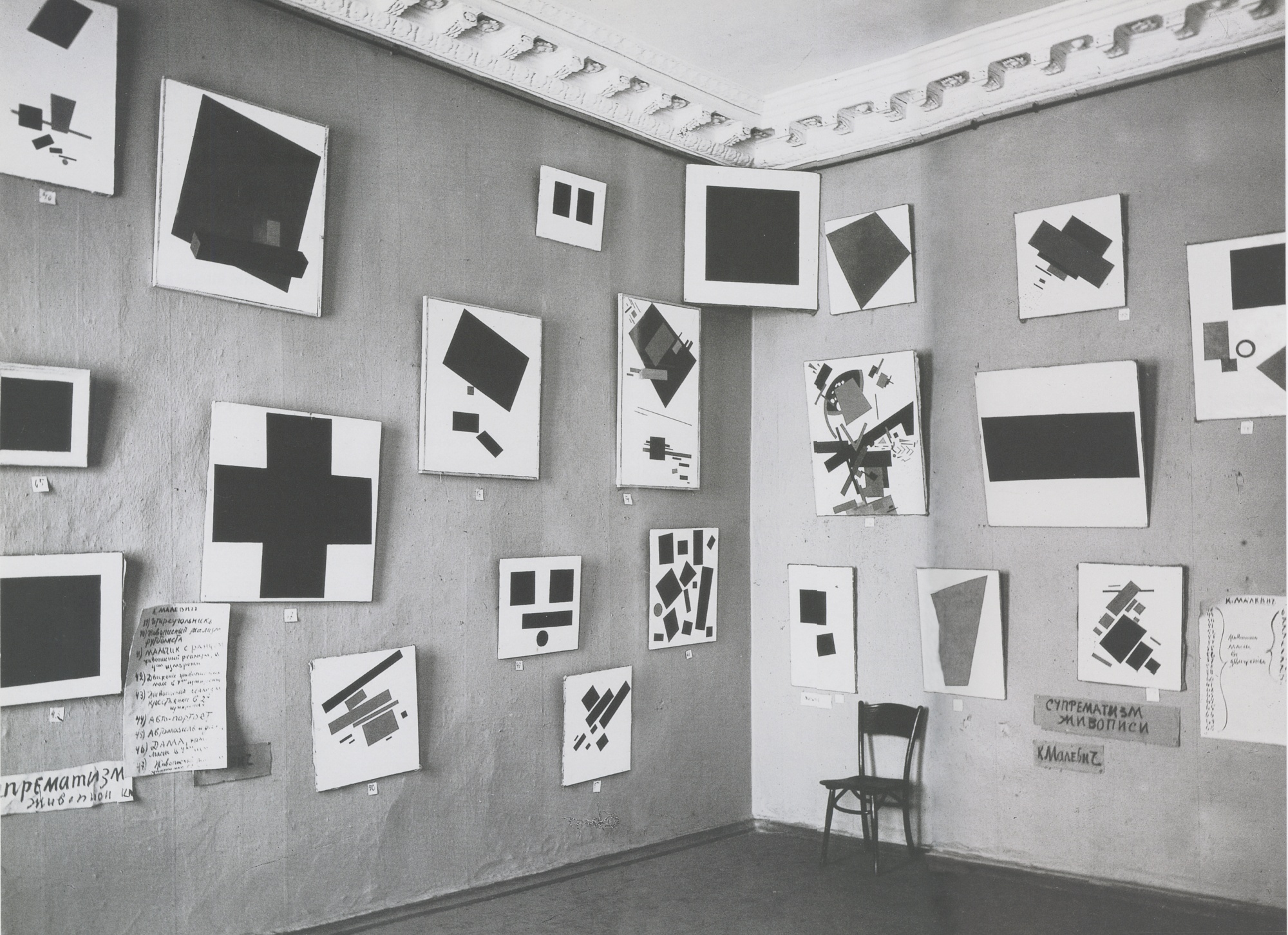
The exhibition's title was a kind of riddle. The "0" was Malevich's mark for the reduction of representational subject matter to nothing. The "10" was the planned number of participating artists, though only fourteen actually showed up. The exhibition was organised by Ivan Puni and Ksenia Boguslavskaya in their gallery on the Marsovo Pole in Petrograd.
Malevich had not yet announced his break with Cubo-Futurism publicly. The paintings he hung at 0,10 were the first time the wider Russian art world saw Suprematism. The reaction was mixed. Vladimir Tatlin, the other major Russian avant-garde figure, was furious; he had his own corner of the exhibition with his counter-reliefs and refused to share a wall with Malevich.
What the Painting Looks Like
The 1915 Black Square is, technically, not pure black on pure white. The black square is offset slightly from the centre of the white field, giving the painting a small but measurable asymmetry. The black surface is heavily worked: layered, scraped, repainted multiple times. The original layer was reportedly a brightly coloured composition that Malevich painted over.
The original 1915 painting has cracked extensively over the past century. The black surface has crazed, revealing the white ground underneath in a grid of fissures. Conservators have used X-ray imaging to confirm that earlier compositions exist beneath: at least one Cubo-Futurist composition and possibly an even earlier figurative one. The layered history is now part of the painting's substance.
Suprematism as a System
Malevich expanded Black Square into a full programme. The 1915 manifesto, From Cubism to Suprematism, argued that representation in painting was historically obsolete. The new painting would be about pure feeling, expressed through pure geometric forms. The square was the basic unit; the cross, the circle, and the rectangle followed.
By 1918 Malevich had pushed the system to its logical end with White on White, a series of paintings in which a slightly-tilted white square sits on a slightly-different white ground. The colour distinction is barely visible. The painting is, in some sense, the last possible Suprematist painting: any further reduction would result in a blank canvas.
The Soviet Period
The 1917 Revolution found Malevich working in Moscow. The Bolsheviks initially supported the avant-garde as a useful ally against bourgeois aesthetics. Malevich was given teaching positions in Vitebsk (where he founded UNOVIS, the Affirmers of the New Art group) and at the Petrograd State Institute of Artistic Culture. His paintings were collected by Soviet museums.
The position was unstable. By 1928, Stalin's cultural commissars had decided that Socialist Realism was the official aesthetic of the Soviet state. Suprematism was attacked as bourgeois formalism. Malevich was allowed to continue working but was increasingly isolated. He returned to figurative painting in the 1930s, signing his post-Suprematist paintings with a small black square as a kind of trademark.
The Black Square at the Funeral
Malevich died in 1935 at fifty-six. He had directed his own funeral arrangements. The coffin was painted with a black square, a black circle, and a black cross: the three primary Suprematist forms. He was carried to the train station in a Suprematist-decorated truck. Mourners followed on foot. The body was cremated in Moscow and the ashes buried in Nemchinovka, outside Moscow, under a wooden post painted with a black square.
The grave site was destroyed during the Second World War and the precise location was lost. A new memorial was put up in 1988, with a black square on a white cube.
What the Painting Did
Black Square is not just a flat black surface. It is a specific painting made at a specific time as a specific argument. The argument was that representation had ended, and that something new could begin. The argument was strong enough to survive its maker by ninety years.
The 1915 Black Square is the third or fourth black square Malevich made. He repainted the subject several times: a 1923 version, a 1929 version, a 1932 version. The 1915 painting hangs in the Tretyakov Gallery in Moscow. The 1929 version is also in the Tretyakov. The 1923 and 1932 versions are in the Russian Museum in Saint Petersburg.
The painting in the icon corner was the first. Everything else has been a repetition.


