

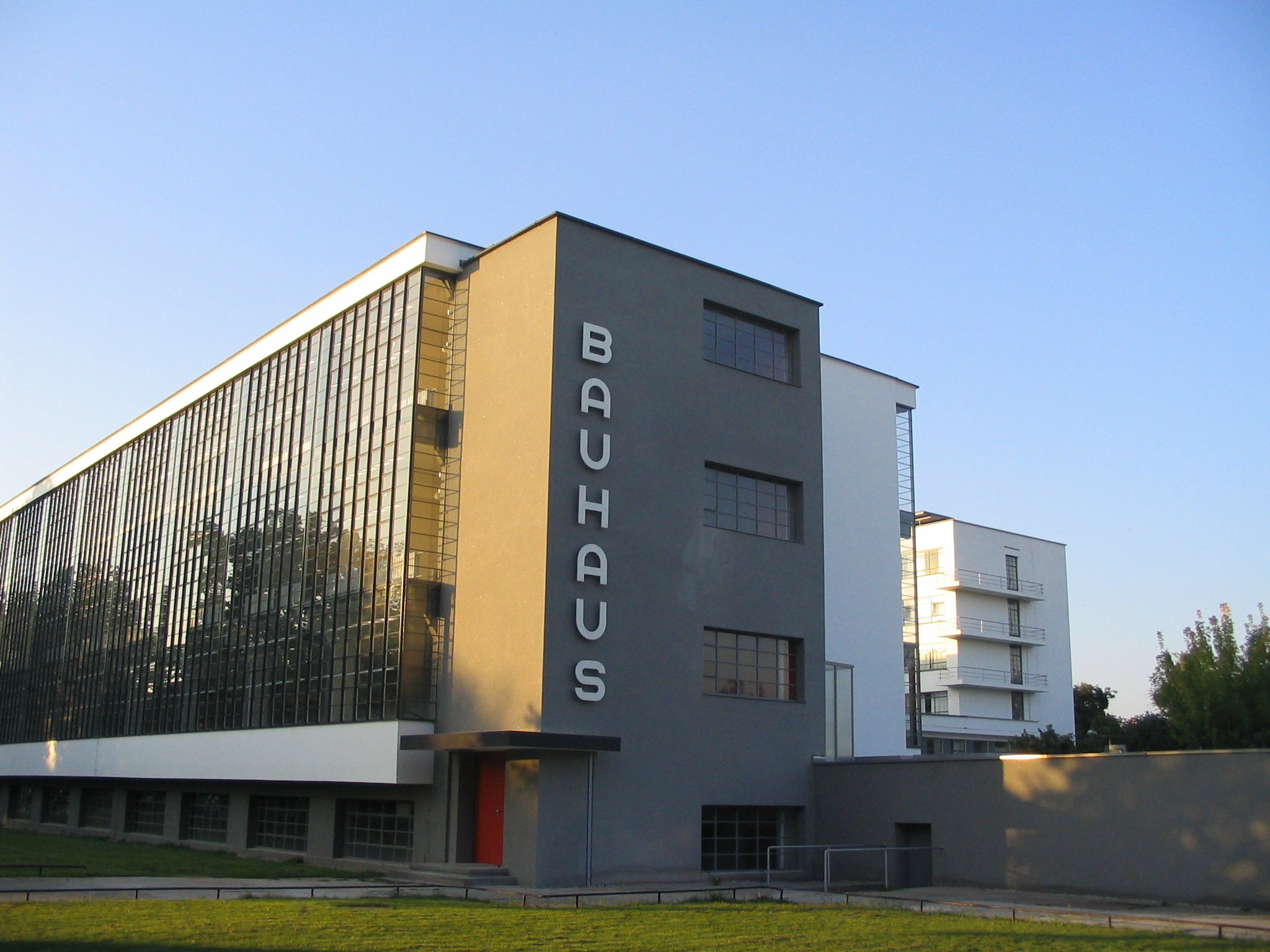
The Staatliches Bauhaus opened in April 1919 in Weimar and was dissolved by Gestapo order in April 1933 in Berlin. Its fourteen years coincided exactly with the Weimar Republic. Within that span, the school produced graduates who designed the typographic, furniture, and architectural language of the modern world: sans-serif type, tubular steel chairs, glass-curtain walls, modular housing.
The school's history was unstable. It was forced to relocate twice (Weimar to Dessau in 1925, Dessau to Berlin in 1932) and to change directors three times (Walter Gropius, Hannes Meyer, Ludwig Mies van der Rohe). It was politically attacked by the Weimar local government, by the Saxon socialists, and finally by the National Socialists. It survived as long as it did through the deliberate effort of a small group of teachers.
Walter Gropius and the Founding
Walter Gropius was thirty-six when he became director of the new school in 1919. He had served in the German army and emerged from the war committed to a programme of total reform of art and craft education. The founding manifesto, written by Gropius and illustrated with a woodcut by Lyonel Feininger of a cathedral with three stars, called for the unification of all artistic disciplines.
The pedagogy was structured around a foundation course (Vorkurs) and specialised workshops. The Vorkurs, designed by Johannes Itten and later Laszlo Moholy-Nagy, taught students to think about materials and forms before any specific application. The workshops covered weaving, metalwork, cabinetmaking, ceramics, typography, mural painting, stagecraft, and (eventually) architecture.
The Teachers
The faculty (called Masters, Meister) included some of the most important figures in twentieth-century art. Wassily Kandinsky taught the foundation course and analytical drawing. Paul Klee taught the weaving and stained-glass workshops, and gave lectures on form and composition that became the basis of his Pedagogical Sketchbook. Josef Albers ran the Vorkurs after Moholy-Nagy left. Oskar Schlemmer ran the stage workshop and choreographed the Bauhaus dances.
The Masters were paid less than they would have earned commercially and the school was always financially fragile. They taught for a complex set of reasons: the chance to develop ideas in dialogue with younger artists, the relative freedom of the school environment, the salary that came with state funding (when the state was willing to provide it).
The Weimar Years
The original Weimar period (1919-1925) was experimental and conflicted. Itten, who ran the Vorkurs from 1919, was a follower of the Mazdaznan religion and ran the workshop with quasi-spiritual breathing exercises and dietary rules. He left in 1923 after disagreements with Gropius about the direction of the school. The replacement, Moholy-Nagy, was a Hungarian Constructivist who introduced photography, film, and industrial materials into the curriculum.
The shift signalled a change in the Bauhaus's orientation: away from the medievalist craft model implied by the founding manifesto, toward an embrace of industrial production. The slogan that emerged in 1923 was Kunst und Technik: Eine Neue Einheit (Art and Technology: A New Unity). The school began designing prototypes for serial production.
Dessau
Right-wing local politicians forced the school out of Weimar in 1925. The city of Dessau, a hundred kilometres north, offered to take it. Gropius designed a new building for the school: a four-storey complex with workshops, studios, classrooms, dormitory, and the masters' houses, all built in a distinct modernist idiom of white walls, ribbon windows, and flat roofs.
The Dessau building (completed 1926) was the architectural manifesto the school had not yet built. Glass curtain walls on the workshop wing exposed the steel structure. The plan was asymmetrical, the volumes interlocking, the circulation legible from the exterior. The building still stands. It is now a UNESCO World Heritage Site.
The Furniture
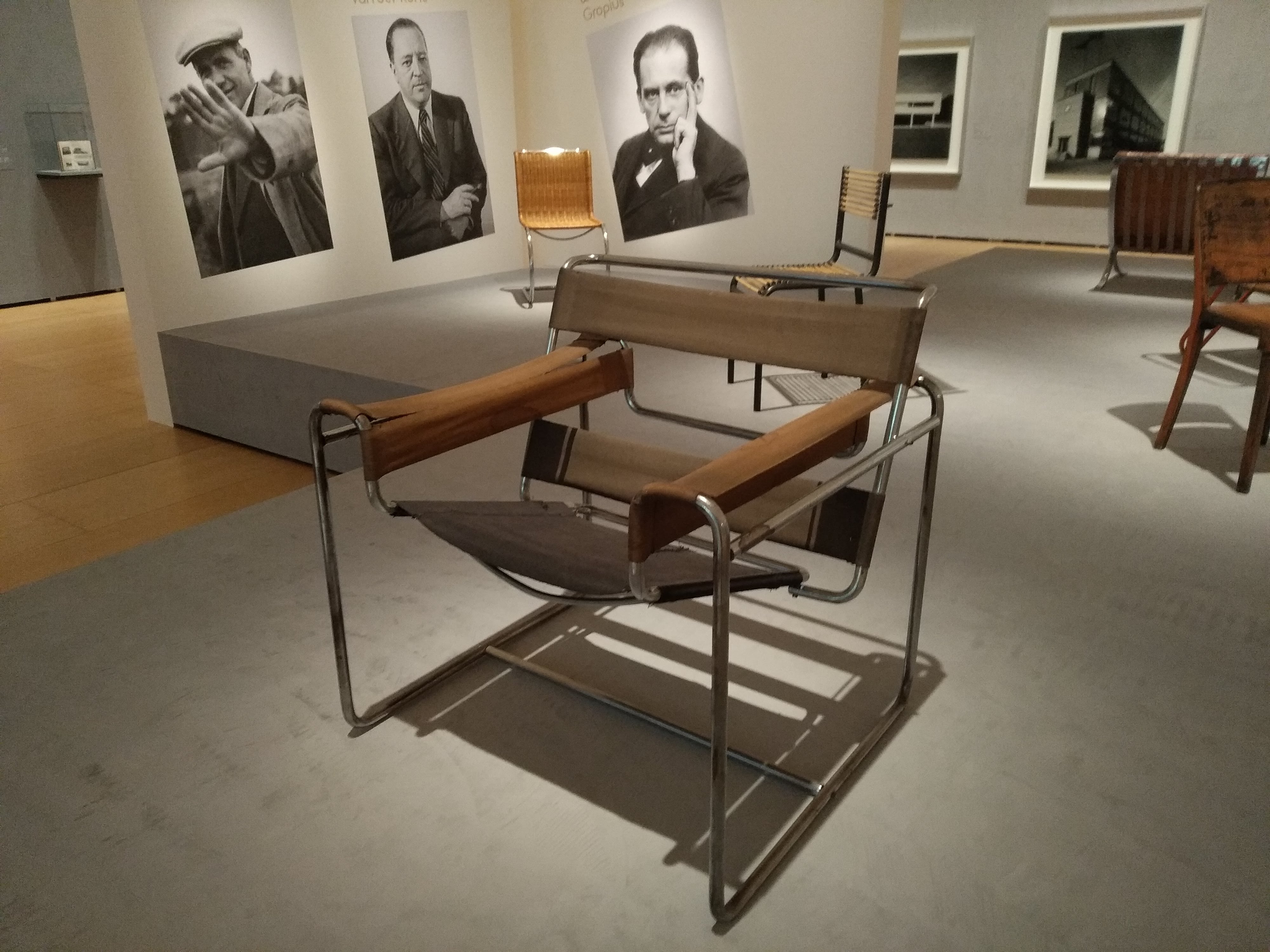
The Bauhaus's most commercially successful designs came from the Dessau years. Marcel Breuer's tubular-steel B3 chair (1925-26), later marketed as the Wassily Chair after Kandinsky's first names, was the first chair to use bent steel tubing as a structural frame. The technology came from Adler bicycles, manufactured in Dessau.
Marianne Brandt's metal designs for tea infusers, ashtrays, and lamps reduced everyday objects to their geometric essentials and pioneered the use of chrome plating in domestic objects. Anni Albers and Gunta Stölzl developed weaving as an industrial discipline, designing fabrics that were sold to commercial manufacturers. Herbert Bayer's typeface Universal (1925) anticipated the sans-serif typography that became the visual signature of mid-century design.
Hannes Meyer and Politics
Gropius resigned in 1928 and named Hannes Meyer, a Swiss Marxist architect, as his successor. Meyer pushed the school further toward industrial production and explicit political engagement. He recruited radical students, ran a cooperative housing project for trade unions, and made the school's left-wing orientation more visible.
The Dessau city council, under pressure from rising National Socialist sentiment, dismissed Meyer in 1930. He went to the Soviet Union. Mies van der Rohe took over and tried to depoliticise the school by removing students with overt Communist affiliations and tightening discipline. It did not work. The Nazi-controlled Dessau council closed the school in 1932.
Berlin and the End
Mies reopened the Bauhaus as a private school in a former factory in Berlin in autumn 1932. It operated for one term. In April 1933, four months after Hitler became chancellor, Gestapo officers raided the building. The school was closed. The faculty dispersed.
The diaspora is what made the Bauhaus into the international movement it became. Gropius went to England and then to Harvard, where he taught for two decades. Mies went to the Illinois Institute of Technology in Chicago and designed the Seagram Building. Albers went to Black Mountain College and then Yale. Moholy-Nagy founded the New Bauhaus in Chicago. Breuer became one of the most prolific architects in postwar America.
The school that lasted fourteen years had taught fewer than 1,300 students. By the 1960s, every architecture school in the United States and Western Europe was teaching some version of its curriculum. The Helvetica typeface, the curtain-wall office building, the modular kitchen, the IKEA chair: all carry the Bauhaus signature.
Hitler called the building in Dessau "an aquarium." It is now a museum.


