

On 24 August AD 79, Mount Vesuvius erupted. The town of Pompeii, twenty kilometres south on the Bay of Naples, was buried under approximately four to six metres of volcanic ash and pumice within twenty-four hours. Most of the inhabitants who had not fled were killed by pyroclastic surges of superheated gas and ash. Their bodies decomposed in the centuries that followed, leaving cavities in the hardened ash that nineteenth-century archaeologists filled with plaster to recover the body shapes.
The wall paintings did not decompose. Buried under sealed layers of ash, protected from light and oxygen, the frescoes that decorated the houses of Pompeii survived more or less intact. The town now contains more Roman domestic painting than has been preserved in the entire rest of the empire combined.
The Eruption
The eruption was described by Pliny the Younger, who watched it from across the Bay of Naples. His uncle Pliny the Elder, the natural historian, was killed in the eruption while attempting a rescue mission. Pliny the Younger's two letters to the historian Tacitus, written about twenty-five years later, are the only contemporary written accounts.
Pompeii had a population of approximately 11,000 to 15,000 at the time of the eruption. Around 1,500 bodies have been recovered from the site since excavations began in earnest in the eighteenth century. Most of the inhabitants probably evacuated when the first earthquakes and ash falls began. Those who remained, including the elderly, the sick, slaves who could not leave, and people who returned to collect possessions, were killed.
The Four Styles
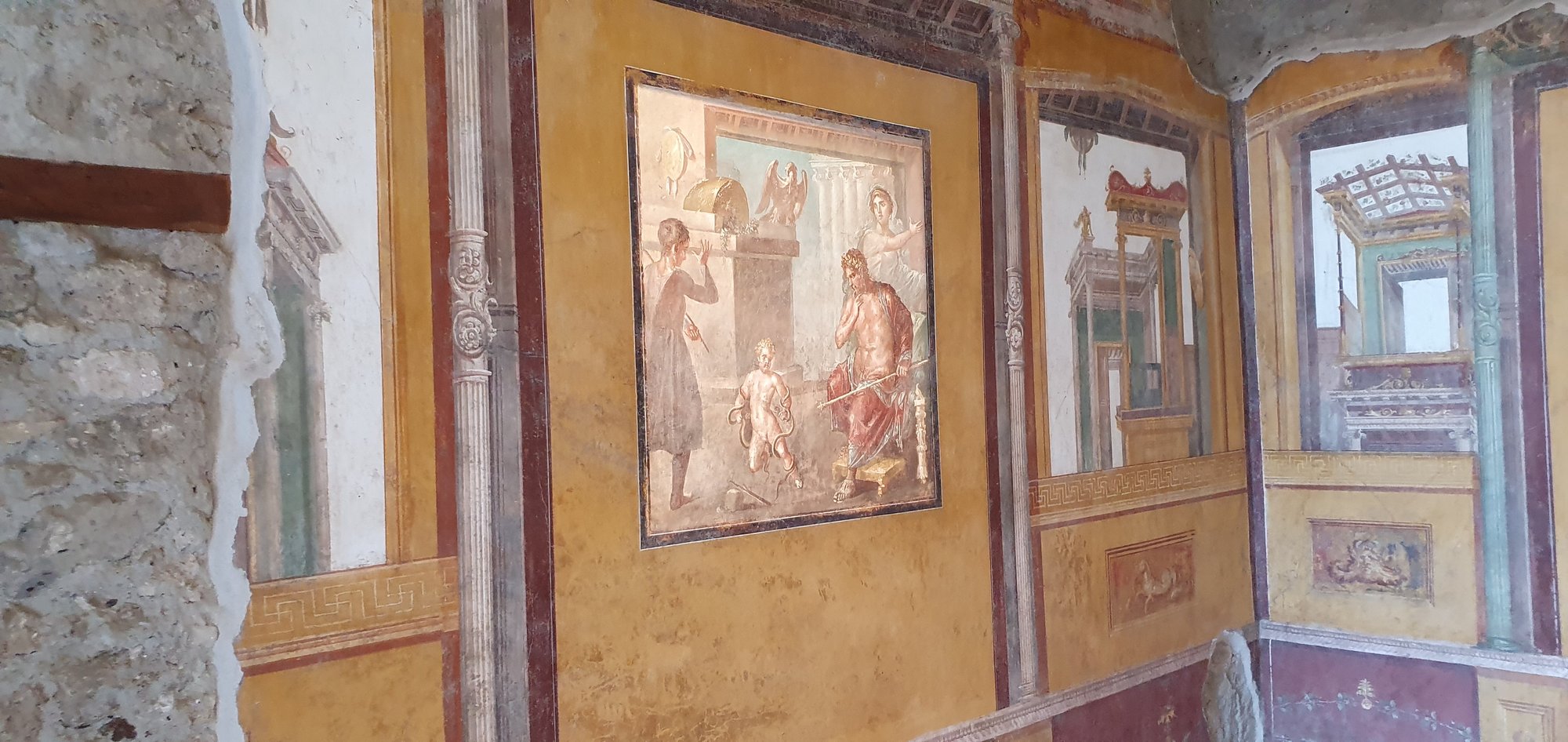
Roman wall painting in Pompeii is conventionally divided into four styles, named in order of their development.
First Style (c. 200 to 80 BC): paintings that imitated marble panelling using painted stucco. The walls were divided into rectangles of painted "marble" of various colours, sometimes with elaborate moulded frames. The aesthetic was austere and architectural.
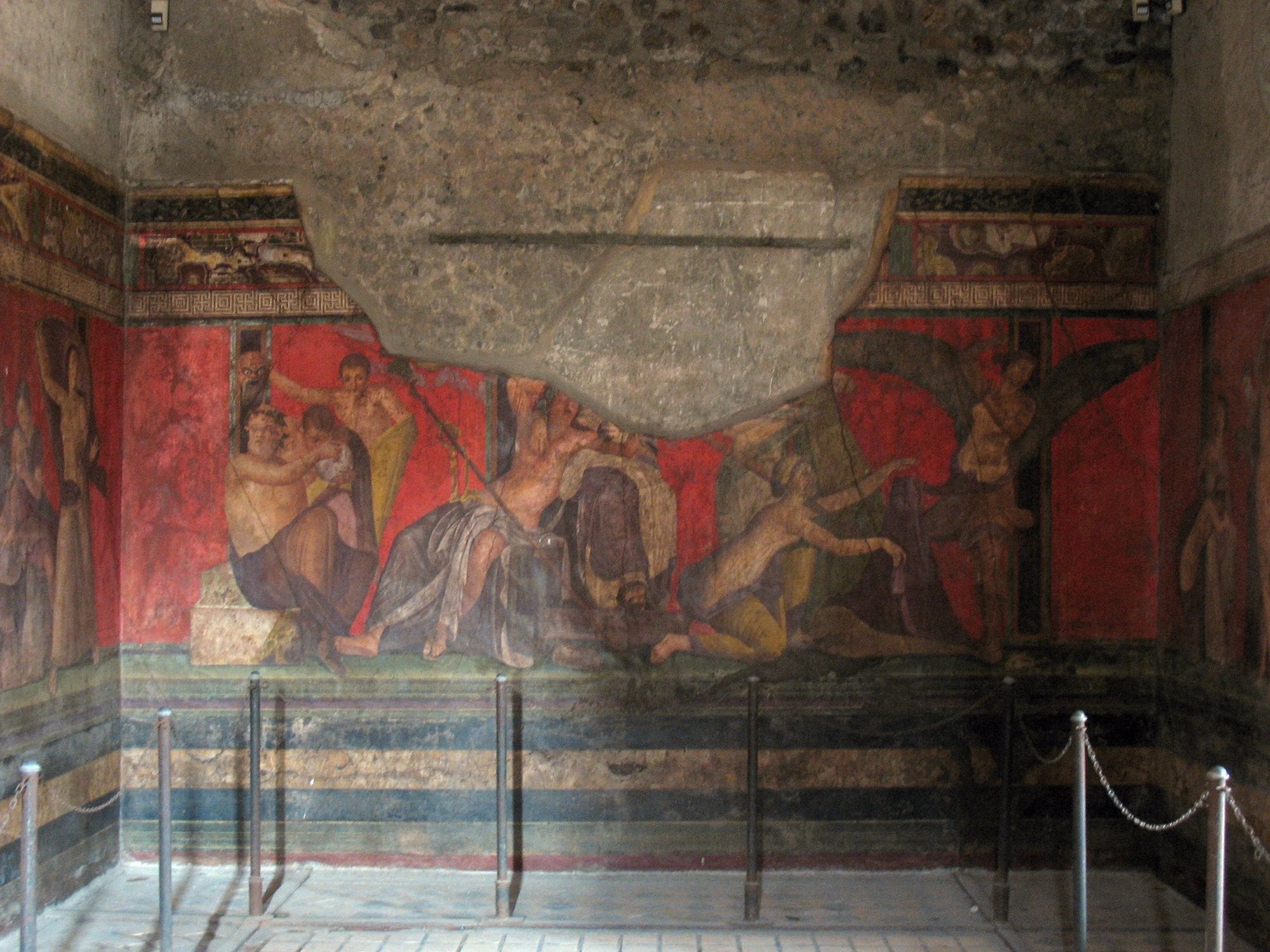
Second Style (c. 80 BC to AD 14): trompe l'oeil architectural painting that opened up the wall surface to suggest deep space beyond. Painted columns framed views of imaginary gardens, distant landscapes, or theatrical scenes. The Villa of the Mysteries, with its famous initiation cycle, is the masterpiece of this style.
Third Style (c. AD 14 to 62): a return to flat surfaces with delicate decorative panels framing small central pictures. The architectural illusionism of the Second Style was abandoned in favour of an ornamental treatment of the wall as a flat surface.
Fourth Style (c. AD 62 to 79): a combination of the previous styles, often combining trompe l'oeil architectural elements with framed central pictures and decorative panels. The House of the Vettii contains the most spectacular surviving examples of the Fourth Style.
The Villa of the Mysteries
The Villa of the Mysteries, on the outskirts of Pompeii, contains the most famous surviving Roman fresco cycle. A single room is decorated with a continuous frieze showing a series of figures (mostly women, some men, one satyr, several allegorical figures including Dionysus and Ariadne) engaged in actions that have been interpreted as an initiation into the mystery cult of Dionysus.
The cycle has been argued about for over a century. The figures perform ritual actions: a young woman is being prepared for initiation; a satyr looks into a bowl; a winged figure raises a whip over a kneeling woman who buries her face in another woman's lap. The scenes are shown against a deep red background that has come to be called Pompeian Red.
The painting was made around 60 to 50 BC, more than a century before the eruption. The villa belonged to a wealthy family who maintained the room essentially unchanged for generations. When the ash fell, it preserved a Late Republican fresco that had no business surviving.
The Garden Paintings
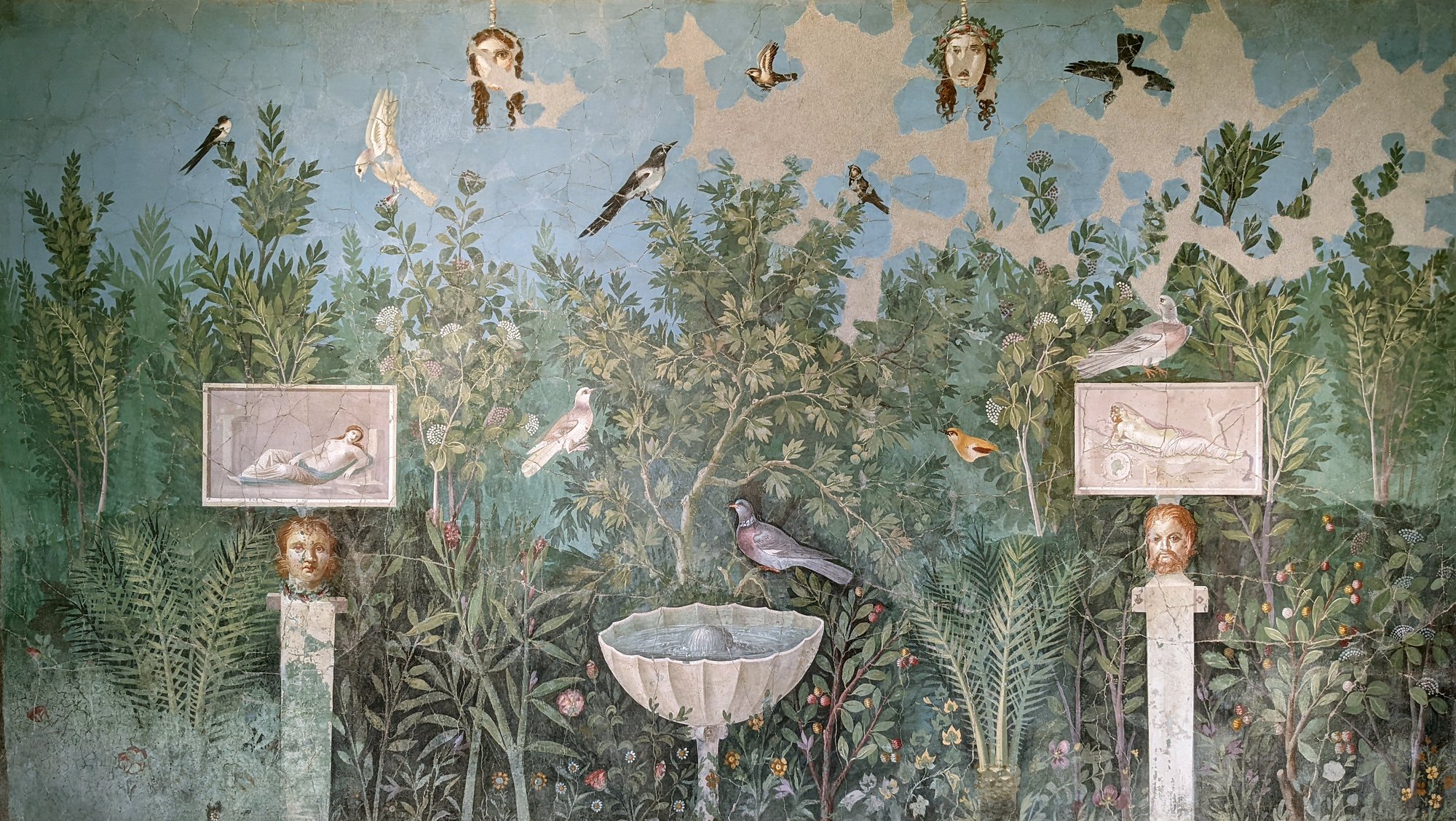
A particular Pompeian speciality was the garden painting: a wall fresco that depicted a real garden so convincingly that the viewer in the small interior room felt as if they were looking out into a much larger space. The House of the Golden Bracelet contains some of the best preserved examples. Trees are painted in receding planes, with birds in the branches and flowers in the foreground. The illusion is helped by the placement of the painting on a curved wall that softens the boundary between the painted garden and the real interior space.
These paintings served a practical function. Roman houses were oriented inward, around courtyards and atria, with few windows facing the street. The garden frescoes opened up rooms that would otherwise have felt enclosed. They were sophisticated solutions to the problem of bringing daylight and the suggestion of nature into urban interiors.
The Erotic Frescoes
Pompeii contains a substantial body of erotic painting, both in private houses and in the brothel known as the Lupanar. The frescoes show various sexual acts, sometimes labelled with prices, in a documentary style that has no equivalent in surviving Greek or Etruscan art.
When excavations began in the eighteenth century, the erotic frescoes (along with portable erotic objects from the site) were locked away in the Secret Cabinet of the Naples Archaeological Museum, accessible only to "people of mature years and known morality" and only with special permission. The Secret Cabinet was not regularly opened to the public until 2000.
The frescoes are now studied as evidence of Roman sexuality, prostitution, and the visual culture of the urban poor. They are also among the few sources for what Roman pornography actually looked like, since most surviving Roman art was made for elite contexts.
The Excavation
Pompeii was rediscovered in 1748, though the site had been known to local farmers for centuries. The Bourbon kings of Naples sponsored the early excavations, which were essentially treasure hunts: portable objects were removed and the structures were left exposed to the weather.
Modern systematic excavation began in the mid-nineteenth century under Giuseppe Fiorelli, who developed the technique of pouring plaster into the body cavities to recover the shapes of the dead. About two-thirds of Pompeii has now been excavated. The remaining third is being preserved underground while archaeologists develop techniques to excavate it without damaging what is found.
The site presents continuing problems. Frescoes that survived two thousand years buried under ash have begun to deteriorate within decades of being exposed to sunlight, rain, and pollution. Several major buildings have collapsed in the past twenty years. The Italian government has invested significant funds in stabilisation, but the long-term survival of what was uncovered in the nineteenth century is not guaranteed.
The houses that survived their owners may not survive the people who dug them up.


