

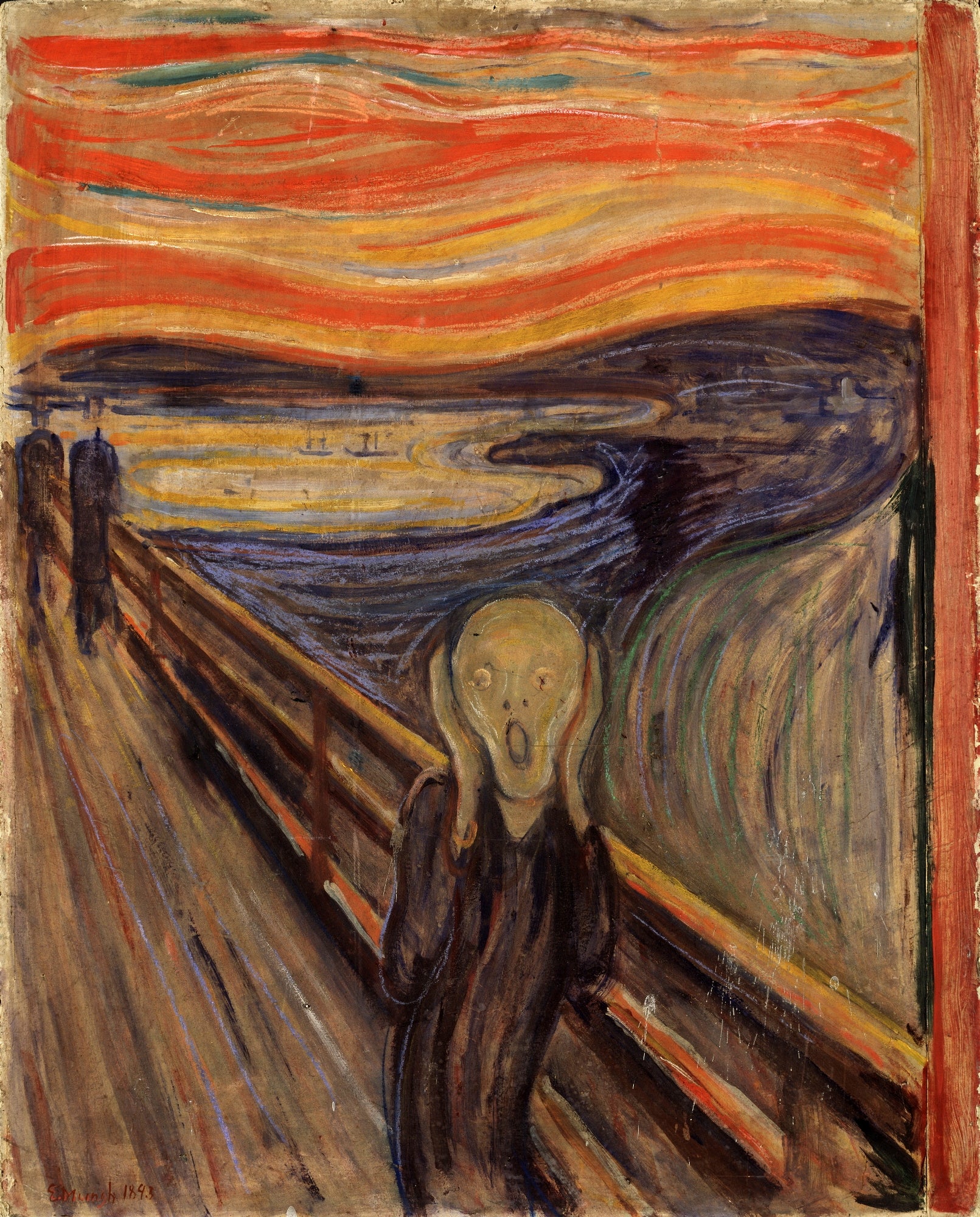
Edvard Munch wrote in his journal that one evening in early 1892, he was walking with two friends along a road outside Christiania (modern Oslo) when he stopped, exhausted. The sun was setting. The clouds turned blood red. He felt, in his own words, an infinite scream pass through nature. His friends walked on. He stayed where he was.
He spent the next eighteen years painting versions of that moment. The first was in 1893, in tempera on cardboard. The second, also in 1893, was in pastel on cardboard. A third pastel version was made in 1895 and is the only one in private hands. The fourth, in tempera and oil, was made around 1910. Two of the four versions have been stolen and recovered. All four are now in Norwegian museums except the 1895 pastel, which sold at Sotheby's in 2012 for $119.9 million.
The Walk Outside Oslo
Munch made the walk in early 1892, when he was twenty-eight. He had recently returned from Paris, where he had spent eighteen months studying contemporary French painting, particularly the work of Manet, Gauguin, and Van Gogh. His sister Sophie had died of tuberculosis when he was thirteen. His mother had died of the same disease when he was five. His father, a doctor, had become increasingly religious and depressive. Munch's own mental health was already fragile.
The journal entry he wrote describing the walk was made in Nice in January 1892. He wrote it twice, in slightly different versions, and the wording matters. He did not say that he screamed. He said the scream was in nature itself, passing through him. The figure on the bridge in the painting is not the source of the scream but its receiver. The mouth is open because the figure is hearing something nobody else can hear.
The Compositions
The four versions of The Scream are similar but not identical. All four show a single figure on a bridge or boardwalk, hands pressed to its head, mouth open in a circle. Two other figures stand in the distance, walking away. A landscape of water and sky stretches behind. The sky is rendered in horizontal bands of red, orange, and yellow.
The first version (1893, tempera on cardboard, National Museum of Norway) is the most fully realised painterly version. The brushwork is loose; the colour is intense. The 1893 pastel is essentially a study; the colours are muted and the brushwork is less developed. The 1895 pastel is the most highly finished and was the version Munch chose to lithograph for prints. The 1910 version, in tempera and oil, is the work of an older artist returning to a subject he could not let go.
The Frieze of Life
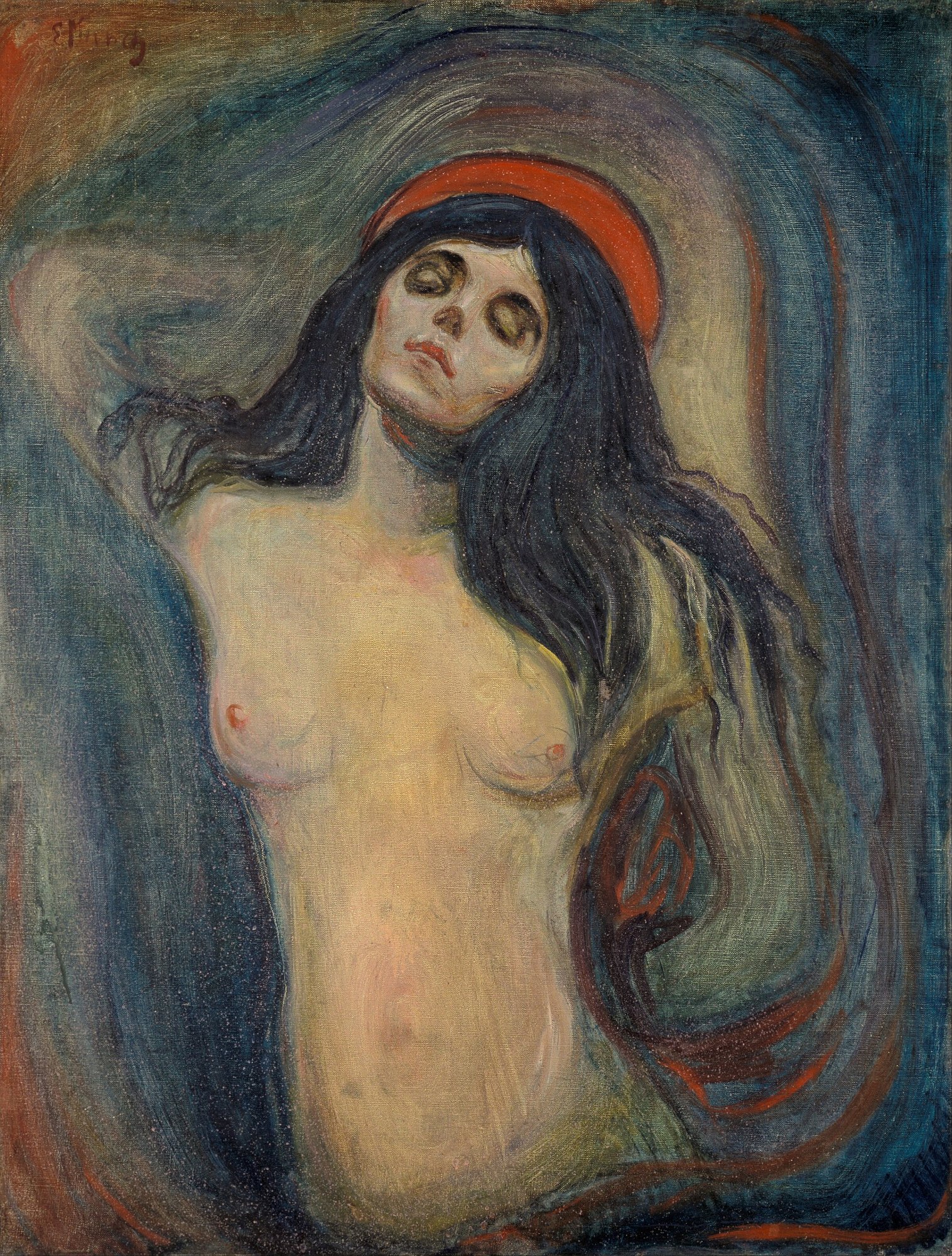
The Scream was part of a larger project Munch called The Frieze of Life: a series of paintings on themes of love, anxiety, and death. The other works in the series included Madonna, Vampire, The Sick Child, Anxiety, Melancholy, and Jealousy. He exhibited the series together repeatedly, hanging the paintings in different orders and combinations.
Madonna shows a nude woman with her eyes closed and her arms raised behind her head. The painting was made in several versions between 1894 and 1895. The figure is sensual and disturbing in equal measure: a Madonna who is no longer the Virgin, presented for the viewer with the kind of frank physicality that Munch's contemporaries found shocking.
The Frieze of Life was not commercially successful in Munch's lifetime in the way it would become later. Norwegian critics found the works upsetting. German critics, who saw them when Munch had exhibitions in Berlin in the 1890s, were more positive. The Berlin exhibitions effectively launched Munch's reputation outside Scandinavia.
The Sick Child
Munch returned repeatedly to one subject from his childhood: his sister Sophie's death from tuberculosis in 1877. He made six versions of the painting called The Sick Child between 1885 and 1927. The first version, painted when he was twenty-two, was attacked by Norwegian critics as crude and unfinished. The painting shows a young woman propped up in bed, her head turned in profile, with an older woman bowed in grief beside her.
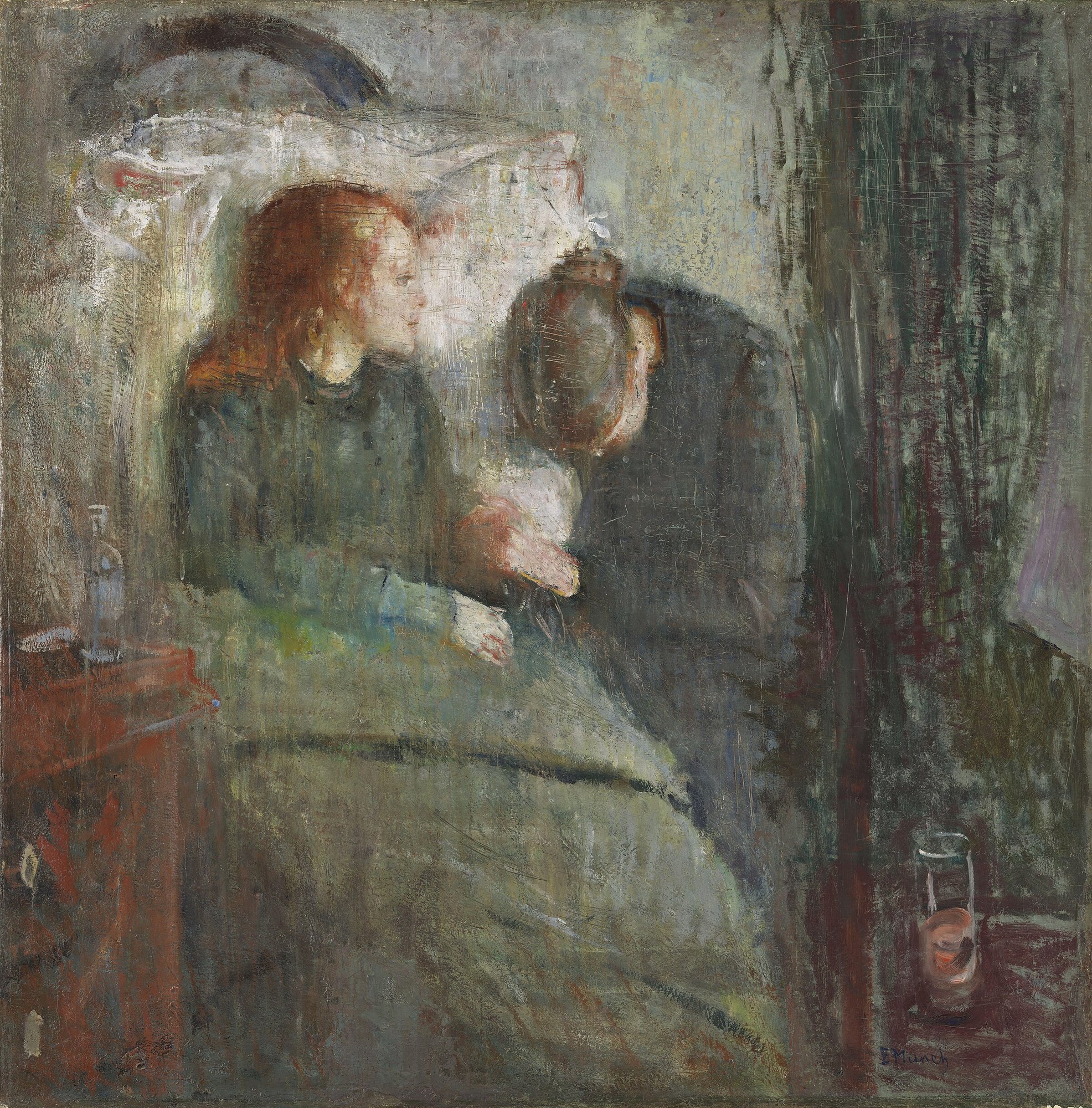
The technique was deliberately rough. Munch had worked the surface with the handle of his brush, scratching back into the wet paint to suggest the texture of the bedding and the patient's hair. The result looked, to 1880s critics, like the painting had been damaged. To Munch, it was a way of registering the physical fragility of the subject through the surface itself.
The painting's reputation has grown steadily. It is now considered one of the founding works of Expressionism, predating the German Expressionist movement by twenty-five years.
The Thefts
The 1893 tempera version of The Scream was stolen from the National Gallery in Oslo on 12 February 1994, the opening day of the Lillehammer Winter Olympics. The thieves left a note that read "Thanks for the poor security." The painting was recovered three months later in a sting operation.
The 1910 tempera version was stolen from the Munch Museum on 22 August 2004, in a daylight raid by armed men who walked into the gallery, threatened the staff, took the painting and a version of Madonna off the wall, and drove away. Both paintings were recovered in 2006. They had been damaged: The Scream had a tear and water damage, the Madonna had been folded.
The thefts increased rather than diminished the painting's fame. Insurance valuations of the surviving versions are now astronomical. The 1895 pastel that sold for nearly $120 million in 2012 set a then-record for any painting at auction.
Why It Lasts
The Scream became an icon partly because of its imagery (the expressive figure, the colour palette, the curving sky), partly because Munch made it reproducible (he printed lithographs of the 1895 version that circulated widely), and partly because its emotional vocabulary turned out to anticipate the twentieth century with unusual precision.
The painting was made in 1893, before the Russian Revolution, two world wars, the Holocaust, the atomic bomb, the Vietnam War, and most of the major catastrophes that would define the next hundred years. The figure on the bridge, hearing a scream pass through nature, became a cultural shorthand for the anxiety of modern life decades before that anxiety had names.
Munch lived until 1944. He spent his last decades in Norway, increasingly reclusive, painting and printing in his studio at Ekely outside Oslo. He left almost his entire collection of his own work to the city of Oslo on his death. The Munch Museum opened in 1963. A new and larger Munch Museum opened in Oslo harbour in 2021.
The painting that began as a private response to a panic attack on a Norwegian fjord now hangs in a building designed specifically to house it.


