

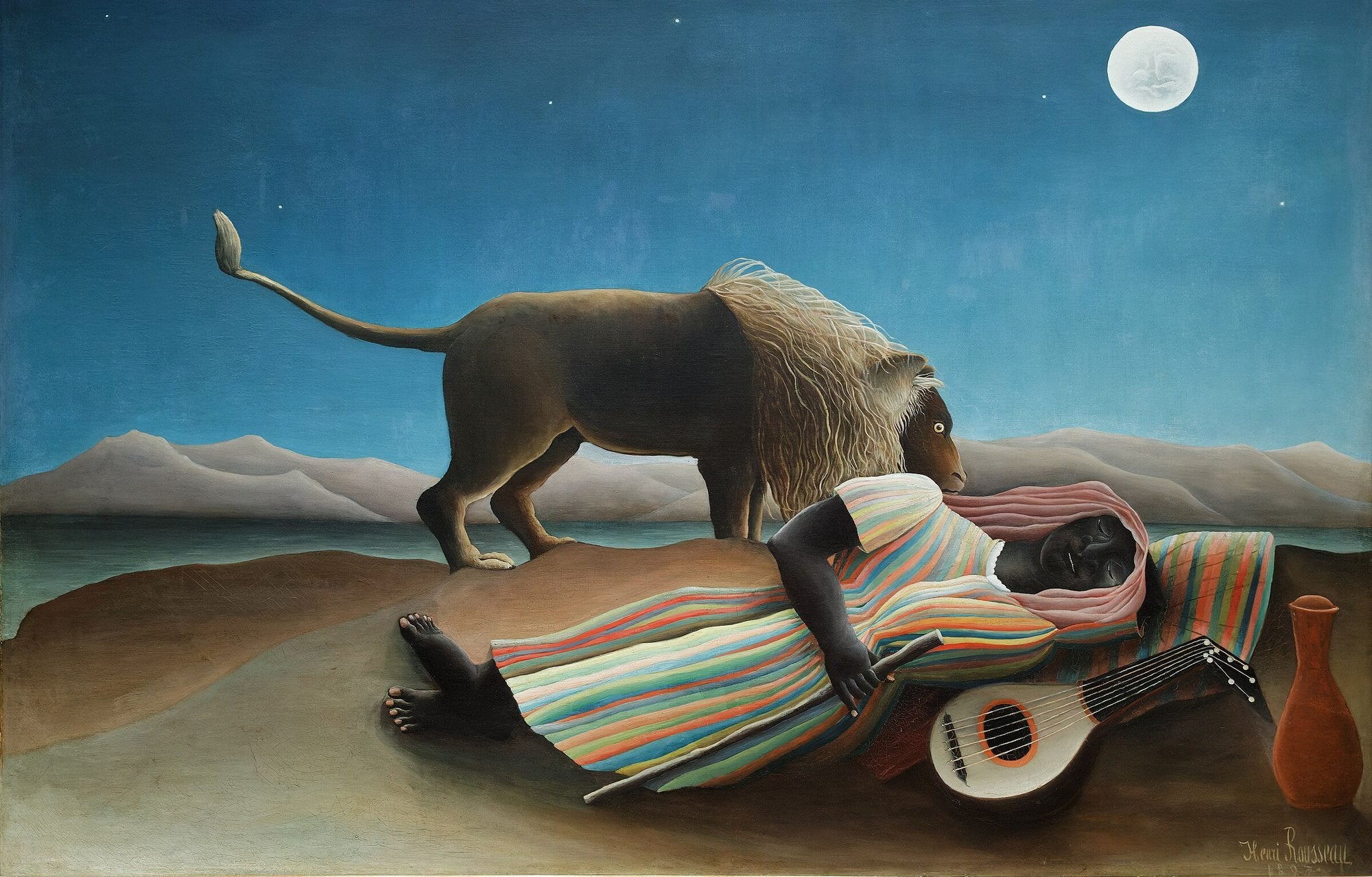
Henri Rousseau (1844 to 1910) spent the working years of his life as a clerk in the Paris municipal toll office. The job involved checking goods entering the city for duty. He painted in the evenings, on Sundays, and during his summer holidays, with no formal training and no studio of his own. His nickname, Le Douanier (the customs officer), came from the day job that funded his real one.
He painted jungles he had never seen, lions stalking sleeping figures in deserts he had never crossed, and portraits of his Paris neighbours that looked nothing like the people they were meant to depict. The Paris Salon mocked him for thirty years. Then Picasso bought one of his paintings in 1908 for five francs from a junk shop, hung a banquet in his honour at the Bateau-Lavoir, and began a reputation that has continued to grow.
The Day Job
Rousseau joined the Paris customs service in 1871, after brief military service. He spent twenty-two years there, working at the city gates checking carts and boats. He was promoted to second-class inspector. He retired in 1893, at forty-nine, with a small pension that allowed him to paint full time for the remaining seventeen years of his life.
He had been painting for years before he retired. His earliest known oils date from the late 1870s. He submitted to the Paris Salon repeatedly and was rejected. He was accepted at the Salon des Indépendants, which was open to anyone who paid the entry fee, and exhibited there almost every year from 1886 until his death.
The Self-Taught Style
Rousseau had no formal training. He copied paintings at the Louvre to learn technique. He read instruction manuals. He looked carefully at photographs and prints, particularly of plants and animals, and he made detailed studies of the plants in the Jardin des Plantes botanical garden in Paris.
The result was a style that contained almost no shortcuts. Where trained painters used loose brushstrokes to suggest leaves, Rousseau painted each leaf individually, in flat colour, with sharp outlines. Where a trained painter used atmospheric perspective to create depth, Rousseau used overlapping shapes, with no diminution of detail in the background. The effect is the opposite of what an academy painter would aim for. It looks deliberate, dreamlike, almost hallucinatory.
His critics called it naive. They meant unsophisticated, untrained, childish. Picasso and the artists around him saw something else: a deliberate flattening of pictorial conventions that produced effects no academic painter could match.
The Jungle Paintings
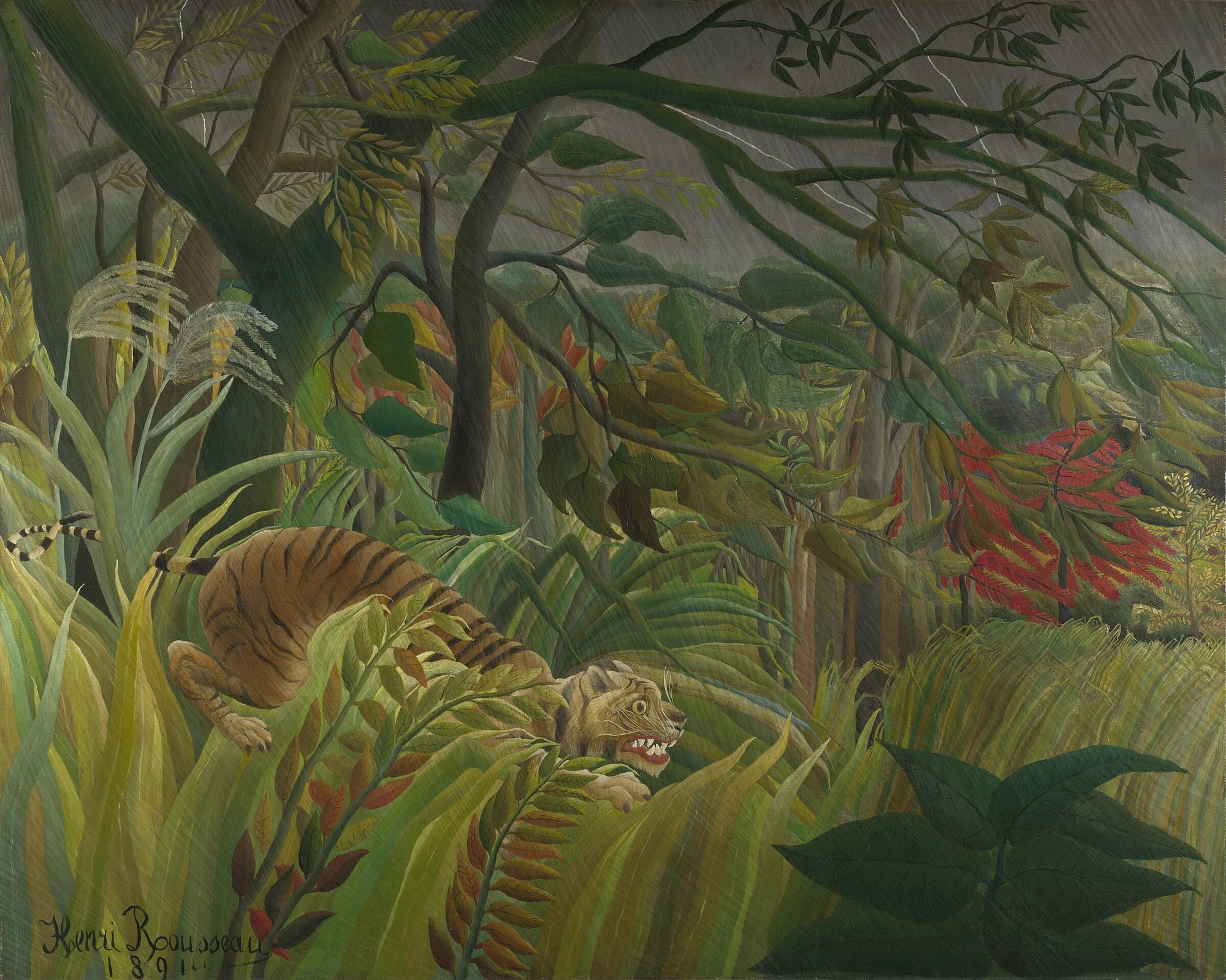
Rousseau painted around twenty-five jungle scenes, starting with Tiger in a Tropical Storm in 1891. He never visited a jungle. He had never been outside France except for his military service in the early 1870s. The jungles came from his imagination, supplemented by visits to the Jardin des Plantes (which had a botanical garden, a zoo, and a natural history museum on the same site) and from looking at illustrated books about colonial expeditions.
Tiger in a Tropical Storm shows a tiger crouched in tall striped grass, lit by a flash of lightning, with rain falling in diagonal lines. The tiger is poorly anatomically observed. The grass is striped because Rousseau painted each blade as a flat shape, building up patterns rather than describing organic textures. The rain is shown as straight white lines slanting across the entire canvas. The painting is, by every academic standard of the day, technically incompetent. It is also visually unforgettable.
The Bateau-Lavoir Banquet
In 1908, Picasso bought a Rousseau painting from a Paris junk shop for five francs. He held a banquet for Rousseau at his studio in the Bateau-Lavoir building in Montmartre, attended by Apollinaire, Braque, Marie Laurencin, Gertrude Stein, and most of the avant-garde of the day.
The banquet was a curious event. Picasso and his friends were partly serious about admiring Rousseau, partly enjoying the absurdity of celebrating a sixty-four-year-old self-taught painter as a master alongside themselves. Rousseau apparently took the event entirely at face value and made a speech in which he placed himself and Picasso as the two leading painters in France: Picasso the great Egyptian-style artist, and Rousseau the great modern artist.
The banquet was a turning point. From 1908 onwards, Rousseau's reputation rose steadily. Within a decade of his death, his paintings were entering major collections. Within fifty years, he was being treated as a foundational figure in twentieth-century art.
The Last Painting
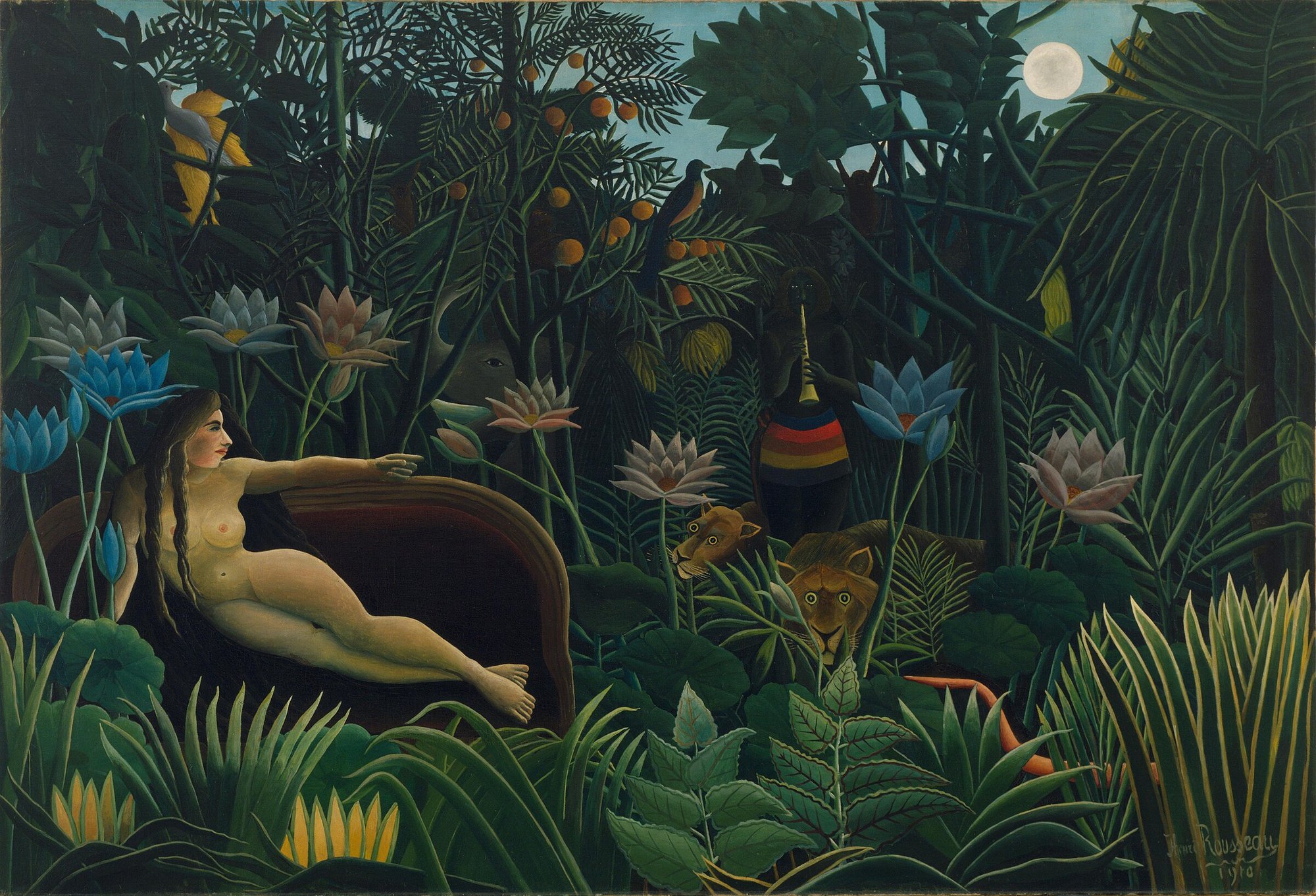
The Dream (1910) is Rousseau's largest work and was his last major painting. A nude woman on a red sofa lies in the middle of a jungle. Lions stare from behind leaves. A snake winds through the foreground. A musician plays a flute among the trees. The composition is a defiant impossibility: the sofa exists in a domestic interior, the woman exists in a French nineteenth-century studio, and the jungle exists only in Rousseau's imagination. He combined them anyway.
Apollinaire wrote about the painting that the woman could be heard listening through the entire forest. The remark captured something true. Rousseau's late paintings have an internal logic that suspends the viewer's normal expectations about what kind of scene can occur in what kind of space.
He died in September 1910, three months after The Dream was first exhibited. He was sixty-six. The cause was an infected leg wound that turned to gangrene.
The Lineage
Rousseau's direct influence ran through the Surrealists, who saw in his paintings a visual analogue of their interest in dream imagery. Max Ernst, Yves Tanguy, and Salvador Dali all knew Rousseau's work and absorbed elements of it. The Mexican muralist Frida Kahlo painted self-portraits that combined the same flat surfaces and dreamlike juxtapositions.
In a broader sense, Rousseau opened a door that had been closed in Western art since the Renaissance: the door between trained academic technique and what was then called primitive or naive painting. He showed that a self-taught painter could produce work that mattered to the most sophisticated audiences in Europe. The door has stayed open since.
The Sunday painter is now in MoMA, the Tate, the National Gallery, and the Musée d'Orsay. The customs office where he stamped goods at the Paris gate is gone. The paintings are still being looked at.


