

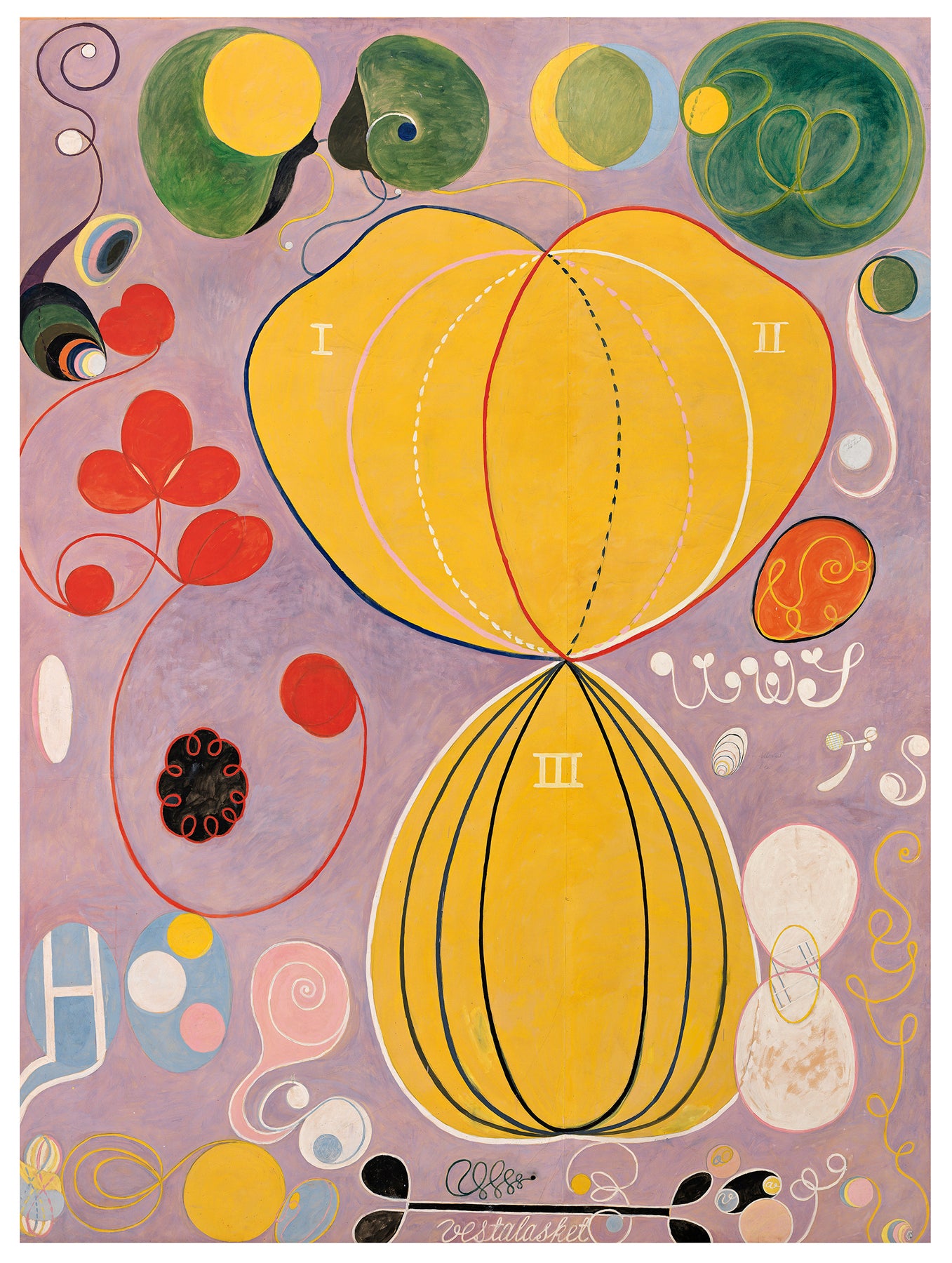
In October 1907, in a rented studio in Stockholm, a forty-five-year-old Swedish painter called Hilma af Klint finished the largest paintings of her career. The Ten Largest are each more than three metres tall. They are completely abstract: spirals, flower forms, calligraphic script, symbols invented for the occasion. They were painted five years before Wassily Kandinsky's First Abstract Watercolour, which is conventionally cited as the founding work of abstraction in Western art.
Af Klint never exhibited them. She painted abstractly for the next thirty-seven years, accumulating roughly 1,200 paintings and 26,000 pages of notebooks. She left a will instructing that the abstract works be kept hidden for twenty years after her death. They were not seriously exhibited until 1986. They have been the subject of major retrospectives only since 2013.
Stockholm
Af Klint was born in 1862 to a naval family. Her father was an admiral and an amateur mathematician. She studied at the Royal Academy of Fine Arts in Stockholm from 1882 to 1887, becoming a successful painter of botanical illustrations and portraits. She kept a public conventional career going for the rest of her life, while privately doing something completely different.
From the 1880s onward, af Klint was involved in spiritualist and theosophical circles. She held séances with four other women, a group they called The Five (De Fem). They communicated through automatic writing and drawing. Af Klint kept the records: thirty-three notebooks of transcribed séance dialogue with figures the group called the High Masters.
The Commission
In January 1906 the High Masters, through af Klint, commissioned a series of paintings to decorate a temple. The temple existed only in the séance dialogue. It was never built. The instructions were detailed: dimensions, colour palettes, sequences of motifs, the order in which the canvases should be made.
Af Klint received the instructions and made the paintings. The Paintings for the Temple, as the project came to be called, eventually consisted of 193 canvases produced between 1906 and 1915. They are organised into groups: Primordial Chaos (small dark gestural works), Eros, the Ten Largest (a developmental sequence representing the human life cycle from infancy to old age), and the Tree of Knowledge.
The Ten Largest were painted across two months in autumn 1907. Af Klint worked on the floor, the canvas laid flat. She used tempera and oil, often applied with sponges or large brushes. She finished one or two paintings a week.
What the Paintings Look Like
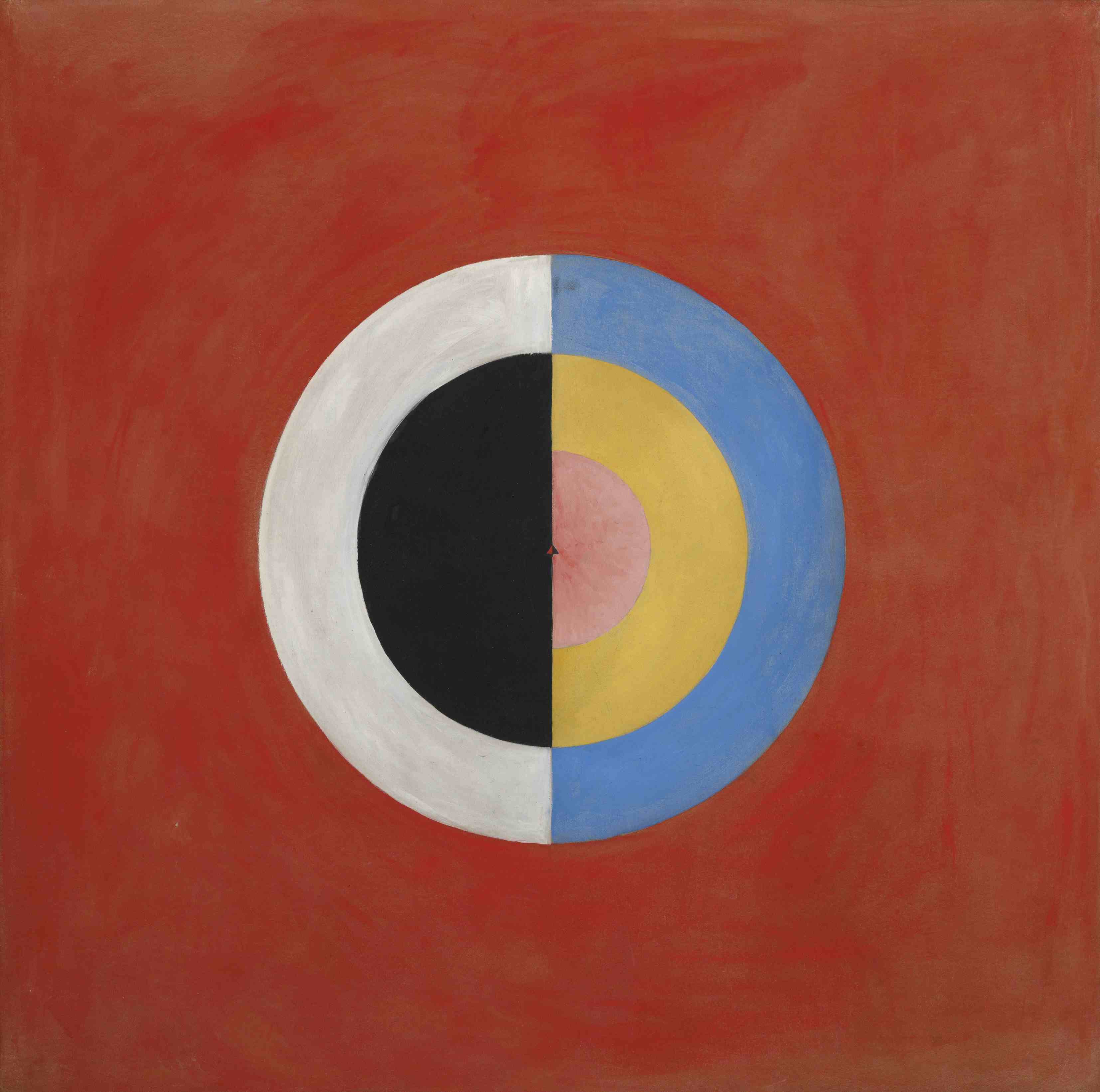
The Ten Largest, Adulthood, No. 7 is dominated by a vast orange spiral floating in a pink field, with smaller blue and green spirals satellite-like around it. Symbols (flowers, letters, geometric shapes) cluster at the spirals' edges. The composition is divided into zones: dense at the top, sparse at the bottom. The painting is more than three metres tall and more than two metres wide.
The works are abstract in the strict sense: the symbols and shapes do not represent objects in the visible world. But they are not abstract in the sense that Mondrian and Kandinsky would later make abstract: af Klint's compositions are signs in a system of correspondences she derived from Madame Blavatsky, Rudolf Steiner, Goethe's colour theory, and her own séance dialogues.
The Visit from Steiner
In 1908, Rudolf Steiner visited Stockholm and met af Klint. She showed him a selection of the Paintings for the Temple. According to af Klint's notebooks, Steiner's reaction was discouraging: he told her that the paintings were not yet of their time, and that she should not show them publicly for fifty years.
Af Klint stopped painting for four years. She resumed in 1912 and continued until 1944, refining her symbolic system through later groups (the Swan, the Dove, the Altarpieces). She incorporated Steiner's anthroposophical teachings into her later work but never fully accepted his framework.
The Will
Af Klint died in 1944 at eighty-one, struck by a tram in Stockholm. Her will instructed that her abstract paintings (about 1,200 works, plus the notebooks) be kept hidden for twenty years after her death. She believed that the world would not be ready for them until then.
The works passed to her nephew Erik af Klint, who stored them in a cottage in Sweden. The Hilma af Klint Foundation was created to preserve them. The first significant exhibition was at the Los Angeles County Museum of Art in 1986, in a group show called The Spiritual in Art. Even then, she was treated as a curiosity rather than as a major figure in the abstract canon.
What Changed
The 2013 retrospective at the Moderna Museet in Stockholm, then the Serpentine Gallery in London in 2016, and especially the 2018 exhibition at the Guggenheim in New York (Hilma af Klint: Paintings for the Future), changed her standing. The Guggenheim show drew about 600,000 visitors and broke that museum's attendance records. Major retrospectives followed at Tate Modern in 2023 (paired with Mondrian) and at the Grand Palais in Paris in 2026, her first solo exhibition in France, eighty-two years after her death.
The reframing has been uneven. As recently as 2012, the Museum of Modern Art ran an exhibition of abstract art that did not include her. The art historian Caroline Levisse, quoted in The Guardian in April 2026, called the omission "crazy". The most striking detail in the timeline is not 1944 or 1986, but 2012.
The historical question that her work raises is uncomfortable. If a Swedish woman painting in spiritualist circles produced abstract canvases five years before Kandinsky, why has the canonical history of abstraction not been rewritten to include her? The answer combines the late discovery of the works, the difficulty of fitting them into the formalist narrative that dominated twentieth-century art history, and the gendered structure of the avant-garde itself.
What is clear is that af Klint did not need to read Kandinsky's writings to make abstract art. She arrived at it independently, from a different starting point, for different reasons. The history of abstraction now has at least two roots, not one.


