

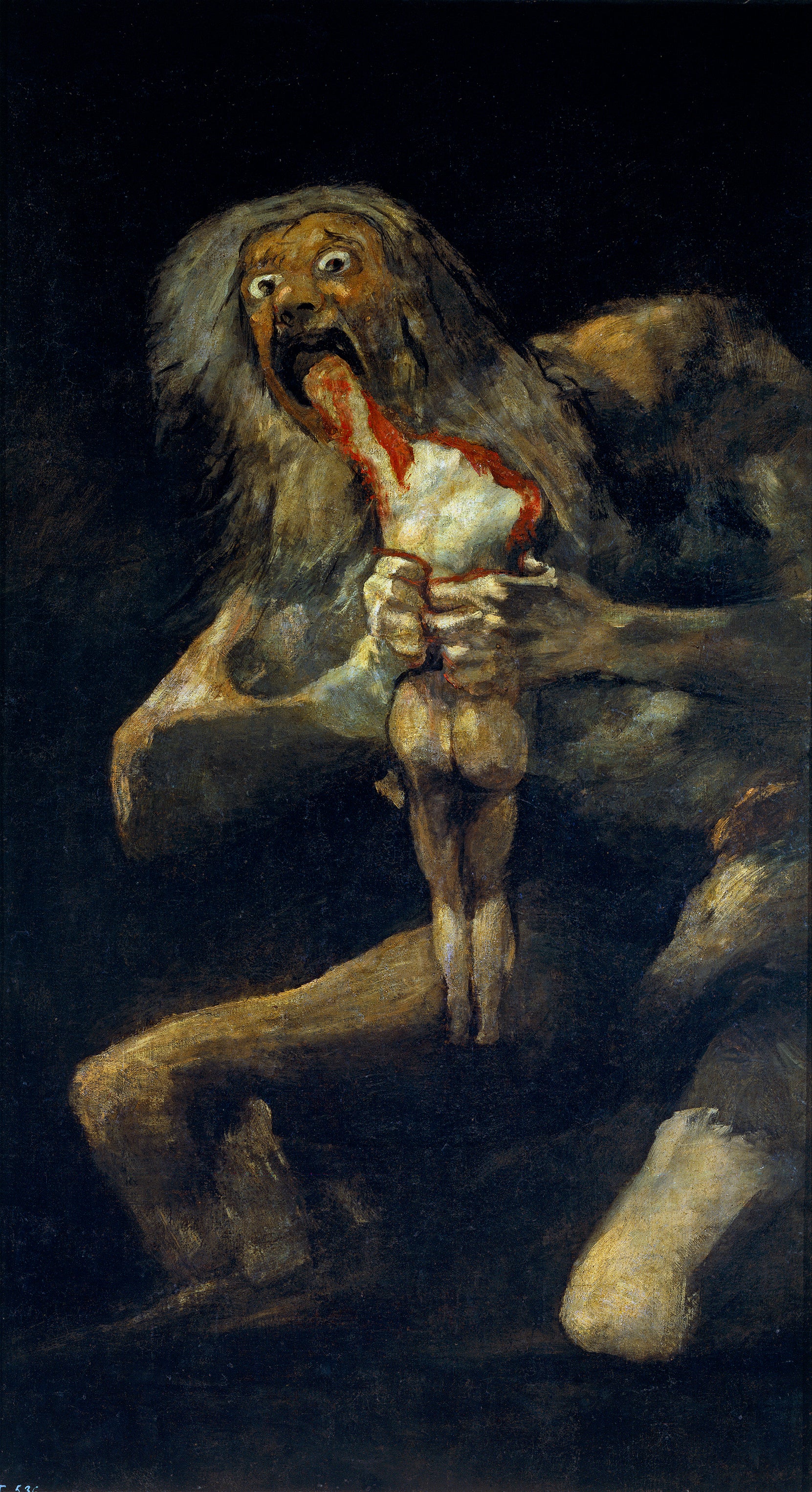
In 1819, Francisco Goya bought a country house outside Madrid called the Quinta del Sordo, the House of the Deaf Man. He was seventy-three, deaf, recovering from a near-fatal illness, and politically out of favour after the restoration of Ferdinand VII to the Spanish throne. Over the next four years he painted fourteen scenes directly onto the plaster walls of the house: dark, silent, often grotesque images that include some of the most disturbing pictures in European art.
He never exhibited them. He never wrote about them. He gave them no titles. The names by which they are now known (Saturn Devouring His Son, The Dog, Two Old Men Eating Soup) were assigned by later cataloguers. They are called the Black Paintings because of the dominance of black, brown, and grey in the palette, and because the subjects are uniformly bleak.
The House
The Quinta was a two-storey property in the countryside south of the Manzanares river, opposite the city of Madrid. The original deaf owner whose name had attached to the building had died decades earlier; Goya simply inherited the nickname. He moved in with his housekeeper, Leocadia Weiss, and her young daughter Rosario, whom Goya treated as his own.
The Black Paintings covered the walls of two rooms: a dining room on the ground floor and a sitting room on the first floor. They were painted in oil directly onto the plaster, a technique Goya had not previously used at scale. The wall surface was prepared with a smooth ground, then the images were built up over months and years.
Saturn
The most famous of the fourteen is Saturn Devouring His Son. The Roman god, learning that he is destined to be overthrown by his children, eats them as they are born. Goya's Saturn is a wild-eyed figure clutching a small adult body, the head and one arm already bitten off, blood running down the torso. The figure looks directly out at the viewer. It is approximately life-size and was painted in the dining room.
The subject was a familiar one in European art. Rubens had painted Saturn in 1636. The standard treatment showed an aged but composed god, the act of devouring presented as a piece of mythology. Goya's Saturn is not composed. The body is contorted, the eyes are bulging, and the mouth is open in mid-bite. The figure does not look like a god. It looks like a man going mad.
What Was on the Walls
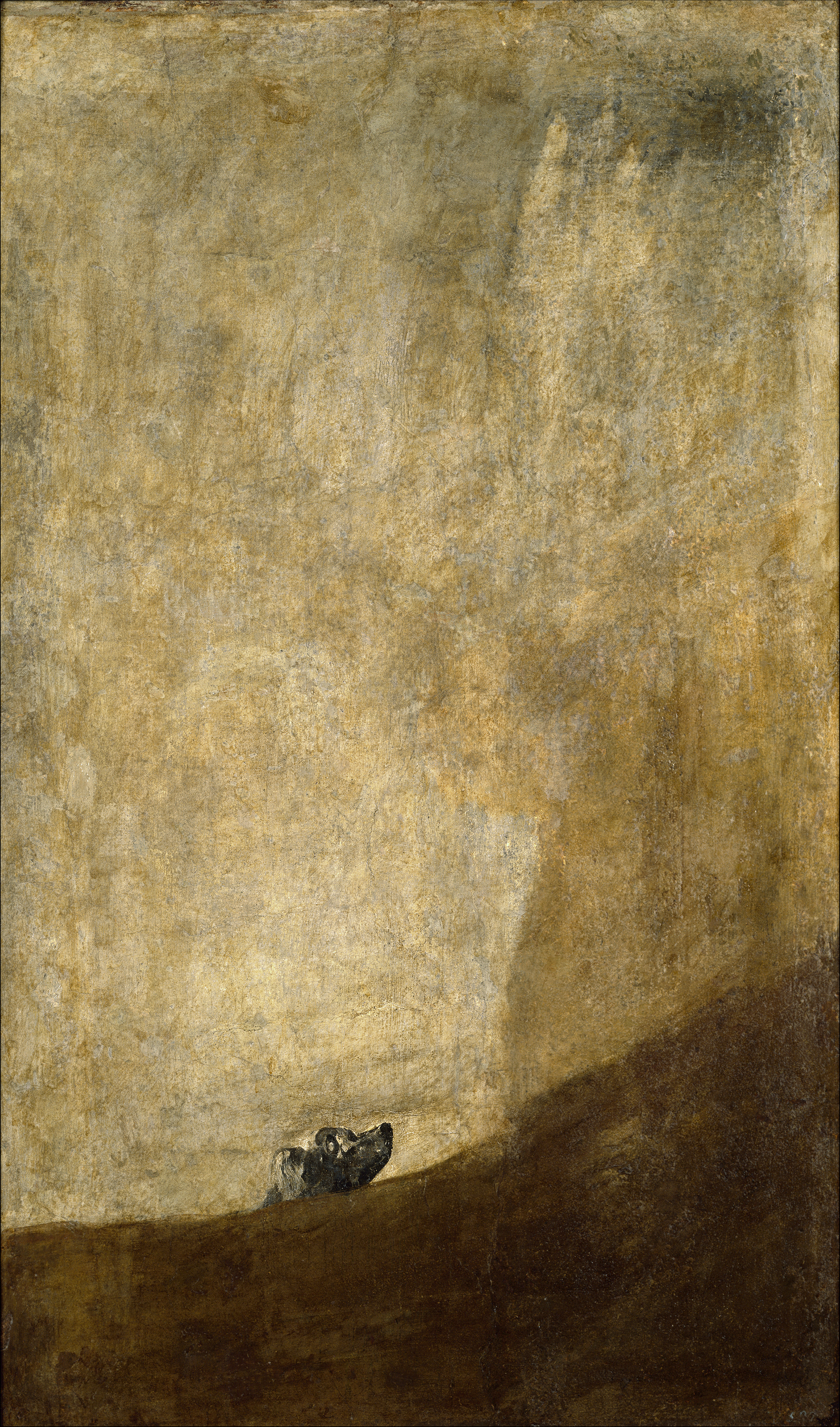
The fourteen paintings together formed a coherent decorative scheme, though the logic is debated. The downstairs dining room held Saturn, Two Old Men Eating Soup, Witches' Sabbath, Judith and Holofernes, and three smaller scenes. The upstairs room held the Pilgrimage to San Isidro, the Atropos (Fates), Asmodea, Two Men Fighting with Cudgels, and four others including The Dog.
The Dog is the strangest of the set. The painting shows the head of a small dog protruding from a sloping mass of brown and yellow, looking up toward the empty top half of the canvas. The dog appears to be drowning in sand or earth. Above it is nothing: just a sky-coloured void. The image is approximately a metre and a half tall. It hung above a doorway in the upstairs room.
Why He Painted Them
The Black Paintings have generated more interpretation than perhaps any group of works in Goya's career. The pictures have been read as expressions of his disillusionment with the Bourbon restoration, as products of his lead-poisoning-induced depression, as a private response to his earlier near-fatal illness, and as a meditation on death by an old man who knew he was running out of time.
The truth is that nothing Goya wrote survives to explain them. He left no notebooks describing the work. There are no letters in which he tells anyone what the paintings are about. He continued to paint conventional commissioned portraits for the public market while these private images covered the walls of his own house.
How They Survived
Goya left Spain in 1824, fleeing the renewed political repression of Ferdinand VII's regime. He went to Bordeaux, where he died in 1828 at eighty-two. The Quinta passed through several owners. By the time it was bought by a Frenchman named Frederic Emile d'Erlanger in 1873, the paintings on its walls had survived for fifty years through neglect alone.
D'Erlanger commissioned a meticulous transfer of the murals to canvas. The plaster was stripped from the walls, the images were transferred section by section, and the canvases were stretched and stabilised. The work, done by the conservator Salvador Martinez Cubells, was extensive: some scholars have argued that what we see today shows substantial restoration. The original walls, with whatever subtle details Cubells did not capture, are gone.
D'Erlanger donated the paintings to the Spanish state in 1881. They have hung in the Prado since.
What They Are
The Black Paintings are not a public statement. Goya made plenty of public statements: the Disasters of War, the Caprichos, the official portraits. The Black Paintings are something else. They are the work of an old man, alone in a house, painting on the walls of his own dining room.
The most likely reading is the simplest. He was old, deaf, and ill. The paintings are a working out of what death looked like to him. They are private in the way a journal is private: not meant to be read, but written anyway because the writing was its own purpose.
The Quinta was demolished in 1909.


