

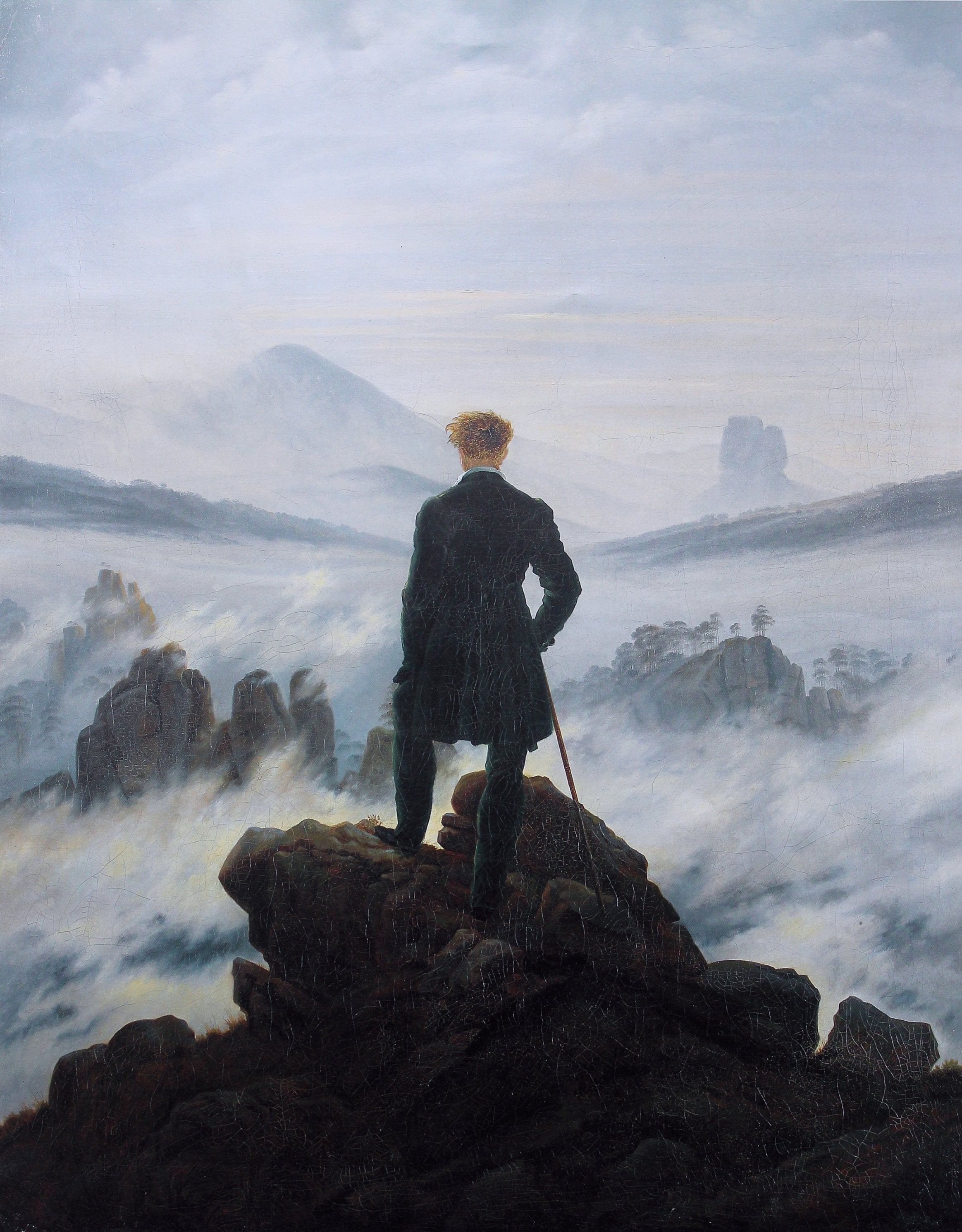
Caspar David Friedrich painted Wanderer above the Sea of Fog around 1818. A man in a dark green coat stands with his back to the viewer on a basalt outcrop, leaning slightly on a walking stick. Below him, mountain peaks emerge from a sea of grey-white cloud. The figure dominates the foreground; we see his hair, his shoulders, the seam down the back of his jacket. We do not see his face.
The pose, called the Rückenfigur (back-figure) in German, was used by other Romantic painters but Friedrich made it his signature. About a quarter of his major paintings include a figure or figures seen from behind, looking out at a landscape. The device is not just a compositional choice. It is the painting's argument.
Greifswald
Friedrich was born in 1774 in Greifswald, a Baltic port that was part of Swedish Pomerania at the time. His mother died when he was seven. Two of his siblings died before he was twenty. The most traumatic loss was his younger brother Johann Christoffer, who drowned at thirteen trying to save Caspar from falling through ice on a frozen river. Caspar was the one who survived.
He studied at the Copenhagen Academy from 1794 to 1798, then settled in Dresden, which would be his base for the rest of his life. He worked primarily in pencil, sepia ink, and oil on canvas. He never travelled to Italy, the conventional pilgrimage for German artists of his generation. He stayed in northern Europe and painted what he knew.
What the Rückenfigur Does
The Rückenfigur device works because it forces a triangulation. The viewer stands behind the figure. The figure stands at the edge of a landscape. The landscape extends into the distance. The viewer cannot see the figure's expression, so cannot read the figure's emotional response to the scene. This forces the viewer to do the responding themselves.
Friedrich's predecessors had used the device sparingly. The Italian and Dutch landscape traditions placed figures within the scene, often facing it from the side, allowing the viewer to identify with their reactions. Friedrich's figures stand at the edge, between us and the view, their position making them surrogates rather than subjects.
The Specific Mountains
Friedrich's landscapes look invented but are mostly assembled from real places. The geological elements in Wanderer above the Sea of Fog are recognisable rocks from the Elbe Sandstone Mountains in Saxon Switzerland, south of Dresden, which Friedrich walked extensively. The basalt formation in the foreground is the Kaiserkrone. The mountain in the middle distance is the Rosenberg. The peak at the right edge is the Zirkelstein.
None of these landmarks were ever in this exact configuration. Friedrich made composite landscapes from sketches done over years of hiking. The fog is also a Friedrich device: it both reveals and conceals, allowing him to suggest a vast space without committing to specific topography.
The Politics
Friedrich was a German nationalist in a period when Germany did not exist as a state. His landscapes are recognisably northern, often featuring Gothic ruins, oak trees, and figures in old German dress. After Napoleon's invasion and the wars of 1813-1815, the imagery took on a political edge. Friedrich became friendly with Theodor Körner, the poet who died fighting the French, and painted figures in the Altdeutsche Tracht (Old German costume) that German nationalists had adopted as a symbol of cultural resistance.
The dark green coat in Wanderer is an Altdeutsche Tracht. The painting was finished in the year that Karl Sand, a German nationalist student, assassinated the playwright August von Kotzebue, an event that triggered the Carlsbad Decrees of 1819 banning German nationalist activity. Whether Friedrich's figure was meant to be specifically political is not certain. The dress would have been read politically by his contemporaries.
The Other Major Works
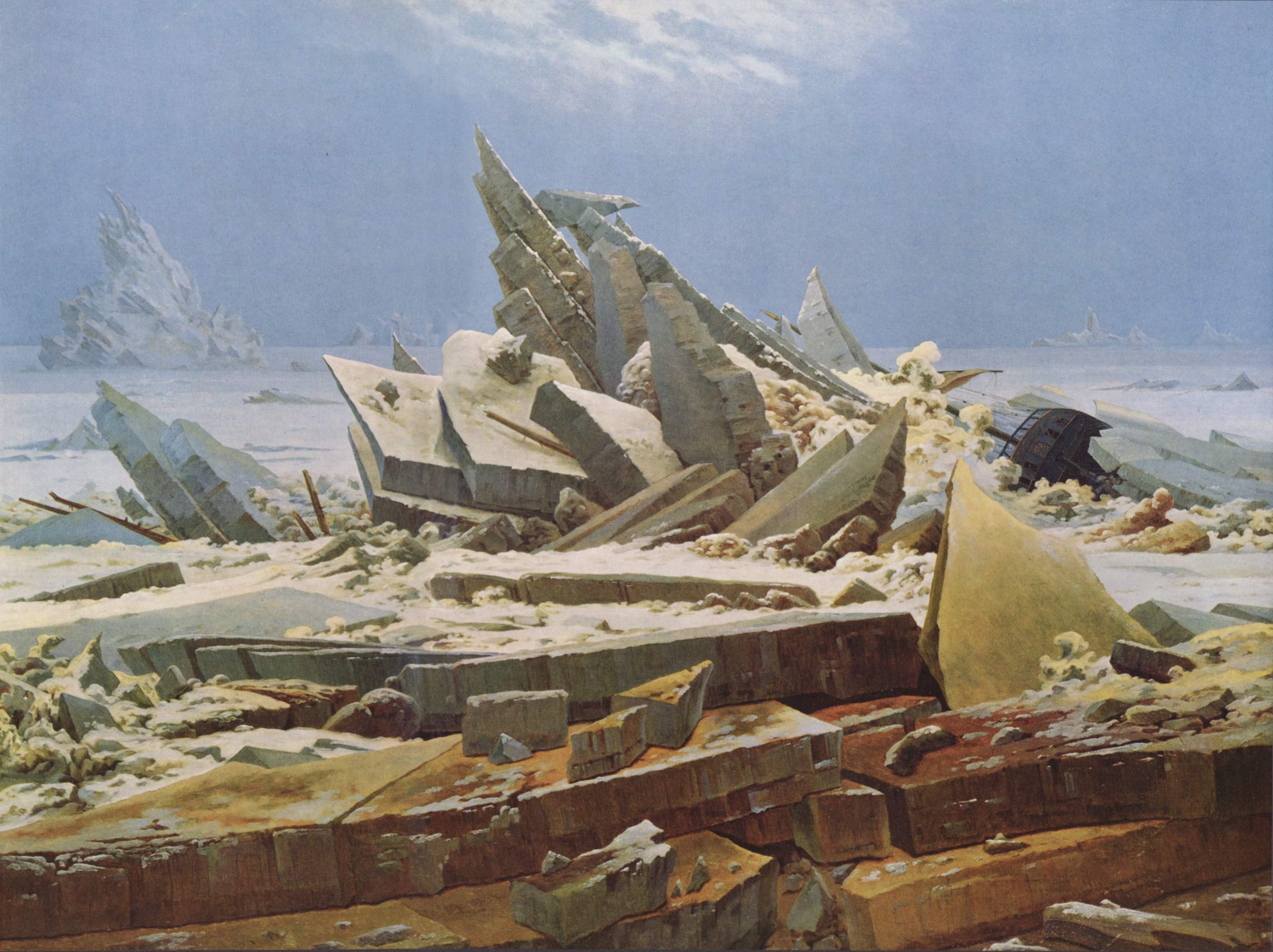
Friedrich's Sea of Ice (1823-24), originally called The Wreck of the Hope, shows a sailing ship crushed under shards of arctic ice. The picture is structured around a triangular pile of broken floes; the wreck is barely visible at the right. The painting is about scale: the ship is shown as small against the indifferent geometry of the ice.
Monk by the Sea (1808-10) is a landscape so reduced it almost stops being a landscape. A grey beach, a strip of dark sea, an enormous overcast sky. A single tiny figure in dark clothing stands on the beach. The painting was the most radical landscape Friedrich ever produced and was attacked at the Berlin Academy when first exhibited.
Both paintings work the same Rückenfigur logic, scaled differently. Sea of Ice removes the figure entirely; the wreck stands in for the human presence. Monk by the Sea reduces the figure to almost nothing, a marker of human scale rather than a participant in the scene.
What Came After
Friedrich's reputation collapsed after his death in 1840. His Romantic style was unfashionable in the realist mid-century, and his work was rediscovered only in the early twentieth century, partly through the championing of Norwegian critic Andreas Aubert and partly through nationalist German curators who found the imagery useful.
The use of Friedrich's paintings in Nazi propaganda contaminated his reputation again after 1945. The 1972 retrospective at the Tate Gallery in London was the first major postwar exhibition that reframed him as an artist independent of that history. Since then his standing has risen steadily. Wanderer above the Sea of Fog is now reproduced more widely than perhaps any nineteenth-century landscape.
The figure has his back to you because Friedrich wanted you to be the one looking. The Wanderer is the position of the viewer, not of a subject. Once you understand the device, the painting is no longer about the man on the rock. It is about whatever is in front of him.


