

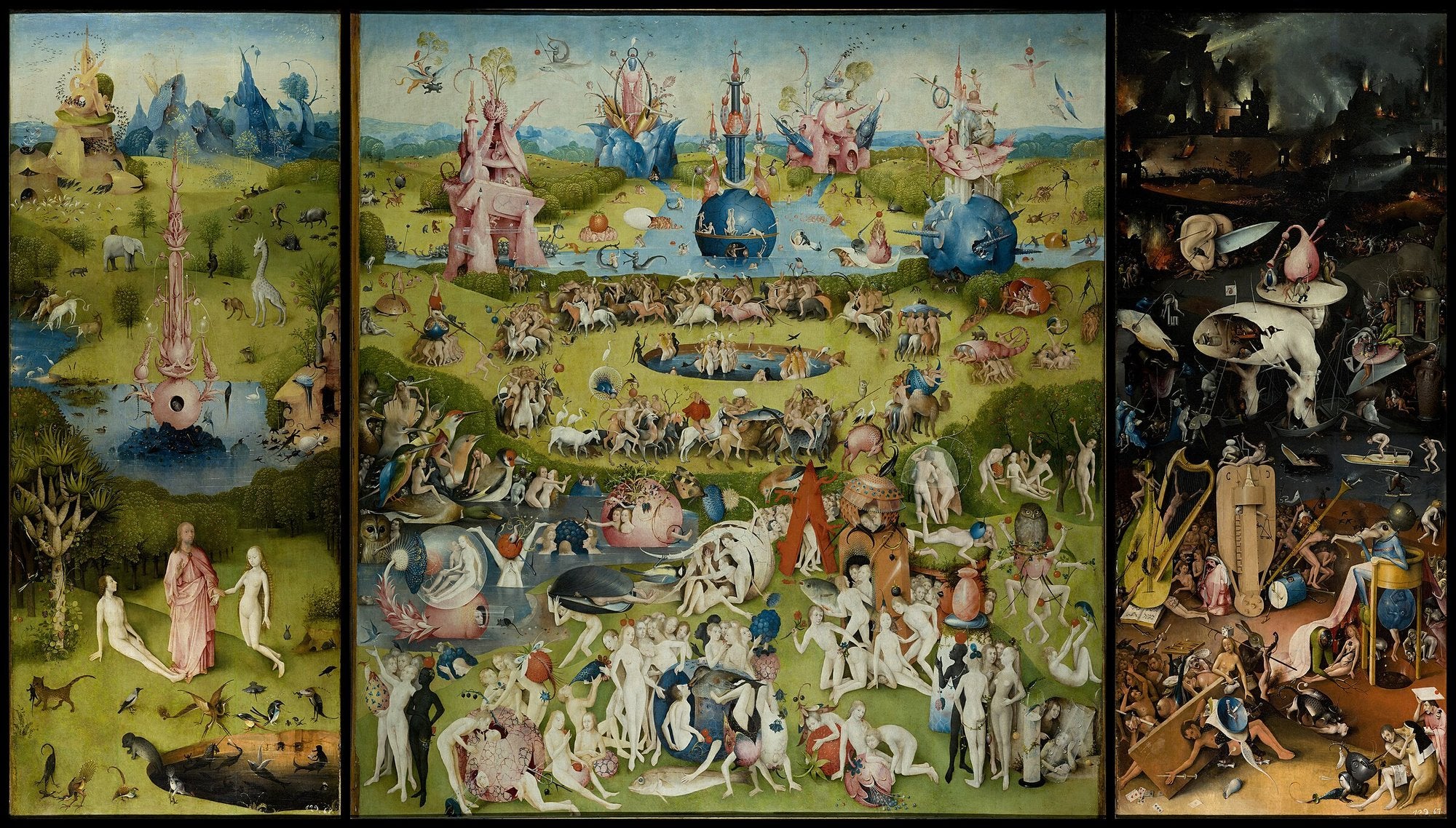
Hieronymus Bosch painted the Garden of Earthly Delights between roughly 1490 and 1510. The triptych is enormous: 220 by 390 centimetres when the panels are open. The left panel shows the Garden of Eden with Adam, Eve, and God. The right panel shows hell. The central panel, occupying as much space as the other two combined, shows several hundred nude figures interacting with oversized berries, transparent spheres, hybrid animals, and architectural shapes that exist in no real architecture.
Art historians have argued for five centuries about what the central panel actually depicts. The major theories: a vision of human sin before the Flood; a heretical paradise belonging to a sect Bosch may have secretly belonged to; a moralising warning against earthly pleasure; a straightforward depiction of innocent prelapsarian sexuality; or some combination of all four.
What Is Definitely There
The painting is now in the Prado Museum in Madrid, having been acquired by Philip II of Spain in 1593. Philip displayed it in his bedroom at the Escorial, which is one of the oddest facts in art history: the most fervently Catholic monarch in Europe slept beneath a painting whose meaning has never been agreed upon.
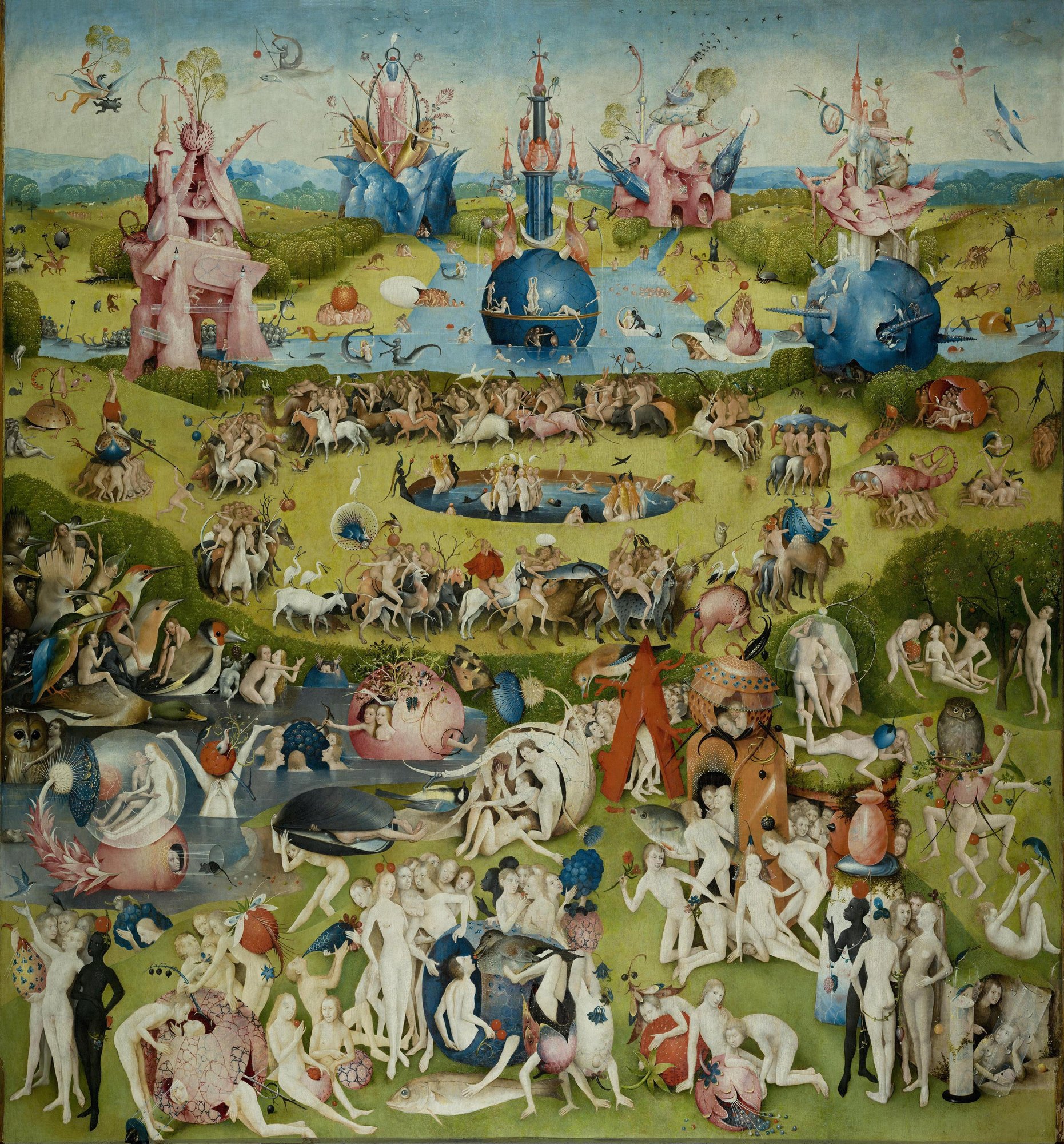
The Prado's catalogue identifies the central panel as a depiction of humanity engaged in sin. The figures are nude, mostly white, mostly young. They eat strawberries (a symbol of fleeting pleasure) the size of haystacks. They ride exotic animals in a procession around a pool. They climb in and out of giant transparent globes containing other figures. Birds carry humans on their backs. Couples emerge from oversized fruit. Nobody appears in distress. Nobody is performing anything obviously sinful in the conventional iconography. The composition is calm, almost serene.
The Hell Panel
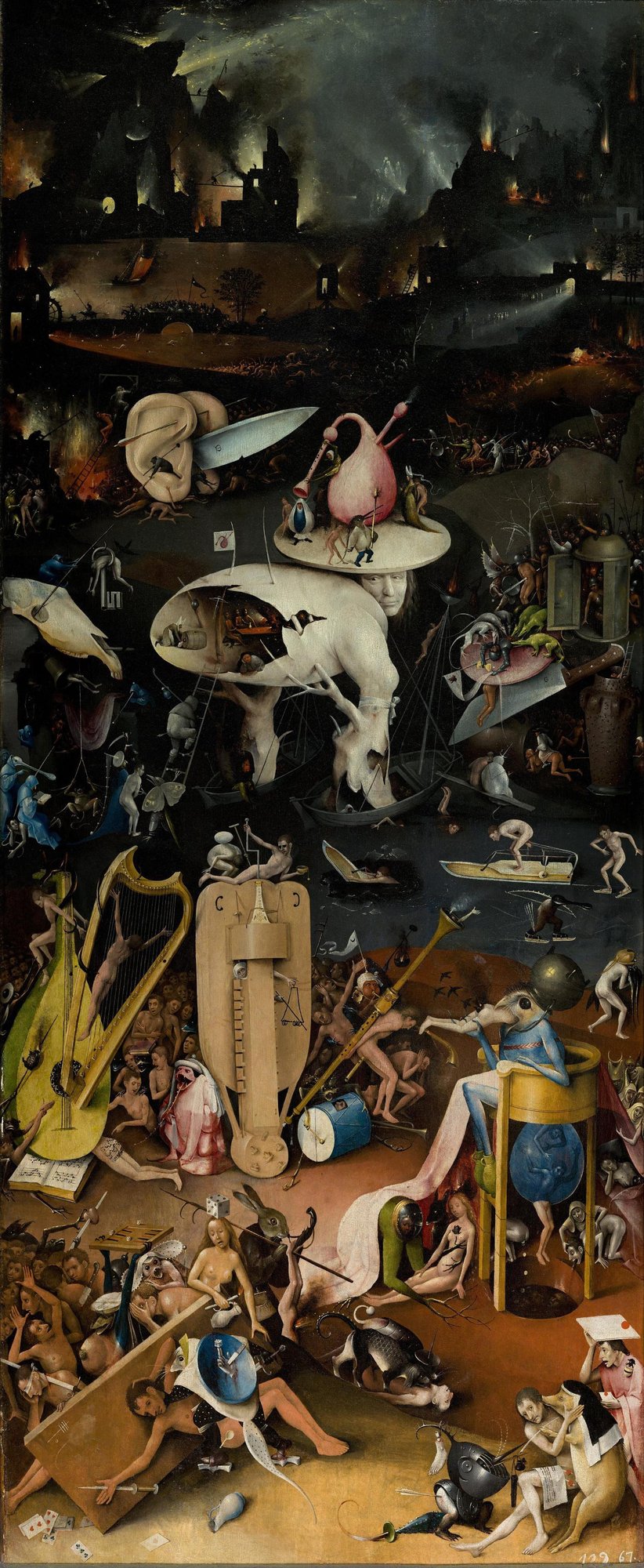
The right panel is hell, and it is the panel that established Bosch's later reputation. A burning city dominates the background. In the foreground, the so-called Tree-Man, a figure with a hollow torso shaped like an eggshell standing on tree-trunk legs, looks out at the viewer. His body contains a tavern scene. Birds peck at sinners. Musical instruments become instruments of torture. A pig dressed as a nun seduces a damned soul.
The hell panel depicts torments calibrated to specific sins: gluttons are forced to vomit, gamblers are nailed to dice, lechers are embraced by demons. This is recognisable medieval iconography. The same scenes appear in church frescoes across Europe. What makes Bosch's hell different is the inventiveness of the creatures and the scale of the vision: Bosch packed more incident into one panel than most contemporaries managed across an entire altarpiece.
Five Centuries of Reading
In the sixteenth century, the painting was understood by some as a depiction of pre-Flood humanity, the antediluvian world that God destroyed for its corruption. By the seventeenth century, it was being interpreted as a moral warning against the consequences of indulgence.
In 1947, the historian Wilhelm Fraenger argued that Bosch had been a member of a heretical sect called the Brethren of the Free Spirit, who believed that sex was sinless if performed without lust. The central panel, in Fraenger's reading, was an Edenic vision of innocent erotic life. The argument has not been accepted by most subsequent scholars (no documentary evidence exists for Bosch's membership of any heretical group) but it has remained influential.
Modern interpretations tend to emphasise the painting's resistance to single readings. Bosch may have intended ambiguity. The triptych functions as a kind of religious puzzle: viewers stand in front of it and try to make sense of what they are seeing. The act of looking becomes the moral exercise.
Bosch the Outsider
Bosch (c. 1450 to 1516) lived his entire life in 's-Hertogenbosch, a town in the Duchy of Brabant in the Low Countries. He took his name from the town. He inherited a workshop from his father, joined the local Brotherhood of Our Lady (a respectable religious confraternity), and was a successful artist whose work was collected by Habsburg royalty.
He left no writings. The interpretive tradition has had to work entirely from the paintings themselves. The sources for his iconography include medieval bestiaries, alchemical manuscripts, popular sermons, Flemish proverbs, and possibly drug-induced visions, depending on which scholar you read.
What is certain is that he produced a body of work unlike anything before or after. His direct successors (Pieter Bruegel the Elder, working two generations later) borrowed his creatures and his moral seriousness but not his strangeness. The Garden of Earthly Delights remains one of the most reproduced and least understood paintings in Western art.
The argument is the painting's afterlife. Bosch built a structure that resists final interpretation, and five centuries of viewers have not exhausted it.


